

As geopolitics, volatility, and technological disruption collide, many of the assumptions that have shaped companies’ operating models over the past two decades — predictable cost structures, stable supply chains, well-established career paths — are being tested all at once. In the turbulent business climate of 2026, growth is harder to achieve, capital is more constrained, and the path from investment to value creation is less certain.
For chief financial officers, this moment is making already demanding roles even more challenging. And many are rising to the occasion.
Long central to both financial stewardship and strategic decision-making, CFOs today are playing a bigger role in shaping enterprise strategy and making capital allocation decisions — driving transformation efforts both across the enterprise and within their functions. The more volatile business conditions and larger sums being invested in transformation are creating greater urgency around financial discipline and placing the finance function at the center of how companies turn ambition into value. As CFOs lean into strategy even more heavily than before, boards are rewarding talent when they see it: CFO-to-CEO promotions reached a decade high in early 2026.
To understand how the role is changing, the New York Stock Exchange and the Oliver Wyman Forum surveyed nearly 500 CFOs of companies across all major industries and geographies, both public and private. The public companies alone represent roughly 12% of global market capitalization.
Their responses show how today’s CFOs must navigate five different, and at times competing, agendas simultaneously: a widening CFO mandate, the convergence of cost and growth, the need to transform the finance function, the need to scale AI effectively, and the need to redesign the finance workforce.
How the different strands of the CFO agenda tie together
In the pages ahead, we explore each of these elements in greater detail. This report, a companion to our CEO Agenda, is designed to give CFOs more than just sentiment; the research and analysis that follows provides real, useful peer insights on key business decisions. We show how CFOs must adapt to a broader remit, skyrocketing AI investment, and more consequential operating model choices in the years ahead. And we identify a common thread: the growing need for execution discipline.
The CFOs who will define this era are likely to be those who most skillfully pair strategic ambition with the rigor to execute it.
CFOs are prioritizing AI and capital allocation
Words used by CFOs to describe their biggest priority in 2026
CEOs also bet on AI but double down on M&A
Words used by CEOs to describe their biggest bet or change for 2026
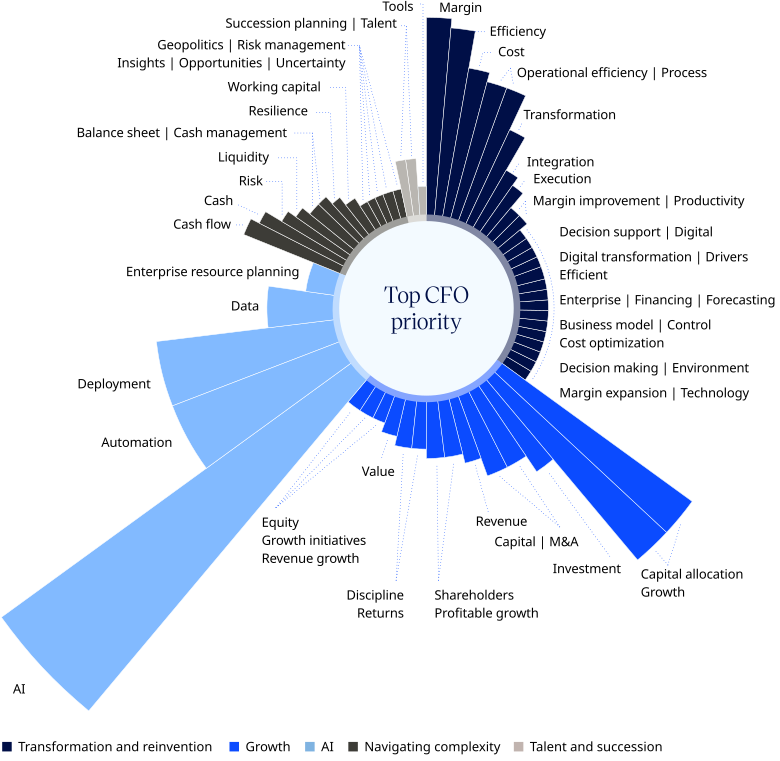
Source: Oliver Wyman Forum x NYSE CFO Survey 2026; Oliver Wyman Forum analysis
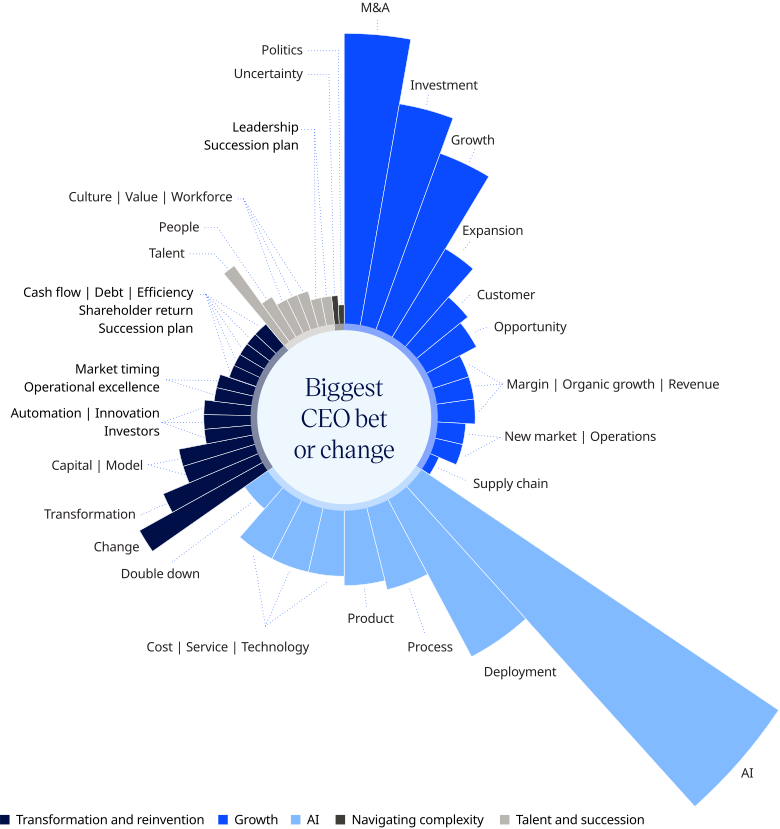
Source: Oliver Wyman Forum x NYSE CEO Survey 2026; Oliver Wyman Forum analysis
The evolving CFO role
Macro business disruptions are thrusting CFOs into a broader strategic role
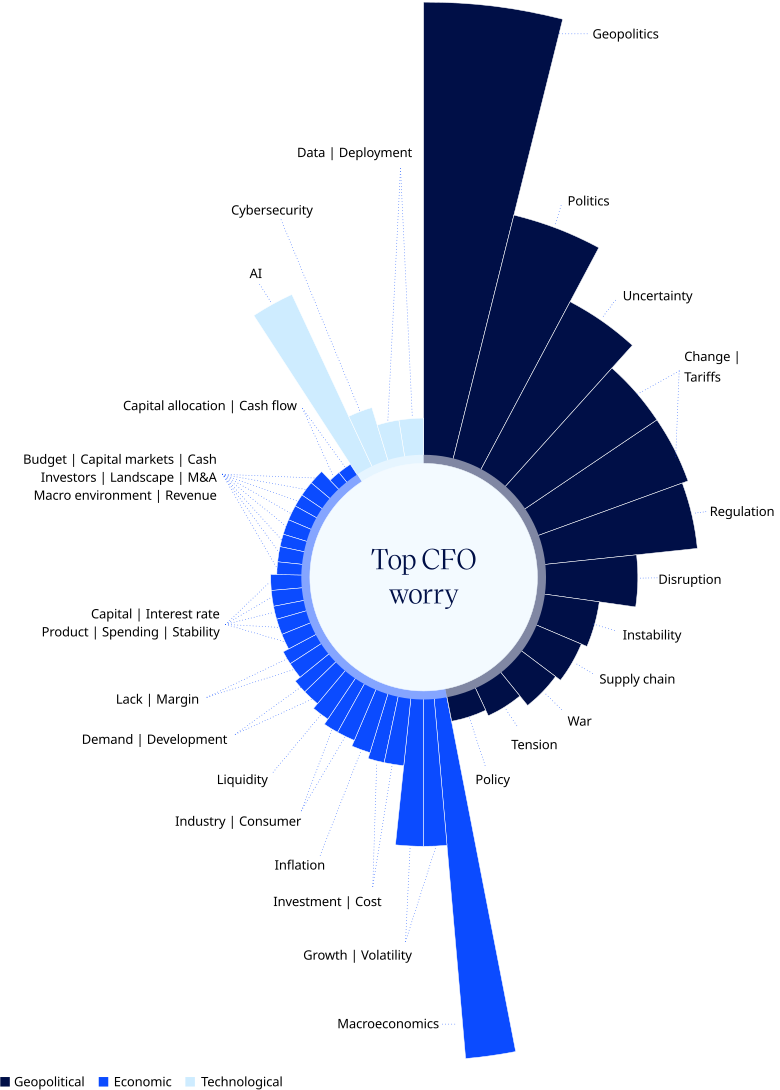
Geopolitical conflict, economic uncertainty, market volatility, and fast-moving technology make planning assumptions less stable. Nearly two-thirds of CFO respondents (64%) cite macroeconomic and geopolitical risk as their biggest worry in 2026. The consequence for CEOs, as we saw in our recent companion report, is an increasingly short planning horizon focused mainly on the coming year. For CFOs, that translates into a broader remit: more scenario modeling, faster decision support, and a greater need to reallocate resources as conditions change.
Tech, disruption, and structural volatility drive changes to the CFO mandate
Factors that CFOs view as among the top forces driving change in their role (% of CFOs)
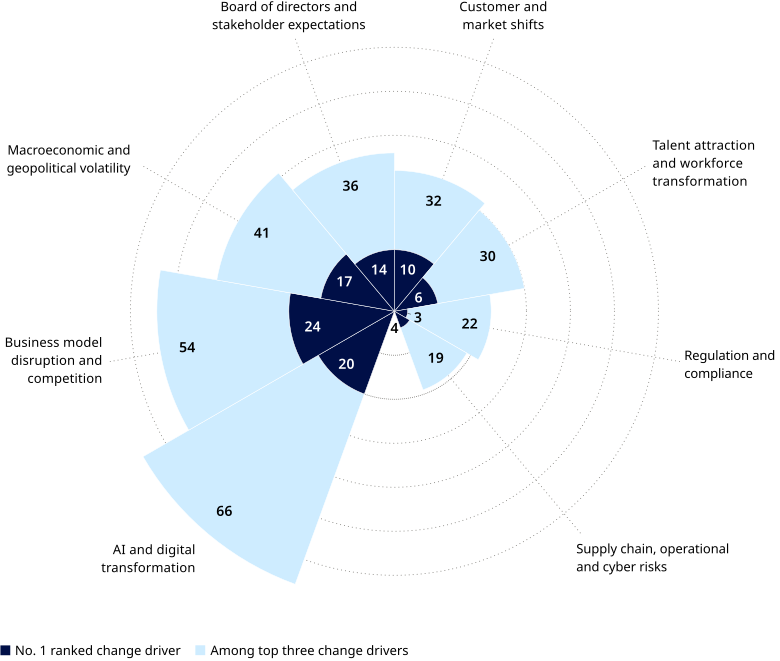
Question: “What are the top 3 forces driving how the CFO role at your company is evolving? (Select and rank your top 3)” (N=494)
Source: Oliver Wyman Forum x NYSE CFO Survey 2026; Oliver Wyman Forum analysis
CFOs have been expanding their role beyond core reporting and control functions for years, but recent disruptions have sharply accelerated this evolution. There is no single dominant shock driving changes in the role. Instead, CFOs are responding to several major disruptions that are interconnected and often reinforcing.
AI and digital transformation sit at the center of several of these pressures: They are reshaping business models, intensifying competition, altering workforce needs, and raising the stakes of technology competition among major economies.
How CFOs rank the forces changing their role depends on where they sit. In North America, business model disruption leads (24%). In Europe, AI and data transformation comes out on top (24%). The Asia-Pacific region presents a more complex picture, with business model disruption first, at 31%, and AI transformation and stakeholder expectations tied for second. Scale matters as well: Among CFOs at mega-size companies, AI and data transformation is the most common No. 1 driver of change (28%), while those at small and midsize companies, more vulnerable to competitive threats, are more likely to put business model disruption first.
Industry differences are equally revealing. AI stands out most in banking and capital markets, where 40% of CFOs rank it as the top factor. Macroeconomic and geopolitical volatility ranks first in materials and chemicals (33%) and transportation and automotive (31%). Energy, natural resources, and utilities CFOs stand alone in saying the biggest force changing their role comes from their own boards, activist investors, and other stakeholders (23%).
CFOs are bringing insight and clarity to business performance and growth
How are CFOs translating the forces of change into action? By defining a broader and more strategic mandate — one they expect to grow in importance.
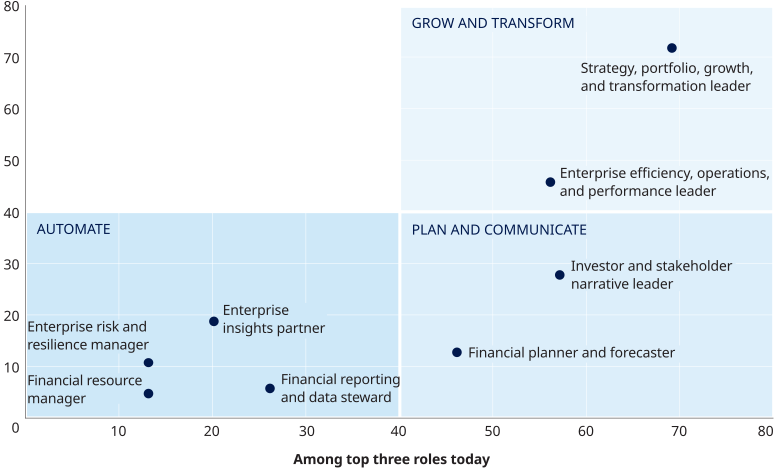
This pattern prevails across companies of all sizes: When asked about their top three most important roles today, strategy and transformation is the most cited among CFOs of small (69%), midsize (67%), large (77%), and mega-size companies (67%).
Enterprise efficiency, operations, and performance leadership is second, with 56% placing it among their top three roles. Looking toward the next three years, nearly half (46%) expect this area to increase in importance, underscoring how closely finance is tied to operating performance across the enterprise. A similar 56% also cite shaping the investor narrative among their top three, though fewer CFOs (30%) anticipate that this role will increase significantly in importance.
There are tradeoffs. As CFOs lean into strategic and operating roles, they are spending less time on traditional responsibilities. Only 26% rank financial reporting and data stewardship among their top three roles today, and 13% do so for financial resource management. Fewer than one in 10 expect either to grow in importance over the next three years. In practical terms, CFOs are entrusting more of the day-to-day finance workload to their teams and tools, freeing themselves to focus where they believe they can have the greatest impact.
Taken together, the results suggest three interconnected shifts. First, CFOs spend more time on strategy, growth, and transformation, with many becoming enterprise performance and transformation leaders who co-own the direction and results with their CEOs. Second, many lean further into optimizing operating decisions, serving as strategic scorekeepers who measure and manage performance across the business. Third, stewardship is not disappearing, but CFOs are stepping back from hands-on oversight of data quality and reporting. As automation matures and finance capabilities spread across the enterprise, these functions require less direct CFO involvement — shifting the CFO’s role from managing the work to setting the standards.
Company size and ownership structure shape the evolving mix of roles. Investor and stakeholder narrative rises sharply with scale: Less than half of small-company CFOs (48%) place it in their top three roles, compared with 87% at large and 74% at mega-size companies. Yet investor narrative increasingly looks like table stakes rather than the next frontier of the role: 57% place it among their top three roles today, but only 28% expect it to grow in importance over the next three years. The priority also varies by ownership structure. Public-company CFOs are about twice as likely as their private-company peers to prioritize investor narrative (73% versus 36%), while private-company CFOs put more weight on enterprise efficiency and financial reporting.
CFOs at companies of all sizes agree that strategy and transformation will become increasingly important. Among CFOs at mega-size companies, 79% select it as one of the two roles most likely to grow, while only 3% to 4% of those at large and mega-size companies say the same for reporting and data stewardship. Across every industry, the role of financial reporting and data stewardship is receding: Only 6% of CFOs globally expect it to increase in importance over the next three years.
CFOs are transitioning from financial planners to strategic partners
Roles cited by CFOs as among the top three most important today and the top two expected to increase the most in importance in the next three years (% of CFOs)
Roles increasing the most in importance in the next three years
Source: Oliver Wyman Forum x NYSE CFO Survey 2026; Oliver Wyman Forum analysis
Regionally, the CFO role converges at the top: Strategy and transformation leadership ranks first everywhere, with local variations reflecting local pressures. But the sharper differentiator isn’t geography; it’s AI maturity. CFOs at firms leading on AI deployment are already twice as likely to see themselves as enterprise insights partners (35% versus 20% globally) and are far less likely to define their role around financial planning (34% versus 46%) or reporting (16% versus 26%). That gap is set to widen: 79% of AI leaders expect strategy and transformation to grow over the next three years, while just 6% say the same for financial planning. As automation takes hold, it doesn’t just streamline the finance workload — it fundamentally reshapes what the CFO role looks like.
CFOs are stepping up on enterprise risk and cybersecurity
In tandem with their evolving roles, CFOs expect to take on more responsibility in enterprise risk management. The expansion is broad rather than selective: CFOs selected an average of 2.8 risk-management areas where they expect to have greater involvement, and 87% selected at least three. The emphasis differs across groups, but the direction is clear: Finance is moving well beyond familiar financial risk boundaries. There is also a historical echo here, since it was more common in the 1990s for risk teams to sit closer to the CFO.
Geopolitics and macro issues top CFOs’ list of worries
Words used by CFOs to describe their top worry for 2026
Source: Oliver Wyman Forum x NYSE CFO survey 2026.
The expansion into cybersecurity and technology resilience is notable. While not the leading area, 44% of CFOs expect greater involvement there over the next three years, showing how closely digital resilience is now tied to finance leadership.
CFOs naturally skew their risk focus toward the threats most relevant to their industry. In banking, treasury and market risk (74%) tops the list, and banking emphasizes regulatory risk (40%) more than any other sector — unsurprising in one of the most heavily regulated industries. Technology CFOs stand out on cyber and technology risk (61%), well above the global average, a consequence of their heightened exposure and digital footprint. In materials and chemicals (52%) and energy (45%), geopolitical risk takes center stage, reflecting the urgency of securing physical operations and navigating trade uncertainty.
CFOs at mega-size companies are especially focused on geopolitical and macroeconomic risks, with 59% expecting increased involvement — nearly double the rate of large-company CFOs and well above the 43% global average. For the largest companies, the CFO’s job includes understanding how shifting trade dynamics and regulatory regimes will affect a global portfolio of assets and obligations. Midsize-company CFOs, by contrast, report the broadest expected expansion in risk oversight, with an average of 2.9 risk categories selected (more than any other size group). Without the dedicated risk functions that larger companies typically maintain — including, in many cases, a chief risk officer — midsize CFOs tackle a wider share of the risk agenda personally.
This creates a significantly wider mandate, and one that’s often under-resourced. Midsize-company CFOs are effectively operating as de facto chief risk officers without the dedicated teams, tools, or frameworks that their counterparts at larger companies rely on. The good news is that they don’t need to start from scratch. More mature risk frameworks already exist at larger companies and in heavily regulated industries like banking and insurance, where dedicated risk functions have been stress-tested more intensely. But importing enterprise-scale infrastructure wholesale would be neither practical nor cost-efficient. The challenge is to adapt those practices selectively, building fit-for-purpose risk capabilities that match a midsize company’s cost structure and operating model.
Growth and investment
CFOs are making cost management and growth a common agenda for creating value
CFOs are prioritizing growth to increase shareholder value, but not growth at all costs. The line connecting CFO priorities on growth, investment, and capital allocation is the cost discipline that helps fund growth and make it sustainable.
Respondents cite cost management most frequently among their top three priorities for increasing shareholder value (60%), followed by revenue uplift (51%) and acquisitions and partnerships (40%). That two-level view matters: Revenue uplift is the most common No. 1 choice, but cost management is the most common recurring priority, showing that CFOs are balancing expansion with discipline rather than choosing between them. When asked the same question, CFOs and CEOs are closely aligned on the top four levers of shareholder value; the difference is in emphasis, with CFOs leaning more toward capital efficiency and cash flow and CEOs more toward reinvention.
The balance between growth and value drivers shifts with scale. Midsize-company CFOs are the most growth-oriented (71% choose a growth lever as their top priority), followed by those at small companies (65%) and large (64%). CFOs at mega-size companies are more balanced, with 51% choosing a growth lever and 49% choosing a value lever — reflecting more specialization of the CFO and CEO roles at the very largest companies, where 63% of corresponding CEOs choose a growth lever.
Asia-Pacific CFOs place the strongest emphasis on revenue uplift, with 71% citing it among their top three priorities, versus 48% in North America and 53% in Europe. But Asia-Pacific also over-indexes on capital efficiency and cash flow management, suggesting a more disciplined growth posture than the headline implies. North American CFOs stand out on organic investment in new revenue streams (33%), reflecting a capital markets ecosystem that rewards expansion.
Value creation and strategic fit are driving capital allocation decisions
CFOs are anchoring their capital allocation plans in both strategy and financial rigor. Respondents cite enterprise value creation (65%), strategic fit and portfolio positioning (62%), and financial return metrics (58%) among the top three factors guiding how they deploy capital. In an uncertain environment, CFOs are directing resources where they demonstrably build the business, fit the strategy, and deliver measurable returns.
The weighting of these factors varies by company size. CFOs at small and midsize companies are more likely to emphasize payback period and cash flow profile (40% to 42%), a reflection of organizations where capital is finite and every investment must generate returns quickly. At mega-size companies, that figure drops to 14%.
By contrast, CFOs at mega-size companies cite strategic fit and portfolio positioning as the dominant factor (70%), and emphasis on the capacity to fund innovation rises to 44%, the highest of any size bracket. Large companies below mega-size occupy an uncomfortable middle ground: The capacity to fund innovation dips to 18% at this tier, suggesting organizations caught between the obligations of returning capital and the demands of funding the next wave of growth.
Asia-Pacific respondents are the most focused on transformation and innovation. Forty percent cite long‑term business transformation as a top three shareholder-value priority, 14 points above the global average, and 46% cite capacity to fund innovation as a top three capital-allocation factor.
Capacity to fund innovation is a top three capital-allocation factor for 35% of CFOs overall, but it is higher among those in insurance and asset management (47%) and tech (45%). Growth-oriented CFOs are eight points more likely than value-oriented peers to cite innovation. Private-company CFOs place far more weight on payback period and cash flow profile than public-company CFOs (52% versus 24%), reflecting the capital constraints that shape investment decisions in the absence of easy access to public markets.
AI as a test case for capital discipline — and a lever for growth and efficiency
AI brings the need for capital discipline to the forefront, given the disconnect between ambition and value realized at many institutions. CFOs surveyed see it as a major force shaping their institutions and as a key lever for transformation within the finance function. With three-quarters of respondents planning to increase AI spending and a growing share of enterprise budgets flowing to the technology, CFOs face a familiar test of capital discipline — ensuring that investment commitments are matched by measurable returns. Yet only 6% rank steering its deployment as their No. 1 lever for driving enterprise value, suggesting skepticism around the effectiveness of efforts to date and their ability to generate returns.
Closing the gap between AI investment and value delivered will be a key issue CFOs face, and may be existential in several industries where the gap between AI leaders and laggards is widening.
The spending trajectory is clear — but ambition varies. One in six CFOs is targeting AI spending growth of more than 20%, while the majority plan more measured increases. Only 5% report no AI-related spending at all in 2025 and 2026. For those already deploying AI at scale, the technology is much more than a cost-saving tool. They are looking to grow by pursuing tech deployment, new revenue streams, and M&A simultaneously. AI laggards, by contrast, remain more anchored in cost management.
Asia-Pacific and North American CFOs are more likely to view AI primarily as a growth lever (20% and 17%, respectively) than their European counterparts (13%). CFOs of mega-size companies are the most likely (52%) to place deploying technology and AI among their top three levers for increasing shareholder value in the next one to two years — a reflection of organizations with enough scale to invest and transform substantially.
Those at midsize companies are somewhat more likely than others to view AI primarily as a growth lever (21% versus 17% globally), treating technology investment as an accelerant for gaining scale. Larger firms have the scale to realize efficiency gains from AI, which raises its strategic priority for these CFOs. Those at midsize firms, with less to gain from automation alone, are more likely to see it as a path to growth.
Transformation in finance
Real finance transformation goes beyond technology to talent, data, and process
As the CFO role becomes more strategic and growth‑oriented, the finance function is evolving to keep pace. Delivering on cost, growth, and capital allocation priorities requires faster steering, sharper analysis, and more agile resource deployment from finance itself. There is a credibility test at work: Before finance can steer transformation across the enterprise, it must first transform itself. Our conversations and interviews reveal that many CFOs are disappointed with the results to date, despite years of activity and enormous sums spent. Traditional reporting cycles, labor-intensive processes, and multiyear transformation programs are increasingly out of step with what the moment demands.
In many cases, finance transformation efforts have fallen short because of the model behind them: multiyear technology implementations aimed at delivering everything at once. Real transformation does not come from technology alone. It comes from rethinking processes, capabilities, data flows, and the workforce that supports them. It is a permanent discipline rather than a one-time program. The stakes are even higher given the expanding risk mandate discussed earlier in this report. A finance function that still relies on fragmented data and lagging information cannot support the role CFOs are now expected to play: driving enterprise performance, allocating capital through uncertainty, and managing the strategic, cyber, and geopolitical risks that CFOs increasingly oversee.
Driving cost, margin, and productivity gains to achieve performance transformation
CFOs are pushing finance beyond reporting and into enterprise-wide transformation. Seventy-one percent of CFOs rank driving cost, margin, and productivity improvement among their top three priorities for generating enterprise-wide performance and transformation over the next three years. Sixty-eight percent aim to drive performance through advanced analytics and scenario modeling, and 64% are leading cross-functional business cases, portfolio reviews, and capital allocation. When asked to name their No. 1 enterprise transformation priority, CFOs are about evenly split: 27% prioritize cost and productivity improvement, 25% favor leading cross-functional business cases, and 22% cite advanced analytics. The CFO is simultaneously operator, allocator, and analytical copilot.
Using data, automation, and AI to power finance transformation
Within the finance function, two priorities stand out. The category of data, automation, AI, and digital capabilities is the most widely selected means of transformation (80% of respondents place it in their top three), while financial planning and analysis, performance management, business partnering, and investor relations is the most common No. 1 priority; 31% of CFOs rank it first compared with 27% for data and digital. The point is not technology for its own sake; it is better steering — a finance function repositioned as a strategic contributor that combines forward-looking analytical capability with the technology infrastructure to support it.
Industry patterns are revealing. CFOs in transportation and automotive (49%) and materials and chemicals (34%) most often rank operational and productivity improvement first. Those in energy and natural resources (33%) and industrials (28%) lean toward advanced analytics, while those in consumer and retail (33%), banking (29%), and tech (27%) most often prioritize cross‑functional business cases.
In the Asia-Pacific region, a notable divergence emerges: Rather than advanced analytics, Asia-Pacific CFOs are more likely to emphasize shaping and governing enterprise-wide technology and AI initiatives (17%) as the top vehicle for transformation. CFOs at small and midsize companies worldwide place more weight on foundational financial planning and business partnering capabilities.
The survey findings reinforce a shared belief that finance transformation is not a program with a finish line. It is an ongoing capability that must be embedded in how the function operates, moving from periodic reporting toward continuous steering through redesigned processes, better data, sharper decision support, and a workforce built for a different kind of work. The chapters that follow examine the two most consequential dimensions of this shift: the role of artificial intelligence in reshaping the function, and the talent and operating model changes needed to support it.
Artificial intelligence in finance
Investment is accelerating, but AI scaling remains a challenge
The conversation on AI in finance has moved from experimentation to execution. The question is no longer whether to use the technology but how quickly organizations can scale it in priority use cases. Spending intentions are broad, and CFOs have placed AI at the center of the transformation agenda outlined in the previous chapter, but deployment maturity remains limited. That gap makes it especially important for CFOs to demonstrate they can drive change effectively inside finance as they take on a wider role across the business.
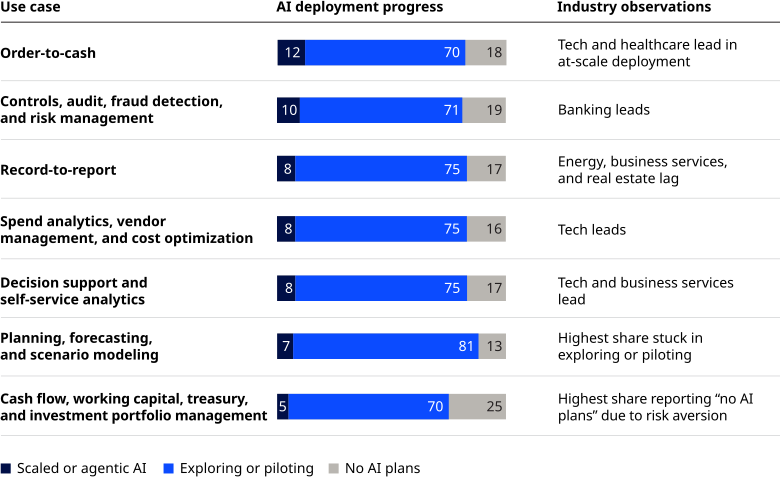
Fourteen percent of companies in our sample qualify as AI deployment leaders in finance, defined as having deployed the technology at scale across at least two use cases. Deployment is most advanced in the order-to-cash process, where 12% report using AI at scale, followed by the category of controls, audit, fraud detection, and risk management at 10%. CFOs show the least interest in applying AI to cash flow, working capital, and treasury activities, where they worry about high‑impact errors — the finance equivalent of a driverless car hitting a pedestrian.
The leaders point to where the rest of the field is likely headed. Asia-Pacific reports the highest average level of at-scale deployment per use case, at roughly 14% — about double the rate in North America. The gap is especially pronounced in spend analytics, vendor management, and cost optimization, where 21% of Asia-Pacific respondents report deployment at scale compared with roughly 6% to 7% in North America and Europe. That spread suggests significant room for North American and European finance functions to increase adoption as the technology matures and deployment frameworks become more established.
A similar pattern holds by industry. Tech leads in the average level of at-scale deployment across key functions (15%), followed by consumer and retail (10%), healthcare (9%), and insurance and asset management (9%). Real estate, energy, and materials are at an earlier stage, at 3% to 5%. Tech’s lead is consistent with being the sector closest to the technology itself, but the use cases driving adoption — planning, controls, spend analytics — are not industry-specific. As deployment costs fall and models improve, other sectors are likely to follow a similar path.
Size is closely associated with AI maturity. CFOs at mega-size companies report higher rates of experimentation and at-scale deployment across most use cases. They are furthest along in order-to-cash (21%), and both mega-size and large companies lead in controls and fraud detection (17% to 18%). Conversely, nearly a quarter of small-company CFOs report no AI plans across key finance use cases, five percentage points above the global average.
AI investments are flowing to planning, forecasting, and analytical capabilities
The finance areas attracting the largest increases in AI investment show where CFOs are concentrating near-term resources. Planning, forecasting, and scenario modeling tops the list at 56%, followed by decision support and self-service analytics at 45%, and spend analytics, vendor management, and cost optimization at 40%. CFOs are concentrating first where finance needs faster steering, better forecasting, and more timely insight.
Mega-size companies are investing broadly: 70% are increasing investment in planning and forecasting, 62% in decision support, and 52% in record-to-report automation, reflecting both their complexity and their capacity. Large companies stand apart for controls, audit, fraud detection, and risk management, where 46% are increasing investment (versus 37% globally), suggesting a cohort focused on hardening financial infrastructure before expanding its intelligence capabilities.
No region is moving faster on near-term enterprise AI investment than Asia-Pacific, where 81% of CFOs see their companies increasing spending. North America leads in spend analytics investment (47%), while Europe lags on that measure at 28%.
Banking and capital markets CFOs are the most aggressive on AI, with 88% planning moderate or substantial enterprise spending increases. Their leading investment area is controls, audit, and fraud detection — a reflection of an industry where the cost of error is measured in regulatory consequence as much as financial loss, and where regulators are voicing concerns over the threat of AI-driven cyber risk.
Most AI deployment is at pilot stage, with highest scaled deployment in order-to-cash
Level of AI maturity across key finance use cases (% of CFOs)
Source: Oliver Wyman Forum x NYSE CFO Survey 2026; Oliver Wyman Forum analysis
Growth-oriented CFOs are about twice as likely as value-oriented peers to report AI at scale across key functions (10% versus 5%), and 22% of AI deployment leaders plan substantial enterprise spending increases in 2026, compared with 15% of laggards. The pattern suggests that deployment changes mindsets as well as budgets, widening the gap between early leaders and the rest of the field. A finance function that can model scenarios faster, close books more efficiently, and surface insights in real time is not just more productive; it is more strategically useful to the organization it serves.
Our conversations with CFOs add another layer of complexity. As they weigh AI’s potential to reshape both the operating model and the finance function, many CFOs confront a familiar but higher-stakes question: whether to build capabilities internally, buy external solutions, or combine the two. That decision will usually need to be made at the enterprise level and cascaded to each function. The better answer will usually be the one that accelerates value without fragmenting accountability.
Talent and operating model
Reshaping finance with centralization, shared services, and more midlevel roles
CFOs envision leaner finance functions and a shift away from junior roles, but not a one-directional shift in operating model. The future they are planning for combines centralization, selective capability upgrading, and tighter control over headcount.
Forty-seven percent of CFOs plan to further centralize their finance functions over the next three years, and the same percentage plan to increase their use of shared services, global capability centers, and external providers. The two trends reinforce each other: More standardized work can move into scaled delivery models, while strategic finance talent stays focused on higher-value activities.
Larger organizations are moving most aggressively. Fifty‑nine percent of large companies and 57% of mega‑size companies expect more centralization, while use of shared services rises steadily with company size, reaching 58% among mega-size companies. Small companies, by contrast, are more likely to embed finance staff directly in business units (31%), a model that drops to just 10% among large organizations.
The regional picture differs in important ways. North America and Europe are moving toward centralization at similar rates (49% and 48%, respectively). Asia-Pacific is taking a more mixed approach: 46% of CFOs there plan to embed more finance staff directly in business units, nearly double the European rate, while 56% also expect greater use of shared services. This suggests companies in the region are pursuing both strategies simultaneously, embedding strategic talent closer to the business while consolidating transactional work.
The consumer and retail industry anticipates the most operating-model change, with only 15% of CFOs expecting no change, compared with a 28% global average. Those in banking and capital markets anticipate less change (45% expect no change). Materials and chemicals leads in shared-services adoption (67%), well above the global average. Across industries, the bigger question is not whether work should be centralized or embedded but which activities belong in each model.
CFOs are freezing or cutting staff and turning talent pyramids into diamonds
The pattern mirrors what we found among CEOs in our parallel survey: Many organizations are planning to freeze or reduce headcount overall. The most common expected mix shift is toward midlevel roles (41%), followed by a shift toward senior roles (23%). Twenty-three percent anticipate no change. Only 13% expect a shift toward more junior roles. In other words, the traditional finance pyramid is starting to flatten into more of a middle-heavy diamond. As operating models evolve and finance functions slim down, roles are changing, not just disappearing: The pull is toward more analytical, technology-enabled work and a more experienced talent base.
Workforce expectations vary by size. Mega-size companies are the most likely to expect a decline of more than 10% in headcount (36%). By contrast, 14% of small companies expect an increase of more than 10%, suggesting that some are still building core finance capacity. Large companies are more likely to expect a shift toward junior roles (28%), the highest of any cohort and more than double the global average, which may suggest a move toward delegating automated tasks to lower-cost staff or global capability centers.
Regional differences are sharp. In Asia-Pacific, 44% expect the finance pyramid to shift toward more senior roles, nearly triple the rate of North America (15%), and 42% expect headcount to decline by more than 10%, well above Europe (31%) and North America (28%). As automation absorbs more routine tasks, Asia‑Pacific organizations are both reducing headcount and upgrading the remaining staff.
Among industries, real estate (69%) and banking and capital markets (69%) show the strongest preference for keeping workforce changes broadly flat, followed by energy and natural resources (68%). Insurance and asset management (39%) and materials and chemicals (39%) lead in planned workforce reductions. Business services CFOs are the most positive on increasing headcount, at 18% versus 9% globally.
Talent strategies now center on succession planning and leadership development
As the finance function evolves, leadership continuity has become a clear priority. Seventy percent of CFOs plan to intensify succession planning and leadership development in the next three years. Large companies are the most aggressive (79%), while smaller ones sit slightly below the global average at 68%. Industrials, aerospace, and defense and business services are highest at 82%, followed by banking and capital markets at 76%.
Taken together, these workforce findings suggest the central talent question for finance leaders is no longer how many people the function will employ but which portfolio of skills is needed and which organizational shape will provide the best support. The finance function of the future will be smaller, more skilled, more centralized in its transactional work, and more strategically embedded in the business. Succession planning now operates on two levels: building the next generation of finance leaders inside the function and preparing CFOs themselves for a broader enterprise role as strategy, performance, and transformation take up more of the mandate.
That dual charge captures the larger arc of this report. The widening CFO mandate, the fusion of cost and growth with more disciplined capital allocation, the imperative to transform the finance function, the pressure to turn AI spending into real value, and the redesign of talent all point to the same conclusion: Finance is becoming the place where strategy gets translated into operating choices. CFOs are no longer defined primarily by what they control — the books, the budget, the close — but by what they enable: growth funded by discipline, transformation grounded in measurable outcomes, and AI that scales from proof-of-concept to strategic advantage. The gap between ambition and execution remains real, in AI deployment, in finance transformation, and in workforce redesign. But the direction is clear, and the CFOs who close that gap fastest, pairing strategic breadth with the rigor to deliver, will not just run the finance function. They will help run the enterprise. CFO-to-CEO promotions reached a decade high as of early 2026. On the evidence of this survey, that trend has room to continue.
Research methodology
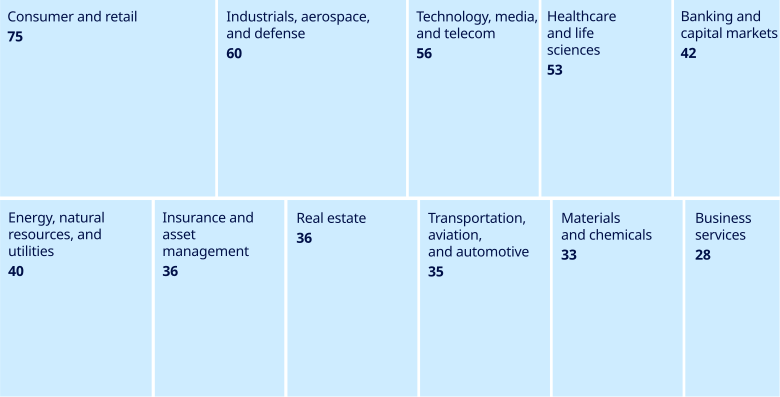
The 2026 Oliver Wyman Forum and New York Stock Exchange CFO survey captures the views of 494 chief financial officers from public and private companies, the first annual edition of the most extensive survey of its kind. The public companies alone represent an estimated 12% of all global listed equity at the time of publication. Respondents span 11 industry categories and company sizes from less than $1 billion in annual revenue to more than $10 billion, with the largest concentrations in North America and Europe and additional coverage in Asia-Pacific, Latin America, and other regions. This report draws on the CFO survey along with CFO interviews, the Oliver Wyman Forum’s 2025 Q4 survey of more than 15,000 workers across 20 nations, and our 2026 CEO survey. This companion to the CEO survey is designed to give CFOs the same caliber of peer business insight, not just sentiment.
The survey was fielded from January 12 to March 13, 2026. Size categories used throughout this report are: small (less than $1 billion in annual revenue), medium ($1 billion to $5 billion), large ($5 billion to $10 billion), and mega (greater than $10 billion). Industry categories include: banking and capital markets; insurance and asset management; healthcare and life sciences; industrials, aerospace, and defense; transportation, aviation, and automotive; energy, natural resources, and utilities; materials and chemicals; technology, media, and telecom; consumer and retail; business services; and real estate.
Throughout the report, “AI deployment leaders” refers to the CFOs whose finance functions have achieved at-scale AI deployment across at least two finance use cases. “Growth-oriented” and “value-oriented” CFOs are categorized based on whether their top priority for increasing shareholder value is a growth lever (such as revenue uplift or acquisitions) or a value lever (such as cost management or capital efficiency). All forward-looking figures refer to CFOs’ plans, decisions, and priorities over the next one to three years unless otherwise stated.
Distribution by industry group (number of companies)
11 industries
Distribution by revenue (number of companies)
$16 trillion
combined equity value (12% of global market cap from public companies alone)
Distribution by region (number of companies)
Global coverage
Acknowledgments
Authors
Eric Czervionke is a Partner and leads Finance and Treasury in the Americas.
Gayla Bella is a Partner with the Turnaround and Restructuring practice of Oliver Wyman.
Jörg Stäglich is an Oliver Wyman Partner, Global Head of Utilities, and the European Head for the Energy and Natural Resources practice.
Vivek Sen is a Partner and leads Performance Transformation in the Americas.
Lars Stolz is an Oliver Wyman Partner and leads the global Performance Transformation practice.
Ana Kreacic is Partner and Chief Knowledge Officer of Oliver Wyman, and COO of the Oliver Wyman Forum.
Jose Lopez is a Senior Fellow at the Oliver Wyman Forum and a principal in Oliver Wyman’s Government and Public Institutions and Digital practices.
Lulu Smith is a Senior Analyst at the Oliver Wyman Forum.
Contributors
Emmanuel Amiot, Ashik Ardeshna, Patrick Barlow, Laurent Bensoussan, Andreas Berlin, Chris Bernene, Carole Bouchard, Tom Buerkle, Jocelyn Cao, Kaitlyn Choe, Marco Ciet, Larissa De Lima, Bruno Despujol, George Doster, Christian Edelmann, Susanne Eisenegger, Elie Farah, Aaron Fine, Charlotte Fuller, Barbara Galli, Mark Goldstein, Ricardo Gomeza, Neve Gong, Tim Hoyland, Robert Hunter, Rupal Kantaria, Dan Kleinman, Ugur Koyluoglu, Maggie Lavoie, Nick Liptak, Marissa Lynch, Laksh Maggoo, Jilian Mincer, Ted Moynihan, Anders Nemeth, Ben Paik, Carlo Pellerani, Mark Pellerin, Tejas Porwal, Rutger von Post, John Romeo, Sarah Said, Silvia Sanz, Dimitri Schweiger, Til Schuermann, John Seeliger, Athan Siah, Jai Sooklal, Tom Stalnaker, Heather Stern, John Thompson, Vanessa Webb, Arran Yentob, Michael Zeltkevic
Art and Design
Adrien Slimani, Anne-Laure Chauvin, Cynthia Perez, Dalí Velasco, Julia Chudzik, Melissa Ureksoy, Weronika Talaj, Yireli Pale