By John Romeo
“Events, dear boy, events.” That line, attributed to former UK Prime Minister Harold Macmillan when asked what most shapes a government, is more relevant now than when he left office six decades ago. War in the Middle East, tensions between major powers, trade fragmentation, accelerating technological disruption — we are not short of events.
But to focus on the headlines is to miss the deeper story. These are not isolated shocks; they are the visible expression of convergent and mutually reinforcing forces.
The world order that shaped the past 80 years has broken down. Companies can no longer treat geopolitics as episodic — an external shock to absorb and move past. Today’s world is moving from integration to managed competition, from shared rules to national interests, and from multilateralism to spheres of influence.
The global economy is becoming more mercantilist and resilience oriented. Supply chains are strategic, with trade policy becoming security policy. Nations are reassessing dependencies in energy, food, semiconductors, and critical minerals. Efficiency is being balanced, and often trumped, by security.
Finally, we are in the early stages of an artificial intelligence revolution. AI is not merely a software story; it is industrial policy. Data centers require power. Chips require advanced manufacturing. Energy infrastructure becomes geopolitical leverage.
These pressures have been building for a long time but were easy to overlook during the decade of cheap money that prevailed after the global financial crisis. We focused on the top of Maslow’s pyramid (purpose, identity, experience), assuming the base (security, affordability, energy, health, trust) would take care of itself.
Now, money has been repriced, geopolitics have hardened, and technology is accelerating faster than institutions can adapt. The buffers that once bought us time are thinner. Suddenly the foundations matter again.
People sense this. Our 300,000 Voices survey shows clearly that people feel far more anxious, stretched, and less secure than they did only a few years ago. They are narrowing their focus and turning to what they can control: family, community, skills, savings. Trust has migrated — from institutions to proximity, promises to proof.
This is not a mood swing. It is a rebalancing toward the base of Maslow’s pyramid at precisely the moment when geopolitical fragmentation and technological acceleration are increasing systemic volatility. States are rediscovering power politics, markets are repricing risk, technology is compressing decision cycles, and citizens are reassessing what security really means.
The era of thick buffers — geopolitical, economic, psychological — is over. What replaces it will be determined not by events alone but by how leaders respond to them. In a thinner world, resilience is strategy, domestic reform is national security, and institutional trust is a competitive advantage. The real test now is not diagnosis but delivery.
Ready or not, leadership is less about managing volatility at the margins and more about rebuilding foundations at the core.
John Romeo is CEO of the Oliver Wyman Forum
The paradox of artificial intelligence is vexing business leaders. Tech giants are investing hundreds of billions of dollars in data centers to fuel growth, and AI’s early prowess in coding has knocked more than a trillion dollars off the value of software stocks this year. Yet the productivity miracle we’ve been promised is hardly in sight.
Welcome to the J-curve, that awkward period when organizations need to make heavy investments in a new general-purpose technology before capturing its productivity benefits. That was true with electricity in the late 19th century and it’s especially true for AI, which has capabilities — mimicking human reasoning, absorbing feedback, improving through deployment — unlike any previous technology.
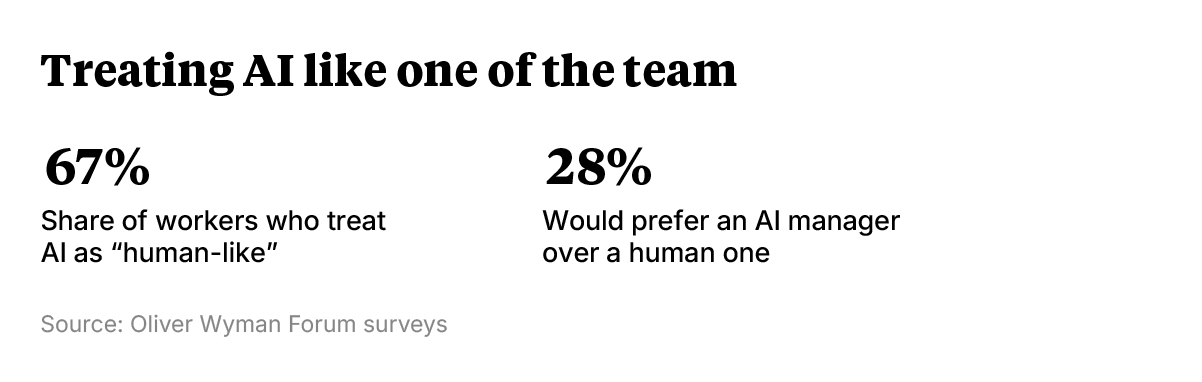
There are clear signs of progress. Generation Z is embracing AI: 58% use it at least three times a week, the fastest uptake of any generation, according to 300,000 Voices, an Oliver Wyman Forum report based on survey responses collected around the world over the past five years. People are interacting with the technology in human-like ways, such as asking chatbots about their day, and AI is producing real gains in areas like customer service and software development, particularly among junior developers.
But speeding up individual tasks doesn’t create real value at an enterprise level. That requires architectural, not just technical, change: Redesigning the way work flows through the organization, where decisions are made, how accountability is maintained and performance measured. That requires steady investment and repeated experimentation.
The divides holding progress back
Enthusiasm about AI is almost unanimous among corporate leaders, and more than a third say their company has articulated a clear AI vision and kept employees informed of progress. Yet few frontline employees agree. Too often, new AI tools are bolted onto old workflows and data are compartmentalized in silos. Workers feel AI is accelerating their day-to-day tasks but struggle to see where that fits into the broader picture of how work gets done.
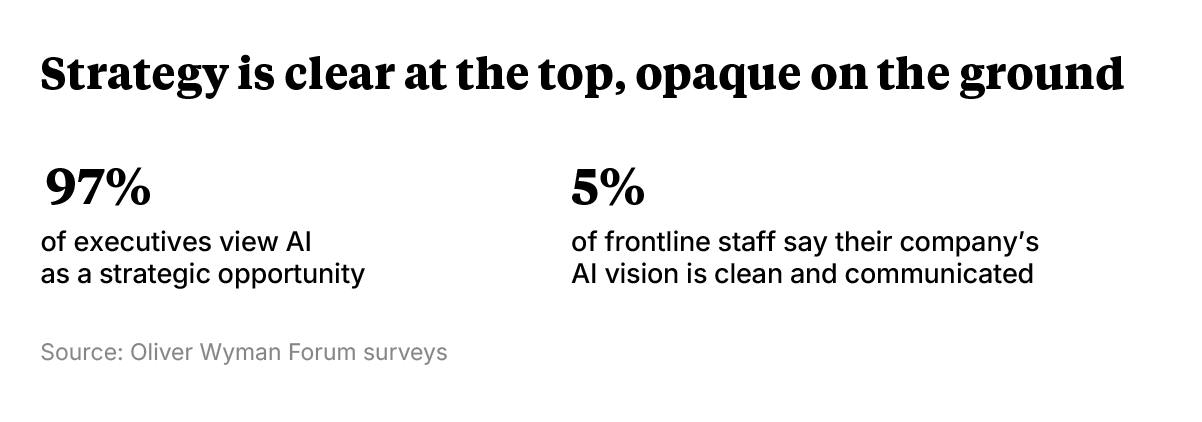
This asymmetry explains the meager results on the bottom line: Fewer than 5% of CEOs of New York Stock Exchange-listed companies reported meaningful return on AI investment (defined as more than 20%), according to a survey by the Oliver Wyman Forum and NYSE.
The workforce itself is divided generationally. Among Gen Z, the oldest of whom will turn 29 this year, the proportion who use AI at least three times a week at work grew by 65% between 2023 and 2025. By contrast, nearly half of boomers, the youngest of whom will turn 62 this year, say they no longer use the technology.
Not surprisingly, Gen Zers are 1.7 times more likely than boomers to participate in AI training and 2.2 times more likely to report productivity gains from training.
Closing those gaps — between the vision and the way work is actually organized, and between generations in the workforce — is critical to solving the productivity paradox.
Redesigning around a workforce that's no longer only human
At many organizations, workers already manage AI the way they do interns: defining good output, critiquing drafts, and pushing for better versions. Some advanced users practice a form of informal “AI management” — helping a system perform without fully controlling it.
Robotics is starting to drive similar changes in physical work in factories, warehouses, and hospitals. Humans will increasingly supervise fleets of AI-enabled robots working alongside humans, with software agents managing the interactions between them.
For business leaders, the key question today is not what AI can automate, but how humans, AI agents, and robots should work together to transform the business. Instead of breaking down existing tasks, that means focusing on the outcome you want to achieve and reimagining workflows to get there.
Leaders will have to decide which tasks machines can handle fully, which are shared with human co-workers, and which are shielded from automation. And they’ll need new governance arrangements to clarify roles, determine accountability when an agent errs, and decide how AI-driven gains are shared with people.
Success will go to those who truly reimagine how value is created, how teams function, and what it means to lead a workforce that’s no longer only human.
Sports is a big business with multiple bottom lines, promoting economic growth and healthier lifestyles while uniting people across borders and backgrounds. To grow those benefits, stakeholders need to address rising levels of physical inactivity as well as climate change and nature loss that threaten to curb athletic activities, according to a report from Oliver Wyman and the World Economic Forum.
The sporting industry generated roughly $2.3 trillion in revenue in 2025, and that’s projected to grow to $3.7 trillion by 2030 and $8.8 trillion by 2050. The relevance of those numbers extends far beyond the playing fields. The sports economy generated 2% of Japan’s GDP in 2024 last year and accounted for 5% of jobs in the United States.
Tourism is the industry’s single biggest growth driver. People traveling to participate in sporting events, cheer on their kids or favorite team, or attend global events like the recent Winter Olympic Games accounted for nearly a third of the industry’s revenue last year, and 10% of global travel spending. By contrast, professional and elite sports generate only 10% of the sports revenue.
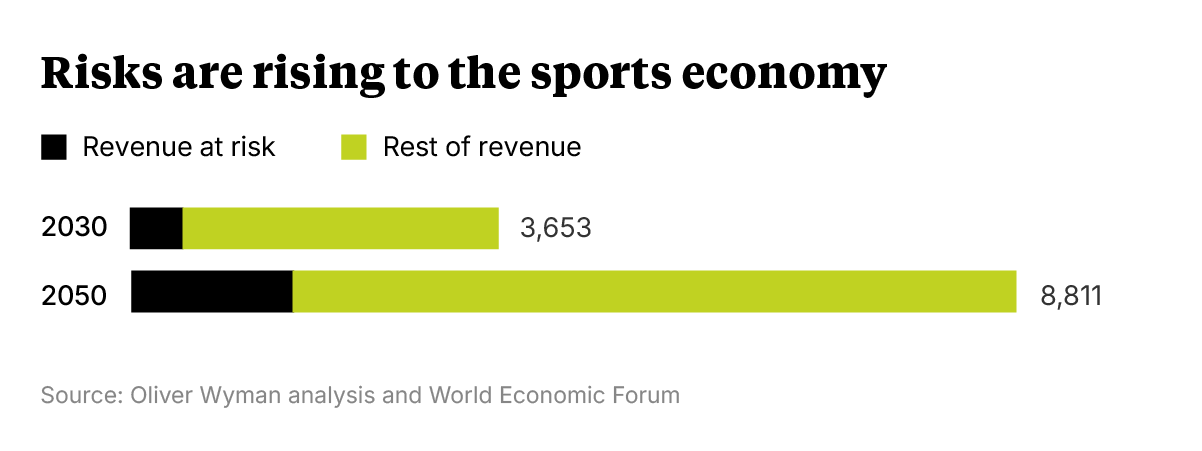
Rising physical inactivity, particularly among young people, and climate change pose a threat to growth and the natural assets that make sports possible. The sports economy produces up to 450 million tons of carbon dioxide emissions a year, more than the French or UK economies.
To turn these risks into advantage, the report proposes three pathways to sustainable growth:
- Champion resource stewardship through avenues such as sustainable water usage, circular business models, and the adoption of sustainable materials and consumption models at sports events.
- Place sports at the heart of cities by turning parks and public spaces into everyday assets for health, resilience, and inclusion.
- Catalyze purpose driven capital flows by shifting sponsorships and investment from transactional deals toward partnerships and blended finance structures designed to deliver climate, nature, and inclusion outcomes.
The emotional resonance and cultural influence of sports make it an ideal platform to promote active lifestyles and sustainable behaviors. This essentially turns fans and participants into agents of change while unlocking new revenue pools for clubs, brands, franchises, cities, and investors.
The rise of stablecoins, a fast-growing $300 billion market, poses the first competitive challenge to state-backed money in modern times. How central banks and regulators respond will determine how monetary policy is transmitted, how crises are managed, and whose currency anchors daily economic life, according to a new report from Oliver Wyman.
Stablecoins are privately issued digital tokens whose values are linked to fiat currencies like the dollar and euro. They thrived initially by enabling crypto investors to move funds without going through the banking system but increasingly are being used more widely to pay for goods and services, transfer funds, and store value.
The growth of US dollar-backed stablecoins, of which the two largest account for more than 80% of the market, shows how quickly this digital money is expanding.
In countries where confidence in local currencies has eroded, stablecoins are accepted by a growing number of online retailers. They also account for a growing share of remittances in developing economies where access to foreign currency is limited. The International Monetary Fund estimates that cross-border stablecoin transactions reached around $2 trillion in 2024.
If households and businesses around the world can hold and use stablecoins as easily as local currency, that could reduce the effectiveness of national monetary policies and reserve requirements. It also could increase funding costs and lower operating margins for banks if households and firms move funds out of domestic deposits and into foreign currency stablecoins. And growing use of stablecoins could accelerate capital flight in a crisis, putting pressure on exchange rates and domestic bond and money markets.
The regulatory responses: Fight, compete, or adapt
To address these risks, some jurisdictions are moving to ban stablecoins in domestic payments and savings, or constrain them through stringent licensing requirements. China and several Gulf states have outlawed crypto trading and stablecoin issuance. This can protect monetary sovereignty but also push innovation offshore and raise enforcement costs.
Other jurisdictions are choosing to compete by building domestic alternatives, such as a central bank digital currency or a fully reserved domestic stablecoin regime. Japan’s 2023 framework, for instance, allows only licensed banks and trust companies to issue fully reserved yen-pegged stablecoins.
A third group is adapting by integrating stablecoins into existing regulatory frameworks. In the United Kingdom, for example, the Treasury and Bank of England require stablecoin issuers to obtain authorization and meet capital, liquidity, and redemption requirements.
Trust remains the ultimate anchor of any store of value or payment mechanism. How authorities respond to the challenge of stablecoins will shape not only domestic monetary outcomes but also the coherence of the international monetary system itself.
"Companies will use quantum computing to predict consumption ahead of demand. Modelling will trigger airline price wars. Quantum will confer an enviable market advantage."
Andrew Turner
CEO of Saibre Capital and member of the UK National Quantum Advisory Board, in conversation with Oliver Wyman Forum Partner Rupal Kantaria.
A selection of smart reads on business, technology, geopolitics, culture, and beyond.
- The Death of Khamenei and the End of an Era. Iran’s supreme leader was brought down by a paradox: The revolution he sought to preserve was designed for a world that no longer exists.
- AI Frees the Corporate Phalanx. The future is no longer command and control but loosely coupled organizations, with task-oriented employees constantly updating and getting guidance from AI agents. Good riddance org charts. Everyone is a chief.
- The Case of the Disappearing Secretary. Talk of an AI-induced jobs apocalypse is in the air, but the durability and adaptability of secretaries and clerical workers — which made up nearly 20% of the US workforce four decades ago — suggests a more gradual and nuanced evolution.
- Formula 1’s Pivotal Year. The grand prix business is in rude health after five years of strong growth. Can a streaming deal with Apple TV and the arrival of American automaker Cadillac in the starting grid enable the motor racing circuit to crack the lucrative US market?
- Jack Dorsey Is Ready to Explain the Block Layoffs. The CEO says he laid off nearly half the firm’s employees to stay ahead of changes looming for nearly every organization: “Every company that's not building itself as intelligence is going to face something existential, and it's going to happen over the next year or two.”
- Buckle Up for Bumpier Skies. Aviation engineers and researchers are puzzling over worsening turbulence from climate change. Past problem-solving focused on fixing mechanical problems. Now, it’s the sky that is becoming more unreliable.
Every month, we highlight key data points drawn from more than five years of consumer research.