Average across all values
10%
20%
30%
40%
50%
60%
70%


 Download Report
Chapters


You're here
Introduction
Swipe left or right
Chapters
Pick a chapter
January 15, 2026
Explore what 300,000 voices have to say across seven chapters:
| What we value | How we feel | How we invest | How we win the next generation of consumers |
| How we work | How we embrace AI | How we inspire and lead |
Historians might disagree about which period of the past century was the most tumultuous, but the 2020s are surely on the shortlist. The global pandemic was just the beginning; social upheaval, geopolitical conflict, economic shocks, and technological advancement have left people unsettled and introspective, focusing their energy on things they can control. They are more concerned with personal fulfillment and less fixated on macro issues, more trusting of smaller communities and less credulous of big institutions, more likely to be thriving but less likely to feel that way than they were at the dawn of this decade.
We know this because they’ve told us.
Back in 2020, when the world first seemed to wobble off its axis, the Oliver Wyman Forum launched the Global Voices survey to collect insights across a range of topics, from workforce trends to disinformation, to help business and government leaders understand and navigate the changes taking place. We assumed the pandemic would impact society like other shocks of the 20th century, creating a “cohort memory” that would reshape long-term attitudes and beliefs. Our hunch proved correct; the results were so revelatory that we were inspired to keep asking questions.
Now, we have reached a milestone. At the five-year mark of this project we have amassed almost 300,000 different cuts of opinion, experience, and belief across 20 nations, on a growing range of topics. Some of the results are longitudinal, with responses across all five years. Others reflect new questions being asked to help us get more closely connected with the ever-changing zeitgeist.
At first the data were noisy to the point of cacophony. But as we began to isolate the signal in those 300,000 voices, we found clear evidence of people changing across numerous dimensions, from what they value and how they feel to how they work and lead to how they invest and spend. Much of this change is being driven by a new variable that has quickly taken a central role in business and society: artificial intelligence.
Taken together, these changing social, economic, and personal dynamics are helping to rewrite the rules of business. Leaders who understand the interplay across all of these categories will have a major advantage in the years ahead. We hope you find enlightening the essays and graphics in the pages that follow.
John Romeo, CEO, Oliver Wyman Forum
Ana Kreacic, COO, Oliver Wyman Forum
Amy Lasater-Wille, Partner, Head of Human Insights, Oliver Wyman
Half a decade can feel like a blip and an eternity. Newborn babies can’t even lift their heads, but the typical 5-year-old kid can skip down the street and construct full sentences. Entire societies can also transform quickly, as Germany of the 1930s, Russia of the 1990s, or Saudi Arabia of the 2010s can attest.
On the individual level, major societal change, even if it’s largely positive, can be disorienting. Today, quality-of-life gauges are pinned at record highs, yet many people are feeling worse. The importance they place on every single value we track has increased since 2021, led by money (+30%), achievement (+26%), and pleasure and fun (+25%) — yet on average people feel 9% worse physically and mentally than they did in 2021. They are pouring their energy toward financial independence, close relationships, health routines, and personal belief systems — and away from activities that feel open-ended or impossible to influence, like climate advocacy or consumer activism. Smaller seems to be better; trust has migrated from big institutions to subcommunities of like-minded people.
Organizations that design for higher expectations and narrower but deeper bonds of trust will earn lasting engagement. Those that don’t could find themselves speaking to an increasingly empty room.
Attitudes toward healthcare are always in flux, but income inequality and technology are accelerating the pace of change. Across life stages, people are increasingly triangulating between clinicians, AI tools, and peers online — so much so that in 2025, respondents ranked healthcare as the No. 1 sector poised for AI transformation over the next 30 years.
Wellness has become a lifestyle. Since 2021, the share of respondents practicing at least four wellness activities rose to 30% from 22%, and proactive health monitoring jumped to 34% from 20%.
Personalization is pulling people deeper into the data economy: While roughly three-quarters of consumers fear misuse, their willingness to share health data for tailored insights climbed to 61% from 51%.
Community is also becoming a form of healthcare infrastructure; the share of people who maintain health routines more consistently as members of a community rose to 61% from 52% since 2021, and those who encourage family and friends to be healthier climbed to 33% from 18%. Roughly one in five now relies on community for adherence and helps others do the same.
Yet despite all this, people still don’t feel meaningfully healthier. Mental and physical well-being sentiment has fallen below peak COVID-19 levels, and the gap between how long people live and how long they live in good health continues to widen. While people have more health data, there seems to be less joy.
Providers see the mismatch, and investment is starting to pivot toward infrastructure that delivers measurable outcomes, not just engagement. The winners will help people step off the treadmill of endless optimization and into tangible improvements in health span.
This age of anxiety is playing out in financial markets as well. The stock market has been soaring despite inflation concerns, tariff jitters, and higher-for-longer interest rates — and now some worry equities are approaching bubble territory.
One clear positive: AI is making markets more democratic. For decades, quality financial guidance skewed upmarket, not because others didn’t want it, but because high-touch service models (human time, minimums, fee economics) made smaller accounts hard to serve profitably. AI is changing the equation, cutting the cost to serve and turning financial guidance into a mass-market product. Meanwhile, investors are upgrading themselves: AI use for investing has jumped to 44% from 34% in the past two years.
The result is a smarter customer and a tougher standard for the industry. If AI makes advice abundant, differentiation moves to what AI can’t fully own: accountable judgment, behavioral protection in volatile moments, and the ability to translate a plan into action.
Even among boomers and Generation Xers, who own the lion’s share of assets, anxiety is high. Financial independence is now the fastest-growing unmet financial need, rising to 41% from 32% in 2022. These cohorts wish they had learned money skills earlier — and they say AI understands them better than human advisers do. Institutions slow to adapt could find their “trusted relationships” being quietly rerouted to apps.
Technology has created what seems like a golden age for consumers. Shopping is now the second most common use of AI, trailing only work-related tasks. The brands that prevail in the future won’t be the loudest, but rather the best able to meet consumers where they are — and satisfy their increasing demands.
The good news: Across ages and incomes, more people are saying today’s products meet their needs better (33%) than they did in 2022 (25%). When brands get personalization right, they’re getting it very right.
The problem: These outperformers are still in the minority and they are creating a new baseline expectation. In 2025, 64% of consumers said they will dump a brand after a single poor experience. Loyalty is on thin ice.
China could be an early preview of what retail looks like once the next wave of digital shopping fully matures. A massive middle-income cohort, estimated at more than 400 million people, operates in an online shopping ecosystem that’s structurally deeper than the US, with an edge in e-commerce penetration of 27% to 16%. Yet this digitally fluent cohort is 54% less likely than global peers to say brands meet their needs. The pipes are built; satisfaction hasn’t followed.
The implication: Being present in the right channel is no longer enough. Brands still have to earn preference through better local fit, dependability, and the cultural cues that shape what “good” looks like.
The Great Resignation has given way to the Age of Bare Adequacy: Rising prices and a precarious economy are keeping workers from bolting, but many are doing just enough to keep their jobs.
In today’s uncertain labor market, workers are both more anxious and less inspired. They now rank the need for fulfillment second among 10 workplace necessities, jumping from eighth place since 2023 and trailing only pay. (The few who report being fulfilled are twice as likely to feel valued, see real career paths, and trust their leaders — offering organizations incentive to increase their ranks.)
Training and development are now top workplace priorities. Since 2021, the number of employees saying training is the best way to improve their work experience has doubled to 32% — the steepest rise of any factor. Yet skills are expiring faster than employers can respond.
There is a ray of sunshine amid all the gloom: Gen Z. Once the poster child for disengagement, they’ve made the steepest gains in satisfaction, manager relationships, and cultural fit of any generation. Gen Z is also the first true AI workforce, and while they’re the most anxious about automation, they’re the most likely to act on it. They report the highest productivity gains from AI and are building automation-resistant skills at the fastest rate — a caution to employers focused on eliminating just the most junior jobs many Gen Zers are in today.
The productivity paradox is back: While AI makes workers faster in pilots, measurable bottom-line returns haven’t yet materialized. Fewer than 5% of organizations reported AI return on investment above 20% in 2025, leaving many in a strange limbo where activity is high but impact is hard to prove.
Yet the payoff does seem to be on the horizon. Some 58% of Gen Zers in 2025 reported frequent AI use (at least three to four times a week), up from 35% in 2023 — and 80% of them said AI makes them more productive.
As AI spreads, the nature of work is shifting in ways we haven’t seen before. Agents and robots are slipping into workstreams not as tools but as colleagues — handling tasks, shaping decisions, and increasingly acting autonomously. Two-thirds (67%) of employees say they already interact with AI in human-like ways.
Still, the limbo period won’t end overnight. For many workers, the experience is uncertainty, not clarity: Where does AI actually touch my job? What does “good” look like? And what happens to me if I get this wrong — or fall behind?
Broad productivity gains tend to arrive only after firms rebuild infrastructure, scrub data, redesign workflows, and retrain people. Progress occurs through repeated experimentation, not just procurement.
It has never been easy to lead. But today’s geopolitical shocks, AI disruption, and generational dissonance are bringing a fresh set of challenges.
For the first time in modern corporate history, five generations share the workplace — and they are not converging. Across several core workforce behaviors measured, Gen Z and boomers diverged by a factor of 1.5 to 7.5 — whether that’s switching jobs, skipping the office, maintaining side hustles, or expecting employers to take social stances. What Gen Z demands, boomers often dismiss — and vice versa.
One notable exception is the desire for proximity; demand across all generations for in-person interaction with leaders has surged 75% since 2021. But employees want to feel genuinely seen, not ceremonially addressed with corporate speak and platitudes. Scripted town halls earn polite applause but little engagement.
A bravery gap is widening between how boldly employees want leaders to speak and how cautiously leaders feel they must behave. Leaders don’t need positions on every issue, but they must provide clarity on why the company acts (or stays silent) on the issues that matter.
Gen Z, as ever, is instructive here. When one-third in 2025 said they’d prefer an AI boss, they weren’t imagining a robot CEO — they wanted the traits they rarely see in humans: consistency, transparency, responsiveness, and fairness. Ironically, it’s emotional intelligence they most yearn for (up to the No. 2 spot of leadership traits), and AI may seem to offer it in spades.
Emerging markets also offer lessons. Workers there are much more engaged and more satisfied with senior leaders than those in developed markets — providing insights for others to follow.
In the pages that follow, we examine each of these dimensions in detail, showing how people have changed over the past five years and where we — as individuals, as organizations, and as societies — are headed in the future.
Five years of rolling crises and tech-driven disruptions have rewired how people think, trust, spend, and allocate their time.
By Ana Kreacic and Amy Lasater-Wille

Address the divide between progress and how people feel
-11%
Relative decrease in self-reported mental health well-being since 2022; physical health well-being declined by 8%
0.756
Outcome of 2023’s global Human Development Index measuring quality of life, an all-time high
+20%
Relative increase since 2021 in the average importance people assign to all measured values, such as money, connection, or safety
Close the trust gap
+80%
Relative increase since 2022 in people feeling pressure to make money to feel satisfied or successful
Close the trust gap through proximity and proof
83%
Share of people who say that misinformation is a major problem, up from 80% in 2022
71%
Share of people who said they have a personal fear of falling for misinformation, up from 61% in 2022
Engage people
+23%
Relative increase since 2021 in trust in “people like you;” trust in government, social media, and news platforms declined or stagnated
Engage people through what they care about
+29%
Relative increase in demand for financial literacy training since 2022
+32%
Relative increase in religious or spiritual practice since 2022, up from 13% to 17%
In 1971, psychologists Philip Brickman and Donald Campbell described the “hedonic treadmill”: As conditions improve, expectations rise to match, leaving satisfaction perpetually out of reach. The pattern they described has never been more visible — or more exhausting.
By most formal measures, life has improved globally. The share of people who say they’re “thriving” jumped to 33% in 2024, while those suffering fell to a record-low 7%. The global Human Development Index, which measures quality of life through health, education, and income, hit a new peak in 2023. People are living longer, learning more, and earning better.
And yet people want more on every front. The importance placed on values has intensified across the board. Specifically, money has increased in importance by 30%, achievement and success by 26%, and learning and growth by 24%. Every value we track has risen in magnitude — demonstrating that even as life improves, expectations rise faster. For organizations trying to engage consumers, employees, or citizens, this creates a moving target. Better is never quite good enough.
People are placing more weight on values across the board
% respondents who describe a value as very important, 2021 and 2025
Self-oriented/individualistic
People-oriented/connective
Experience and enjoyment
Well-being
Question: “Today, thinking about your life overall, how important are the following values to you?”
Source: Oliver Wyman Forum surveys, 4 countries, October 2021 (N=3,893), September 2025 (N=3,504)
The pressure to achieve and get ahead of financial uncertainty is intensifying...
Relative change in % respondents who agree, 2022 and 2025
83%

“I feel pressure to make money to feel successful/satisfied”
56%
“I am willing to put everything I have into my career goals”
54%
“I want to live in alignment with the FIRE movement”
25%
“My job is a defining part of my identity”
33%
“I want to own my own business”
31%
“I aspire to possess a lot of money”
38%
“I want my professional accomplishments to make a lasting impact on the world”
...yet contentment hasn’t followed achievement
23%
“I don’t want to be defined by my work”
13%
“I would rather feel fulfilled and happy in my career than make a lot of money”
Question: “Which of the following statements, if any, do you agree with?”
Source: Oliver Wyman surveys, 4 countries, June 2022 (N=2,439) September 2025 (N=3,504)
People are working harder, spending more, and feeling worse. Nowhere is the disconnect between objective conditions and subjective experience sharper than in how people spend.
The Organization for Economic Cooperation and Development’s Consumer Confidence Index has sat below its long-term average since 2020, yet spending in 2024 outpaced 2019. That’s true even among households that insist they feel worse off. In the United States, average annual consumer expenditures climbed 25% above pre-pandemic levels, according to the US Bureau of Labor Statistics. People are anxious but are spending more.
The pressure to get ahead is intensifying. Desire to earn money has nearly doubled since 2022. Interest in the financial independence, retire early (FIRE) movement has jumped from 24% to 37%. Long‑term investing now touches eight in 10 adults. The share willing to “put everything they have” into career goals rose from 18% to 28%.
But ambition has not translated into contentment. More people say they do not want to be defined by their job, and more want work that feels meaningful. Workers want money — and meaning, too.
The same paradox appears in wellness. Commitment to long-term health and fitness has risen 20% since 2022. Yet self-reported mental health declined 11%, and physical health fell 8%. The proliferation of wellness trackers is partly to blame. Sleep scores, recovery metrics, and biometric dashboards may have created a culture where people feel fine until their devices tell them otherwise.
People don’t need more reminders of their shortcomings. They may need permission to feel “good enough.”
We claim to care about wellness more than ever
Relative change in % respondents who agree, 2022 and 2025
And we’re feeling worse than ever
% respondents who consider themselves healthy, 2022 and 2025
Question: “Which of the following statements, if any, do you agree with?”
Source: Oliver Wyman surveys, 4 countries, January 2022 (N=2,625), September 2025 (N=3,504)
“When I think about the next five years, the clearest goal I have is reaching real financial stability. What I want is to buy time, to buy mental space, and to be able to plan long term without feeling like I’m walking on thin ice.”
- Male, 46, Spain
As confidence in external systems declines, people are doubling down on what they can build, and improve, themselves. On the practical side, financial literacy is now the top skill people wish they had learned earlier — the fastest-rising gap since 2022. Many also wish they had learned the building blocks of self‑reliance: relationship building, career management, tracking life goals. Meanwhile, skills tied to civic or collective life — political knowledge, social cause engagement — have stagnated or declined.
The search for meaning is also becoming more pronounced. Belief in a god is rising (from 36% to 47%), as is scientific belief in evolution (from 39% to 44%). Positive affirmations and belief in manifestation have doubled or more.
Rather than embracing single worldviews, people are assembling individualized “belief stacks” — drawing from tradition, science, introspection, and ritual simultaneously — to anchor themselves in a world that feels unmoored. Think of it as spiritual diversification.
This also shows up in how people spend their time. Religious or spiritual practice has surged 32%, exercising 12%, and time with family and friends 7%. Meanwhile, passive leisure — endless scrolling, idle relaxation — has dropped between 10% and 17%. People are actively substituting drift with structure and connection. Identity, energy, and attention are all being reorganized around what feels controllable.
Financial and personal agency skills are increasingly seen as having been overlooked
Question: “Select up to three skills you feel would be helpful to have today, but you did not properly learn about during your upbringing”
Source: Oliver Wyman Forum surveys, 4 countries, March 2022 (N=2,439), September 2025 (N=3,504)
People are seeking out active pursuits to provide both relief and structure
% respondents who rank activities highly, 2022 and 2025
Religious or spiritual practice
Exercising or otherwise staying fit
Spending time with family and friends
Working or studying
Pursuing hobbies
Running errands or taking care of necessities
Screen-time leisure
Just relaxing
Question: “Rank the following activities from what you spend the most time doing to what you spend the least time doing during the week”
Source: Oliver Wyman surveys, 4 countries, June 2022 (N=2,389), September 2025 (N=11,948)
Belief has surged across every dimension
% respondents who agree, 2022 and 2025
“I believe in evolutionˮ
“I believe in God and/or religious deitiesˮ
“I say positive affirmations to myselfˮ
“I believe in the power of manifestationˮ
“I have a meditation practiceˮ
“Astrology has helped to understand myself and othersˮ
Question: “Which of the following statements, if any, do you agree with?”
Source: Oliver Wyman Forum surveys, 4 countries, June 2022 (N=2,439), September 2025 (N=3,504)
This inward turn shapes behavior, too. The share of people who say they care about social, environmental, or political issues has risen sharply — from 45% in 2021 to 60% in 2025. Among those who care, two-thirds say their concern predates the pandemic. But a notable minority — particularly among Gen Z — became engaged only in the past five years, underscoring how formative this period has been for the generation.
Yet even as caring rises, follow‑through has eroded. The share of people who say their strong views on global, political, or economic issues don’t affect their consumer choices has grown from 32% to 38% since 2022. This suggests the gap between conviction and capacity is growing.
“I want to buy from brands that are more closely aligned with my morals and values, perhaps politically speaking … that’s not something that’s ever really been important to me until recently.”
- Female, 31, United States
Engagement with social and political issues continues to grow, even as people turn inward
% respondents who agree, 2021 and 2025
The increase in those who care about social and political issues today (60%) is being driven by pandemic-era engagement
% respondents who agree, among those who care about these issues
“I have always cared about social, environment, or political issues”
“I only started caring about social, environment, or political issues during or after the pandemic”
Source: Oliver Wyman Forum surveys, 4 countries, October 2021 (N=3,893), September 2025 (N=3,504)
Climate action has shifted toward cost-saving, lower-effort changes
Question: “Which of the following changes have you made because of climate change?”
Source: Oliver Wyman Forum surveys, 4 countries, April 2022 (N=2,272), September 2025 (N=3,032)
Financial constraints and fatigue are creating a widening gap between what we care about and how we act. Boycotts are fading: The share of people willing to boycott a business indefinitely has dropped by a third since 2022, to 29%. The impulse hasn’t disappeared, but its expression has become more bounded — shaped by what people feel they can realistically sustain.
Climate action, for example, increasingly runs through the household budget. People gravitate toward changes that also ease personal costs — like reducing energy usage (+14%). By contrast, lifestyle shifts with no direct financial benefit — changing diet (-23%), minimizing waste (-11%), and changing daily travel habits (-16%) — are slipping.
But constraints tell only half the story. The deeper force is a growing sense that individual action may not matter, or that the problems are too large to move. When people pour energy into causes yet see problems worsen, the impulse is to quietly disengage. It turns out there is a limit to how long you can ask people to save the planet one reusable straw at a time. For retailers, employers, and policymakers, the implication is clear: Values-based appeals must acknowledge both practical limits and emotional exhaustion.
Over the past few years, the landscape of trust has changed dramatically. Trust in “people like you” rose from 65% to 80% — the highest increase and a notable exception. Trust in preferred brands and employers also edged up, suggesting a “proximity trust” effect: people lean toward sources they can repeatedly test. Trust in mainstream news held flat while national government dropped from 40% to 33% and social media fell from 29% to 25%.
Perhaps the information environment helps explain this shift. Agreement that misinformation is a problem rose from 80% to 83% between 2022 and 2025, and the share of people who worry they might fall for fake news jumped from 61% to 71%. When people doubt not only institutions but their ability to discern truth, they retreat toward sources they can verify firsthand and pull away from those they cannot.
The result is a widening gulf between trust in people we know and trust in institutions we don’t. People trust their peers more than twice as much as they trust national government — and three times as much as social media. People now trust what sits across the table, not what issues statements from afar.
Organizations now face a world in which legitimacy cannot be inherited and credibility cannot be asserted. It must be earned through proximity, understanding, and proof. Institutions that succeed will feel less like institutions and more like trusted networks.
Confidence in distant authorities weakens as trust migrates to the familiar and personally verifiable
% respondents who trust stated sources, 2021-2024
Source: Oliver Wyman Forum surveys, 3 countries, October 2021-July 2024 (13 surveys, total N=29,790)
Governments and businesses that build trust and meaning with actionable proof can capture people’s yearning for meaning and progress. The picture that emerges from five years of data is one of recalibration. People are investing in their own foundations — financial, relational, existential — while pulling back from commitments that feel unmanageable. They trust what they can verify and doubt what they cannot.
For organizations, the implications are broad. Employees want the pay and perks — and security and meaning, too. Consumer brands cannot assume values translate into spending; purpose must be made easier, not louder. Policymakers face a trust deficit that messaging alone cannot repair.
Legitimacy now depends on evidence that they understand their audience and provide an honest accounting of any tradeoffs they must make. And any institution that relies on inherited authority — whether a government, a media organization, or a legacy brand — will need to rebuild credibility from the ground up, through networks, not broadcasts.
In short: Show, don’t tell. Prove, don’t preach. And recognize that the days of demanding deference are over. Trust must be earned, meaning must be demonstrated, and attention must be deserved. The organizations that grasp this will thrive. Those that do not will find themselves speaking to an audience that has already left the room.
Frustrated with a health system that feels overstretched, consumers are arming themselves with AI, peer networks, and interventions that deliver visible results.
By Chris Bernene and Sukanya Soderland

Solve for outcomes and health span
10 out of 13
Number of wellness behaviors we tracked that grew in popularity over the past four years, increasing by an average of 6 percentage points each
-9%
Relative change since 2022 of those who say they’re physically or mentally healthy
2 in 5
Share of low-income respondents reporting getting treatment for one or more health conditions, 27% more likely than high-income cohorts
Design for the AI-powered and frustrated healthcare consumer
40%
Share of US respondents in 2025 who report finding traditional healthcare confusing
>50%
Share of respondents who say healthcare needs better-tailored products and services, ranking first across nine categories surveyed
65%
Share of respondents today reporting using AI for healthcare; adoption is 1.6 times higher among those who find healthcare confusing
Treat community
No. 1
Healthcare’s rank among all sectors surveyed as being poised for AI transformation over the next 30 years
Treat community as health infrastructure
+105%
Relative change in the cohort of people who maintain wellness routines better within a community and encourage healthier habits in others since 2021
+80%
Relative change in respondents who reported encouraging their family and friends to be healthier than four years ago
Two divergent healthcare economies are running in parallel. At the top of the K, affluent households buy their way into resilience: preventative care, flexible work, better food, safer homes, and the emerging paraphernalia of longevity culture. Over time, these compound into a “longevity stack” of data, therapies, and well-being.
At the bottom, poorer households live a mirror image: more chronic illness, more missed work, and higher exposure to crisis care. Investments that might interrupt the cycle — better nutrition, time off, early interventions — are out of reach. In the middle sits a swelling population for whom financial safety nets are disappearing faster than their health is improving.
The divergence is not theoretical. Low-income respondents are now 27% more likely than high‑income cohorts to report being in treatment, a full reversal from 2021. Therapy, meanwhile, remains roughly twice as common among the affluent. Optimism follows the same curve. High-income individuals are 29% more likely to expect their well‑being to improve, while low-income cohorts expect deterioration across finances, health, and relationships.
The implication is clear: Firms cannot target the “average” consumer because the average is a statistical ghost. Corporate strategy begins with deciding where to play on the K-curve and then designing accordingly.
As people live longer but often sicker lives, more of the cost burden falls on households rather than systems, especially in markets like the US. That creates a clear opportunity for financial services and wealth managers to help people — particularly those in the “middle” who feel stable today — plan, save, and protect themselves against the rising costs of later life with new products.
The opportunity for healthcare, retail, finance, and tech lies in market structure and clarity. A strategy built around a comfortable “middle” risks mispricing demand, concentrating risk on fragile customers, and colliding with regulatory and reputational pressure as the gap becomes visible. The smarter move is to be explicit about where your business sits on the K while recognizing that the middle is not a stable resting place but a population at risk of sliding down.
Preventative care gaps have widened between income groups
% respondents who engage regularly in activities to manage health and well-being, 2022 and 2025
Visiting the doctor
(in-person/online)
Digital health management
(online)
Working out
(at home/gym)
Question: “Over the past two years, which of the following have you regularly done to manage your health and/or overall well-being?”
Source: Oliver Wyman Forum surveys, 10 countries, January 2022 (low income: N=1,696, high income: N=1,080), September 2025 (low income: N=1,423, high income: N=1,901)
Serving the top may mean high-touch, human-led longevity offerings — think concierge medicine meets performance optimization. Serving the bottom may require lower-cost automated care models that make reliable basic care available at scale. Serving the middle means helping people act before they fall, whether through preventive care pathways, financial planning tools that account for longer and potentially sicker lives, or hybrid models that bridge the gap. Success should be measured by reducing the practical barriers customers face within whichever segment you serve, not by maximizing volume or pretending the gap does not exist.
Since 2021, the burden of illness is concentrating at the bottom, particularly for mental illness
% of respondents who report being in treatment, 2021 and 2025
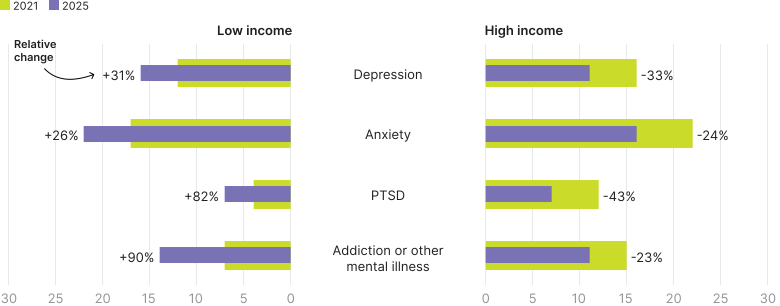
Question: “Are you currently being treated for a mental illness (i.e., depression, anxiety, PTSD, etc.), physical injury, chronic health condition, addiction, or terminal illness?”
Source: Oliver Wyman surveys, 4 countries, October 2021 (low income: N=978, high income: N=548); September 2025 (low income: N=536, high income: N=786)
Hope became a luxury good...
% respondents who expect dimensions to improve over the next 12 months
Overall well-being
%
%
Physical health
%
%
Emotional well-being
%
%
Personal relationships
%
%
Spiritual wellness
%
%
...and worsening outlooks became polarized
Compared to high-income respondents, low-income respondents are more likely to expect worsening:
2.6x
Family and social relationships
(12% versus 4%)
2.2x
Mental and emotional well-being
(17% versus 7%)
2.1x
Physical health
(16% versus 8%)
Note: Percentages in parentheses indicate low-income versus high-income respondents
Question: “How do you expect each of these will change over the next 12 months?”
Source: Oliver Wyman surveys, 10 countries, September 2025 (low income: N=1,423, high income: N=1,901)
The cultural contract between patients and healthcare systems has frayed. More than three in five people globally now say their health system is overstretched, and ratings of care quality have fallen 10 points since 2021, to 43%. When asked which sectors most need better-tailored products and services, healthcare sits at the top at 53% — above finance, fashion, and even technology. The diagnosis is clear: The system is ailing.
Into this vacuum steps AI. Sixty‑five percent of respondents say they have used AI for healthcare, making it one of the fastest-growing consumer uses of the technology. About half have already turned to AI for everyday health questions (55%) and specific conditions (47%), and more than a third for urgent health needs.
The second opinion is now an always-on companion — one that never sighs at your questions or makes you wait three weeks for an appointment.
The shift is especially pronounced among those who find traditional care confusing. In the US, that group is 1.6 times more likely to rely on AI, with about 80% already doing so. AI-enabled patients are 25% less likely to cite doctors as a source of information, and two to five times more likely to turn to blogs and influencers.
The result is a healthcare journey that resembles checking the weather: People triangulate across multiple sources, none authoritative enough on its own.
Overstretched systems and declining trust are healthcare’s volatile equation
[1] Data representative of US survey respondents
Sources: Ipsos Health Service Report 2024/2025, Oliver Wyman Forum surveys, 1 country (USA), November 2021 (N=273), January 2022 (N=720), and September 2025 (N=870)
Healthcare emerges as AI’s breakout use case
2025 compared with 2023
55%
27% relative change
Have used AI for daily health questions (e.g., diagnosing minor conditions)
47%
34%
Have used AI for specialized conditions (e.g., mental health, dermatology)
37%
24%
Have sought AI’s guidance on urgent health situations and serious ailments
Question: “For which of the following purposes have you already interacted with AI?”
Source: Oliver Wyman Forum surveys, 12 countries, August 2023 (N=10,831) and September 2025 (N=8,710)
This is not simply a matter of convenience. Years of staff shortages, long waits, and expectations shaped by on‑demand digital services have reset expectations. Pandora’s medical bag is open. Healthcare systems now need to design for patients who are both proactive and deferential, often simultaneously.
Businesses that win customers will treat them like partners rather than problems. They should build products that sit atop AI models and flag what is safe, dubious, or simply nonsense. They should translate online diagnosis searches into clear, coherent next steps. They should train clinicians to refine patient hypotheses rather than swat them away. Done well, this reduces complaints, boosts conversations, and creates loyalty that outlasts the next algorithm update.
AI-enabled patients are rewriting the care journey entirely
Respondents who use AI for healthcare versus those who don’t
2.3x
More likely to rely on social media for medical information (38% versus 16%)
4.4x
More likely to cite health influencers as a source of medical information (19% versus 4%)
2x
More likely to use an online symptom checker to determine treatment options (13% versus 6%)
36%
Less likely to interact with a primary care physician before going anywhere else (28% versus 43%)
25%
Less likely to cite doctors as a source of medical information (60% versus 81%)
Questions: “Assuming you had the following symptoms: low-grade fever, fatigue, sore throat, congestion, which of the following would you most likely do when seeking care? What sources do you use to get your medical information?”
Source: Oliver Wyman Forum survey, 16 countries, September 2025 (used AI for healthcare: N=6,475, not used AI for healthcare: N=4,188)
Across health and well-being sectors, consumers see room for improvement in tailored products and services
% respondents who say a sector has the greatest need for products and services tailored to their needs
Question: “In which areas do you feel there is the greatest need for products and services to be better tailored to your needs?”
Source: Oliver Wyman Forum survey, 16 countries, May 2025 (N=15,191)
Once an industry, wellness has become a lifestyle — if not a full-time job. The share of people who practice at least four wellness activities has risen from 22% to 30% since 2021, while the “I do nothing” crowd has shrunk from 15% to 4%. Health quantification through digital monitoring has nearly doubled to 21%. Proactive health monitoring has risen from 20% to 34%. Step counts, sleep scores, heart-rate variability — everything is monitored, logged, and, quite often, fretted over.
More than half of people now work out at home or in a gym, up 27% since 2021. And the data deluge has not scared them off: Willingness to trade health data for personalized insights has increased from 51% to 61%, even as three-quarters of people express fears about data misuse. Privacy anxiety is losing ground to the promise of a better sleep score.
Yet despite all of this monitoring and maintenance, we feel worse. Well-being sentiment has slipped four points since 2021 and now sits below peak-COVID levels. The share of people who describe themselves as mentally healthy peaked at 66% in early 2022 and has since fallen to 59%. Physical-health confidence has dropped from 62% to 56%.
Self-care goes mainstream as most people do more across the board
Relative % change in respondents citing methods to manage overall health and well-being, 2021 and 2025
Yet we’re feeling worse than ever
% respondents who consider themselves healthy, 2021-2025
Question: “Over the past two years, which of the following have you regularly done to manage your health and/or overall well-being?” “Select the statements that apply to you”
Source: Oliver Wyman Forum surveys, 4 countries, November 2021 (N=2,417), January 2022 (N=2,625), and September 2025 (N=3,504)
This is not just collective grumpiness. The global gap between lifespan and health span — the years spent in good health — widened from about 8.5 to 9.6 years between 2000 and 2019, according to the World Health Organization. In the US, UK, Australia, New Zealand, and Norway, this gap already hovers at 11 to 12 years, with the US at 12.4. This is closely associated with the rising burden of noncommunicable disease. We are living longer, yes. But we are spending more of those extra years feeling unwell.
Small fixes are losing their charm, so consumers are reaching for bigger levers. Interest in cosmetic procedures has climbed from 13% to 22%. Acceptance of psychedelics has surged to 42%, up 30% since 2021.
Healthcare’s longevity economy will define new business growth opportunities. After pandemic 44 booms in health tech and alternative care, funding is shifting toward the less-glamorous plumbing of health: provider operations, infrastructure, and systems that can turn scattered activity into integrated, outcome-focused care. The goal is to help clinicians, communities, and workplaces act on real-world health patterns rather than celebrate app engagement metrics that signify little.
The winners will design for long-term health, not short-term engagement. That could mean health plans that adjust premiums based on biomarker trends; retailers that turn loyalty programs into health-span programs; employer benefits that track flare-ups rather than logins; or digital tools that simplify a person’s well-being toolkit instead of multiplying it. Success will accrue to those that help people step off the treadmill of constant effort and actually feel better.
“I feel very fortunate to have the resources and the time to get the healthcare I need. I have less confidence that it’s as easy as it used to be, because I know how much the healthcare system and providers have struggled and how resources have thinned out.”
- Female, 31, United States
Community is becoming one of healthcare’s most undervalued pieces of infrastructure — perhaps because it feels too soft to quantify or too difficult to monetize. Yet the evidence is mounting. Gym attendance, diet shifts, screening uptake, and adherence to long-term medication all improve when there is a social element. Digital tools have now made these communities more visible and scalable. People build micro-communities around sleep scores, step streaks, meal plans, or specific conditions — and those spaces can carry as much weight as government health initiatives or corporate wellness programs. Sometimes more.
The share of respondents who say they maintain health and fitness routines more consistently as part of a community has risen from 52% to 61% since 2021. Those who encourage family and friends to be healthier have climbed from 18% to 33%. Gym and studio use is up from 21% to 36%, while home workouts have stayed broadly flat (34% to 38%). This suggests people want health to feel shared, not solitary. Roughly one in five respondents now rely on community for their own adherence and act as evangelists for others. This group has more than doubled in four years, to 22%.
Community is also where trust has migrated. People now turn to friends and family (40%) more than twice as often as government sources (17%). Social media is used twice as often as official channels (34% versus 17%).
The rise of the community champion
2025 compared with 2021
22%
105% relative change
are community champions, who report maintaining health routines within a community and encouraging others toward healthier habits
Community champions prove moving with others is a game changer
17%
More likely to report being physically healthy (65% versus 56%)
81%
More likely to cite that making decisions toward longevity is a priority (35% versus 20%)
36%
More likely to cite that they’ll continue to care about their health and fitness long term (58% versus 42%)
6%
More likely to report being mentally healthy (64% versus 61%)
Over the next 12 months, community champions are more likely to expect improvement in:
46%
Overall well-being
(53% versus 36%)
45%
Spiritual wellness
(49% versus 34%)
42%
Physical health
(52% versus 37%)
41%
Emotional well-being
(49% versus 35%)
Note: Percentages in parentheses indicate community champions versus the general population
Question: “How do you expect each of these will change over the next 12 months?”
Source: Oliver Wyman Forum surveys, 4 countries, November 2021 (community champions: N=265, general population: N=2,417), September 2025 (community champions: N=771, general population: N=3,504). Community champion 2025 profile: 13 countries, September 2025 (community champions: N=1,997, general population: N=10,663)
In a post-pandemic world marked by skepticism and fatigue, health has become one of the few languages that still bring people together — and community is where that language is spoken fluently.
For healthcare, consumer goods, technology, and public sector leaders, community is a strategic lever hiding in plain sight. Ignore it and you inherit higher acquisition costs, weaker adherence, and more volatility when a narrative turns against you — and it will. Use it wisely and you can design offerings that are easier to adopt together than alone, build community features that are transparent, give people tools to bring their own circles along, and measure success at the level of anonymized clusters rather than isolated individuals.
In a world where information is cheap and trust is scarce, the ability to convene and protect trusted health communities may become one of the most defensible assets any brand can build — and one of the few that reduce costs while deepening impact. Community is not a marketing add-on. It is becoming the infrastructure itself.
The global economy is recovering — just not for everyone. With investors becoming more DIY, more AI-driven, and more anxious, firms must decide whether this shift creates danger or opportunity.

Design for the bottom rung of the investing ladder before it disappears
-26%
Relative decrease in low-income consumers invested in 2025 compared with 2021; high-income investors grew 6% in the same period, to 71%
+52% vs. -32%
The K-shaped split in financial optimism. Between 2022 and 2025, high-income earners grew 52% more likely to say economic conditions would improve in the next six months; low-income earners became 32% less likely to say so
49%
Share of lower-income consumers who significantly adjusted their purchasing behavior in response to inflation in 2023, compared with only 32% of high-income consumers
Treat anxiety about financial independence as a product opportunity
+80%
Relative increase in people reporting “feeling pressure to make money in order to feel successful” between 2022 to 2025, more than doubling among low-income earners as well as boomers nearing retirement
+39%
Relative increase between 2022 and 2025 in Gen Zers feeling misunderstood about financial habits, now second among areas in which they feel most misjudged
No. 1
Rank of financial independence among skills people wish they’d learned more about growing up, the fastest growing of all needs measured, jumping from 32% to 41% between 2022 and 2025
Solve for today’s increasingly AI-enabled, hands-on investor
65%
Share of middle- to high-income earners globally who say they “can get better returns on their own than with a financial adviser,” a belief that grew 13% from 2021 to 2025
+30%
Relative increase in investors who say they are trading on cryptocurrency exchanges in 2025 compared with 2021; traditional brokerages saw a 14% decrease
55%
Share of Gen Zers who now cite social media as the top reason they got more into investing, over four times the proportion of boomers
Nearly 1 in 2
Frequency of people who used AI to help with investing in 2025, compared with one in three in 2023 (44% in 2025 versus 34% in 2023)
The mood has brightened on paper: Consumer confidence globally has climbed nearly three-quarters since 2022. But peel back the averages and a messier picture emerges. People at the top of the income ladder, buoyed by roaring markets and less battered by inflation, feel the world improving. Those at the bottom grow gloomier by the quarter. This isn’t a rising tide lifting all boats. It’s a bifurcated recovery where income largely determines whether a person is climbing or sinking.
Price shocks have split consumers into divergent camps. When inflation peaked in early 2023, nearly half of lower-income households radically changed their spending, compared with just a third of high earners.
At the same time, 70% of wealthier respondents still felt comfortable making major purchases over $1,000. Only 37% of low-income consumers say the same. For them, even basic consumption requires careful triage.
The investing ladder is losing its first rung. As lower-income households pulled back on spending and ran down their savings, their stock market participation collapsed from 38% in 2021 to 28% in 2025. Over that same time, high-income participation rose from 66% to 71%. What was once a shared path to long-term security now comes with an express lane for those who can afford the toll.
The timing could hardly be worse. Between 2022 and 2025, the S&P 500 surged nearly 45%, turning a $10,000 investment into nearly $14,500 — gains many poorer households missed entirely. Among those still in the market, resolve is hardening: 91% now say they’re in for the long haul, up from 80% in 2021. But that first rung — the entry point where savers either climb aboard or fall away — is splintering. Participation gaps today will become wealth gaps tomorrow.
Income shapes a widening confidence gap
% respondents who agree, 2022 and 2025
“My country is economically strong compared to other countries”
“Economic conditions will improve in the next six months”
Question: “Which of these statements do you agree with about the economy? How do you anticipate economic conditions will change in the next six months?”
Source: Oliver Wyman surveys, 4 countries, August 2022 (N=1,405), September 2025 (N=1,322)
Firms must navigate a splintering market. On the current arc, markets tilt further toward a well-heeled, trusting elite at the top and away from a shrinking, cash-strapped base.
A narrower investor pool means future revenue will come from fewer, already over-courted clients, with market swings tied even tighter to the whims of the wealthy. Yet firms can’t ignore the 28% of lower-income consumers who still invested while their peers fled. These are tomorrow’s core customers — if they can stay on the ladder. With valuations stretched, a sharp correction could eject new investors for years unless firms build safeguards against panic selling.
Access to investing is key to long-term confidence and economic outlook
% respondents who agree, 2021 and 2025
“I am involved with investing in the stock market”
“I intend to continue investing long-term” (among investors)
Source: Oliver Wyman surveys, 4 countries, October 2021 (N=2,059), September 2025 (N=1,322)
Investors are more likely to have a positive view of the economy than non-investors
% respondents who agree, 2025
Low income
High income
“My country is economically strong compared to other countries”
“Economic conditions will improve in the next 6 months”
Source: Oliver Wyman surveys, 13 countries, September 2025 (N=3,867)
The wealth divide is not inevitable. In fact, it’s economically ripe for disruption. For decades, good financial guidance was reserved for the rich — not because lower-income people were uninterested, but because it didn’t pay. Wealth managers provided white-glove service with teams of experts, demanded hefty minimums, and charged fees on those balances. Retail banks funneled resources toward large accounts. The math pushed financial institutions upmarket, not down.
AI is rewriting the calculus for financial advisers. Robo-advisers charge a fraction of traditional fees. Chatbots and AI assistants handle routine queries at scale, freeing human advisers for thornier cases. Personalization that once required expensive facetime can now be delivered algorithmically. What was once a high-touch, high-cost service is becoming a mass-market product. Lower-income consumers have suddenly become viable — and potentially attractive.
“Self-directed” now means “self-directed with AI.” Two-thirds of middle- and high-income investors now say they can beat financial advisers on their own. Adviser usage hasn’t collapsed — but the meaning of “on my own” has changed. In two years, the share of people using AI for investing has jumped by nearly a third, to 44%. Those confident they can outperform advisers are nearly 50% likelier to use AI for investing and financial planning. People haven’t rejected guidance. They simply want it from people and machines.
AI changes what advice feels like for the better. Investors are roughly 25% likelier to say AI makes them feel more supported and understood than a human adviser does. They’re nearly four times likelier to say AI helps align their personal values with a financial plan, and over four times likelier to say it brings deeper meaning to managing money. What emerges is people seeking something traditional advice often fails to deliver: a judgment-free space to learn at their own pace and test scenarios without embarrassment. AI offers coaching, not prescription.
Yet enthusiasm has its limits. Even as AI use has climbed, interest in letting AI invest automatically has fallen from 41% to 32%. Most see the technology as co-pilot, not autopilot.
AI use for investing has increased universally
% respondents who report using AI for investing, 2023 and 2025
High income
Middle income
Low income
Question: “For which of the following purposes have you already interacted with AI?”
Source: Oliver Wyman surveys, 12 countries, August 2023 (N=10,831), September 2025 (N=8,710)
Younger generations are primed for digital-first finance. Gen Z and millennials, raised in the feedback loops of social media, are particularly comfortable with digital-first money management. Fifty-five percent of Gen Z and 44% of millennials cite social media as the top reason they’re more engaged in investing. For them, AI-powered tools are simply extensions of how they already navigate life.
That openness shows in their platform choices. In 2021, traditional brokerages attracted 44% of investors while crypto exchanges claimed just 28%. By 2025, the gap has nearly vanished: Crypto exchanges stand at 36%, just behind traditional brokerages at 37%. People aren’t just diversifying. They are sampling — and AI is the sommelier.
AI use for financial planning and advice is soaring globally
% respondents who report using AI for financial planning and advice, 2023 and 2025
33%
Overall relative increase between 2023 and 2025
Question: “For which of the following purposes have you already interacted with AI?"
Source: Oliver Wyman surveys, 12 countries, August 2023 (N=10,831), September 2025 (N=8,710)
Firms must choose their target market. For traditional wealth managers, AI poses a strategic choice: Use it to reduce costs in serving existing clients — a defensive play protecting margins — or treat it as a way to make the market’s lower end economically attractive for the first time. Firms building best-in-class AI, combining public knowledge with curated internal research and chief investment officer insights, will be positioned to chase segments previously not worth the bother.
Three models are emerging for firms that get this right. Orchestrators help people see their full financial lives — bank accounts, debts, pensions, and investments — together in a single, clear view. Specialists do one job exceptionally well and plug into whatever else customers use, such as tools optimizing idle cash across accounts where the gap between 0% and 2% deposit rates compounds meaningfully over time. Companions provide emotional reassurance through the journey, not just cold analysis. The most valuable businesses will make it easier to combine investment vehicles, coordinate, and course correct.
These tools and models matter beyond finance. Employers find that financial stress walks through the door with their workforce. Anxious employees are more risk-averse and fixated on short-term cash over long‑term growth. Embedding AI-powered guidance into benefits can ease that anxiety while building loyalty. Fintechs serving adjacent needs — payroll, budgeting, lending — could become the trusted starting point for financial decisions, especially for younger users who may never enter a bank branch. Even retailers and gig platforms could use AI to help customers and workers smooth irregular income in ways traditional institutions never prioritized. The technology exists to meet people where they are. The question is whether organizations will deploy it that way.
How people invest: 2021 versus 2025
% investors
Question: “How do you do your investing?”
Source: Oliver Wyman surveys, 4 countries, October 2021 (investors: N=1,851), September 2025 (investors: N=1,725)
Crypto and apps gain ground as traditional brokerage use fractures by income
% respondents who report using financial systems, 2021 and 2025
Low income
Middle income
High income
Cryptocurrency exchange
Investing app
Traditional brokerage account
Financial adviser
Question: “How do you do your investing?”
Source: Oliver Wyman surveys, 4 countries, October 2021 (N=1,851), September 2025 (N=1,725)
Crypto is no longer fringe, but it is generational
% respondents who report using financial systems, 2021 and 2025
Gen Z
Millennials
Gen X
Boomers
Cryptocurrency exchange
Investing app
Traditional brokerage account
Financial adviser
Question: “How do you do your investing?”
Source: Oliver Wyman surveys, 4 countries, October 2021 (N=1,851), September 2025 (N=1,725)
“I feel fairly confident making financial decisions for myself, but any major things give me anxiety, or at least pause. Something like investing for retirement or buying a house feels overwhelming to try to understand.”
- Male, 28, Canada
Even as new tools and platforms proliferate, people across ages and incomes feel more anxious around money, not less. In 2022, 18% of people said they felt pressure to make money to feel successful. By 2025, that had climbed to 33%, with especially sharp rises among low earners and boomers nearing retirement.
Even the affluent feel the pinch. Middle- and high-income investors are likelier than before to say they got into investing or devoted more time to it because they needed extra income. Among Gen X and boomers, the share citing “another source of income” as a motive has risen by two-thirds since 2021, to 32%.
Financial independence is no longer an aspiration. It is a survival skill. Financial skills now rank as the most important capability people wish they’d built earlier, showing the largest increase of all “missing skills” in recent years. The share citing it has risen from 32% to 41% since 2022, with working boomers showing the sharpest jump, from 25% to 38%. For older workers, the worry often reflects a sense that time is running out and they need new skills to navigate an unfamiliar economy before retiring. For younger people, it looks more like conviction that the old script their elders followed — steady job, simple saving, maybe homeownership — won’t work for them.
Layered over this is a growing feeling of being misread, particularly among Gen Z. The share of this generation saying that others misunderstand how they handle money climbed to 33% in 2025 from 23% three years earlier.
Taken together, the numbers describe a specific kind of anxiety. People are putting more weight on money as a measure of success, believe they started too late, and fear they’re missing a better playbook others found earlier.
The sense of missed opportunity is itself an opportunity. These consumers may be anxious, but they’re highly engaged, not passive. That’s the hallmark of an underserved market.
Even affluent consumers are no longer secure with primary income alone
% investors who started investing more to generate another source of income, 2021 and 2025
High income
Middle income
Low income
Question: “What are some of the reasons why you started investing or spent more time investing/learning to invest?”
Source: Oliver Wyman surveys, 4 countries, October 2021 (N=1,851), September 2025 (N=1,725)
For financial providers, the opportunity is to help people design a basic plan — how to build a buffer, manage debt, save — rather than just hawking products. That means simple, adjustable pathways: If this is your starting point, here are the next two sensible moves. It also means building financial skills into the value proposition so people feel they’re learning to navigate shocks, not just being sold to. A good adviser, human or digital, often does something deceptively simple: confirm that a client’s modest plan is not just acceptable but right, even when markets lurch or headlines scream. Confidence, not complexity, is the product.
AI has created a rare opportunity in financial history: the ability to profitably serve millions of people who were previously difficult to reach. The bottom rung of the investing ladder doesn’t have to break. It can be rebuilt broader, sturdier, and more accessible than before. Whether that happens depends less on the technology — which is here — and more on whether institutions choose to design for the entire market, rather than the comfortable top of the K.
People increasingly feel they lack financial skills
Ranking of skills cited as not properly taught during upbringing
Question: “Select up to three skills that you feel would be helpful to have today, but you did not properly learn about during your upbringing”
Source: Oliver Wyman surveys, 4 countries, March 2022 (N=2,439), September 2025 (N=3,504)
“I think of investing as a very important part of achieving financial stability. It might be risky, but with knowledge and experience you can achieve good results. Investment has become an essential part of my life so that later, when I retire, I have a sufficient amount to live.”
- Female, 34, India
Personalized ads, feeds, and AI agents now put the world’s inventory at modern consumers’ fingertips. That abundance is raising satisfaction and shortening patience. The brands that win will not be the loudest, but the ones that feel right for each person.
By Amy Lasater-Wille and Amit Sabharwal

New product discovery channels have given consumers better tailored recommendations and more agency
+32%
Relative change since 2022 in consumers who say brands are creating products and services that meet their needs (33% in 2025 versus 25% in 2022)
59%
Share of consumers who now expect brands to remember preferences and past purchases for more personalization
No. 2
Rank of finding and purchasing new products among reasons people have used AI (62%), trailing only helping with work tasks (72%)
Loyalty is desired but not guaranteed
+27%
Relative increase in people using social media to research or find products, the fastest growing social media behavior since 2021, increasing from 24% to 31%
Loyalty is desired — but not guaranteed — in a world of shifting priorities
47%
Share of consumers who intend to stay loyal to brands they like, a 22% relative increase from 2022 (38%)
69%
Share of high-income consumers who say they would switch brands after a single poor experience (compared with 58% for lower income groups)
Loyalty is desired
41%
Share of high-income consumers who say they are less loyal because they now have more options available
Loyalty is desired
43%
Share of middle-income consumers who say they are less loyal because they are newly price conscious, the top reason given by this group — even surpassing lower-income consumers (35%) who may be more used to looking for deals
Compared with 2022, more consumers in 2025 said brands are genuinely meeting their needs (33% versus 25%). AI tools and social platforms have turned product search into a continuous background activity, and many people feel they are finally finding items that fit their lives rather than the other way around.
The rub for retailers? Higher satisfaction breeds higher expectations, creating a vicious cycle. Fifty-nine percent now expect brands to remember their preferences and past purchases.
Among wealthier households, that climbs to 69%. Even among low- and middle-income consumers, a majority now expects some form of tailored experience. Age, income, and personal interests are the filters that matter most.
Across generations, consumer needs are being met at a higher rate
Question: “Which of the following statements apply to you?”
Source: Oliver Wyman surveys, 4 countries, April 2022 (N=2,467), September 2025 (N=3,504)
Wanting personalized products doesn’t mean wanting personalized ads. Targeted advertising remains polarizing. Roughly 30% of middle- and higher-income consumers say they like discovering brands this way — a 30% jump since 2022 — and trust in personalized ads has crept up from 17% to 25%.
But this still leaves the majority of consumers distinctly unimpressed. “Too many ads” overall remains the top complaint about social media, cited by 45% of consumers in September 2025, virtually unchanged from 2021.
The difference is agency. Instead of passively relying on ads to deliver customized recommendations, consumers want a say in how those recommendations are made and delivered. Most consumers (69%) demand control over how much of their data is used for personalization. This desire for control spans generations even as expectations for personalization vary wildly by age.
Consumers are seizing the reins of personalization on their own, using AI and social media like prospectors panning for gold. Since 2021, researching and finding products has become social media’s fastest-growing use case, up 27% in four years.
Across generations, about 30% of people still rely on friends and family as their primary “recommendation engine,” but younger consumers have added creators, reviews, and niche communities to that circle.
AI has joined the same advisory council: 62% of consumers say they’ve used AI to find and purchase new products, making it the second most popular AI application after help with work. And before you dismiss this as just another Gen Z fad, consider that boomers’ use of AI for shopping (56%) trails Gen Z by a mere nine percentage points (65%). While social media usage shows dramatic generational chasms, AI has achieved something approaching democratic appeal.
For brands, the implications are clear: The best personalization may come from tools that let consumers brief the AI themselves. Just more than half of respondents told us they’d gladly use AI to curate personalized lists of products based on preferences they provide, a 16% increase from 2023. Being “found” through AI feels better when the consumer is the one asking the questions, not merely being followed around by retargeting. Same recommendations, different power dynamic — entirely different reception.
Personalization is important, but data control can’t be ignored
% respondents who agree
Source: Oliver Wyman surveys, 17 countries, November 2024 (N=16,600)
Word of mouth looks different for younger generations
% respondents who report using different sources to look for products tailored to their needs
Question: “Where have you looked for specialty products or services tailored to your needs?”
Source: Oliver Wyman surveys, 17 countries, November 2024 (N=16,600)
Once consumers find products they like, more say they’ll stick with them. The share who plan to keep buying from brands they like has climbed from 38% in 2022 to 47% in 2025. China is the exception: There, brand consistency has fallen from 39% to 32%, reflecting a hyper-competitive, promotion-driven market.
Still, macro conditions are reshuffling loyalties. Inflation, income inequality, and an explosion of choice have made loyalty more conditional everywhere. While 74% still cite quality as a brand’s most valuable attribute, affordability and availability often tip the decision at checkout. Among consumers who say they are less loyal than before, the leading explanation is newfound price sensitivity, especially among middle-income shoppers who are now hunting for deals. High-income consumers, by contrast, churn because they can: more options, more switching, and a 69% likelihood of walking away after a single bad experience.
Brands must pay attention to both trial and repeat purchase. Enticing a middle-income shopper into trying a product once is only half the job; keeping them means maintaining a clear value story over time. Winning and keeping affluent customers, meanwhile, demands flawless service, consistent quality, and swift recovery when something goes wrong. The margin for error is, in practice, zero.
The good news is that the same data and AI engines used for acquisition can also power retention. That is, if firms choose to point them at repeat purchase patterns, complaints, and signals of quiet drift, not just click-through rates.
A quarter of consumers say they have become less loyal to brands
% respondents
Question: “How do you feel your loyalty with brands has changed over the past five years?”
Source: Oliver Wyman surveys, 17 countries, May 2025 (N = 15,784)
Increased options and access to deals are top threats to brand loyalty
% respondents who say they have become less loyal to brands in the past five years
Question: “Why have you become less loyal to brands over the last five years?”
Source: Oliver Wyman surveys, 17 countries, May 2025 (N=4,226)
With this in mind, we’ve identified four consumer groups that exemplify this emerging landscape. These profiles are intentionally broad, but they illuminate trends in loyalty, personalization, and networking that will reverberate through the smaller segments that brands target going forward.
1. The consumers who will share with you — and for you
Gen Z “community influencers” (5% of our sample, 33% of Gen Z)
Why they matter: Gen Z already commands an estimated $2.7 trillion in global spending power and is projected to reach $74 trillion in income by 2040, according to a Bank of America Institute report. Within this cohort, a distinct slice functions as micro-influencers long before anyone gives them a brand deal. They happily trade data for relevance and then broadcast their verdicts to peers.
What they want: This group leans into personalization and technology even when it means surrendering some privacy. They are more comfortable with targeted ads, more willing to share information for better experiences, and more likely to let celebrity or athlete endorsements sway them — though not necessarily to buy the same brand every time. Their real influence lies in what they post: reviews, comments, and casual recommendations inside online communities.
This group trades data to get what they want...
24%
More likely to share personal data for a better website experience (56% versus 46%)
24%
More likely to use social media to research and find products to buy (35% versus 28%)
1.6x
More likely to trust personalized targeted ads (26% versus 16%)
… and promotes brands in return
43%
More likely to submit online reviews on favorite brands’ websites (49% versus 34%)
1.9x
More likely to join online communities discussing favorite brands (48% versus 25%)
All profiles are compared with the general population sample
What it means for brands: Pleasing this group is straightforward: Give them exactly what they want. If you understand them, they’ll talk to you. Brands should use data to deliver precise, genuinely useful recommendations, not generic “people like you” noise — and then make it easy for these consumers to share their experiences. The goal is not just a sale, but an unpaid ambassador.
2. The consumers who might leave you
Affluent middle-aged switchers (3% of sample, 60% of 50- to 65-year-old high earners)
Why they matter: Affluent adults aged 50-plus already account for 42% of global consumer spending, making their satisfaction non-negotiable for any brand serving them. But this group is exacting. Three in five say one bad experience is enough to walk away. They are both a lucrative growth pool and an early-warning system for sloppy execution.
What they want: These consumers swiftly drop brands that don’t meet their needs or their standards for product quality and service. They are wary of indiscriminate data sharing but surprisingly open to AI for shopping when they control what is revealed. They blend digital and physical verification: checking official websites, reading detailed descriptions, and, where possible, seeing or trying products in person.
This group exits quickly after disappointment…
60%
Of high earners ages 50 to 65 will switch brands after a single poor experience
14%
Among likely switchers, 14% more prioritize quality over price (63% versus 55%)
12%
More insist on controlling how brands use their data (73% versus 65%)
… and they trust a hybrid approach
60%
Have used AI for finding and purchasing new products
16%
Likely switchers are 16% more probable to visit official websites for product research (74% versus 64%) but are 25% less likely to trust information companies put out about themselves
16%
More likely to value seeing, touching, and trying products before purchasing (80% versus 69%)
All profiles are compared with the general population sample
What it means for brands: To win this segment, brands must combine rock-solid execution with visible safeguards. AI-enabled journeys should be transparent, conservative with data, and backed by human support that can recover quickly when something goes wrong. The test is simple: Would a skeptical, well-informed customer still feel they made the right choice after a slipup?
3. The consumers who want to find you
Frequent AI users[2] (14% of population)
[2] Daily AI usage at work, have used AI for finding and purchasing new products, and have used AI for online shopping customer service
Why they matter: This group is the vanguard of AI-enabled consumption. Their numbers have grown by 72% since 2023. They ask chatbots for personal advice; use AI to curate what they buy, watch, and visit; and are vocal about brands they like. They also tend to worry less about affordability and more about convenience and experience.
What they want: Frequent AI users want to feel like part of the conversation. It’s more important to them that brands value their opinions, and they are more inclined to discuss brands online. They like learning about brands from personalized ads and behave as if every purchase decision comes with a research assistant and personal shopper, and it has given them greater satisfaction and trust in brands than the average consumer.
1.6x
More likely to seek personal advice from chatbots (38% versus 23%)
41%
More likely to trust social media (61% versus 43%) and 64% more likely to trust personalized ads (27% versus 16%)
68%
More likely to regularly comment on favorite brands’ social media communities (40% versus 24%)
56%
More likely to tag favorite brands on social media (50% versus 32%)
52%
More likely to submit online reviews for favorite brands (52% versus 34%)
39%
More likely to think it’s important that brands they purchase from value their opinions about global issues (34% versus 24%)
What it means for brands: Brands can use this group as a test bed for new AI-driven experiences — conversational discovery, adaptive offers, co-created content — and count on them to amplify what works. As with Gen Z community influencers, the goal is not only to satisfy them, but to enlist them.
4. The consumers who still aren’t satisfied
China’s middle class
Why they matter: Middle-income Chinese consumers represent enormous spending power. Yet they’re 54% less likely to say brands meet their specific needs, despite openness to personalization and digital discovery channels. This disconnect is critical because the population is massive, representing a tremendous opportunity for brands that can navigate a distinct cultural context. With more than 400 million Chinese middle-income consumers, 47% of Chinese retail sales already happening through e-commerce (versus 16% in the US), and “instant commerce” growing more than three times faster than total e-commerce, global brands must flex to meet diverse consumer needs in a digitally enabled market.
How they’re different: This group behaves differently from their peers in other surveyed countries. They’re less inclined to keep buying from a brand once they like it and place unusually high weight on product availability and a brand’s “cool” factor. Their discovery process differs, too: They trust personalized ads at nearly double the global rate, and feel less in control of their data once it’s shared.
34%
Less likely to keep buying brands they like long-term (31% versus 46%)
2.2x
More likely to cite product availability as a top brand attribute (51% versus 39% for general population) and 32% more likely to value the “cool” factor (38% versus 17%)
96%
More likely to trust personalized ads (32% versus 16%)
38%
More likely to feel little to no control over personal data once shared (86% versus 62%)
What it means for brands: Here, the pipes of personalization are fully installed, but the payoff is not. Heavy AI use and sophisticated social commerce have not translated into higher satisfaction. Global brands will need to go beyond “right customer, right channel” and focus on “right product, right feeling” — matching local tastes, availability expectations, and status cues, not just targeting models.
Winning the consumer of the future means offering tailored products and appealing ways to find them. The post-COVID, AI driven marketplace is crowded but far from closed. Consumers are juggling price pressures and information overload, yet they remain keen to find products that consistently work for them — and are increasingly willing to share both data and opinions that make that search easier.
The leading edge — frequent AI users and Gen Z community influencers — points to where the mainstream is heading: more comfort with sharing, more reliance on AI-enabled recommendations, and a continuing need for human-driven social proof. The older, wealthier cohort, meanwhile, shows that even AI-literate consumers want multiple modes of interaction and have zero tolerance for sloppy experiences. And China reminds us that technical sophistication is not a shortcut to genuine fit or loyalty.
The lesson: Personalization is necessary but not sufficient. To win the next generation of consumers, brands must decide which segments they truly serve, design journeys that let those customers feel in control, and deliver products that match real, local needs. AI can help people find you. Only relevance, reliability, and the occasional moment of delight will persuade them to stay.
“Increasingly I use an AI chatbot to help me make purchase decisions, in combination with my own experiences and online reviews. I want to ‘buy once and buy well’ with the limited funds that I have.”
- Female, 59, Canada
The workforce that limped out of the Great Resignation stayed put — but quietly stopped believing. Now, a potent mix of fading fulfillment, frantic upskilling, and generational friction is changing what organizations must do to sustain their performance.
By Ana Kreacic, Ravin Jesuthasan, and Simon Luong

Lean on workforce fulfillment
2nd
Fulfillment’s rank as a workplace necessity, rising from 8th place in 2023; it’s now tied with work-life balance, just behind pay
Near 0%
Increase in employees quitting due to lack of fulfillment since 2023, compared with increases in those leaving for career advancement (+24%) and pay (+15%)
26%
Share of employees who say they are fulfilled, but this cohort is significantly more likely to feel valued, believe they can build a career at the company, and feel confident in senior leadership
A skills-based organization gives employees the development they want
97%
Share of investors who say their investment in an organization would be negatively impacted if the organization had a less progressive approach to agile, skills-based models
85%
Share of employers that reported using skills-based hiring in 2025, up from 57% in 2022 — marking a structural shift toward work defined by capability, not credentials
+98%
Relative increase in employees citing access to training as the best way to improve their work experience — marking the steepest rise of any factor since 2021 and outpacing better work-life balance (+19%) and greater interaction with leadership (+74%)
Reset your views and double down on Gen Z
+79%
Relative increase since 2022 in Gen Z respondents saying that working long hours is a necessary trade-off for financial security — outpacing millennials by more than two times and Gen X by six times
Nearly 75%
Share of Gen Zers who are satisfied with their jobs; their satisfaction levels now match millennials’ and exceed those of Gen X and boomers
For all the talk about AI, automation, and agile talent models, the quiet force reshaping the workplace is more human: People want to feel fulfilled. Not indulged, not coddled — but fulfilled by their role in a company with a mission they believe in.
Work, they say, should add up to something more than a paycheck and dental plan. When that sense of meaning is missing, productivity falters just as surely as when systems crash or a strategy goes sideways.
Since 2023, lack of fulfillment has surged from a muted frustration to the second-most-cited workplace complaint behind compensation. No other sentiment has moved as far or as fast. Fewer than half of employees say they feel fulfilled at work. Leaders are rightly focused on AI as a powerful performance engine, but fulfillment is the fuel that keeps workers engaged, willing to adapt, and productive.
Curiously, this dissatisfaction hasn’t produced a stampede for the exits. Employees frequently cite lack of fulfillment, but it barely changed their stated reason for quitting between 2023 and 2025, rising only from 21% to 22%. Instead, employees were more likely to leave for career growth or for higher pay. The pattern suggests a quiet tension: Fulfillment is fading, but many employees no longer believe switching jobs will provide more satisfaction. Why jump when the landing looks just as uncertain?
There are a few reasons behind this. Many employees may be prioritizing stability or searching for meaning outside of work. Others may suspect that changing employers will merely swap one set of frustrations for another, especially in an uncertain economy shaped by technological disruptions. Some could simply be stuck, hemmed in by mortgages, caregiving duties, or inertia from years invested in a role.
For employers, the danger is not that unfulfilled employees will leave. The real risk is that they stay — grinding out uninspired work and dragging down their colleagues while contributing none of the creativity or energy that powers successful companies.
The data are stark. Fulfilled employees are more than twice as likely to believe they can build a meaningful career at their company (50% versus 24%) and to feel that their input is genuinely valued (46% versus 22%). They are twice as likely to feel they are gaining needed skills (60% versus 31%) and that their strengths are being used (48% versus 25%).
The effect extends to how they see the organization: Fulfilled workers are 67% to 91% more likely to understand the company vision, believe in its future, and trust senior leadership. Even retention reflects the divide: 69% plan to stay, compared with 56% of the broader population. Across every dimension, fulfilled employees operate in what amounts to a different workplace. Same org chart, same tools, entirely different experiences.
A lack of purpose is the fastest-rising workplace complaint
Question: “What are your top five areas of dissatisfaction at your current job?”
Source: Oliver Wyman surveys, 4 countries, February 2023 (N=1,701), September 2025 (N=3,504)
Fulfillment creates a better kind of employee
% respondents who agree
Fulfilled employees are more anchored and valued...
...more able to grow and do their best work...
...and more aligned with where the company is going and who is steering it
Question: “Indicate your level of agreement with the following statements”
Source: Oliver Wyman surveys, 4 countries, September 2025 (fulfilled employees: N=928, general employee population: N=3,504)
“I think it’s really hard to find fulfillment at work for me, but I have a new mindset where this is no longer number one in my priorities. I think my fulfillment, I found it outside of work.”
- Female, 38, United States
A third of employees say access to training would most improve their work experience — a 98% leap since 2021 and the steepest rise of any workplace priority we track. Training has vaulted from seventh to fourth in the ranking of workplace needs, a sign that capability-building has become the closest thing modern employment has to job security.
Workers know that AI is about to reshape jobs at warp speed. In just three years, a third of the skills required for the average job have changed, according to Lightcast. For the most disrupted roles, that figure reaches three-quarters. After years of economic whiplash and technological upheaval, workers are prioritizing improving AI skills, which will set them up for long-term success. They see which skills are rising in value, and it’s often faster than formal development systems can adjust.
The appetite isn’t limited to the young or the restless. Interest in training now clusters between 27% and 34% across all age groups. Gen X enthusiasm has doubled, and boomers’ more than tripled, rising from just 8% in 2021 to 27% today. The message is clear: Everyone sees the skills economy arriving. Not everyone sees their employer arriving with it.
Employers are rebuilding around capability, but unevenly. Organizations have started to rewire how they find and match talent. Skills-based hiring has surged from 57% of companies in 2022 to 85% in 2025. Internal talent marketplaces are going mainstream: Gartner forecasts about 35% of large enterprises will have one by 2027.
Training is employees’ fastest-growing workplace need
Ranked, across workplace factors, 2021 and 2025
Question: “What, if anything, could make your working experience better?”
Source: Oliver Wyman surveys, 4 countries, October 2021 (N=809), September 2025 (N=3,504)
Interest in training now spans all generations, led by late-career surges
% employees who say training to develop further skills would most improve their work experience, 2021 and 2025
Gen Z
Millennials
Gen X
Boomers
Question: “What, if anything, could make your work experience better?”
Source: Oliver Wyman Forum surveys, 4 countries, October 2021 (N=809) and September 2025 (N=3,504)
Workers want to grow but organizations are not delivering
% respondents who want to receive training to develop skills versus the training they currently receive from employers
Lack of skills training that employees want
No gap
Abundance of skills training that employees don't want
Questions: “What areas of types of skills does your employer offer training in?” “What areas or types of skills would you like to receive training in?”
Source: Oliver Wyman Forum surveys, 16 countries, July 2024 (N=16,210)
But the infrastructure that develops and deploys skills hasn’t kept pace. Only a quarter of employees say they have access to learning opportunities and time to develop new skills, and access falls with age: 28% for Gen Z but just 17% for boomers. The same barriers that slow learning also prevent employers from using the talent they already have. Only 27% of employees feel their current skills are fully used — less a gap than a quiet indictment of organizational design.
The skills employees want most — cross-functional, data literacy, and leadership — are exactly where training is lacking. Cross-functional programs trail interest by 12 percentage points; leadership and management trails by nearly 10. Meanwhile, compliance, health and safety, and customer-service programs remain the staple diet: popular with legal departments and regulators, but not with workers.
For those gaining the right skills, the difference is striking. Only about a third of employees are confident they are getting the skills they need, but those that do 300,000 Voices are far more assured and engaged. Their job satisfaction has held steady between 88% to 90% since 2021, while the general population has swung between 68% and 71%. Trained employees also are nearly twice as likely to feel that their strengths are used, far more likely to enjoy their work, and report better relationships with colleagues and managers.
For leaders, the pattern is hard to miss. Workers across every generation now see training as one of the most important improvements to their work experience. At the same time, access to meaningful development remains patchy and training is skewed toward the familiar rather than the necessary. Most employees feel their existing capabilities are underutilized.
Mercer’s 2026 Global Talent Trends study shows that leaders recognize this in principle: 63% of executives agree they need to move toward skills-powered talent practices to ready their organization for the future, yet only 50% of C-suite leaders say they are investing enough today to close the skills gaps they expect to face.
The firms that pull ahead will treat skills as the backbone of how work is designed, staffed, and rewarded. They will help employees see future opportunities and chart the skills those roles demand. And they will measure managers not only on delivery but how effectively they grow and deploy their teams. Investors have already priced this in: Mercer’s 2026 Global Talent Trends study finds that 97% of investors say their view of a firm dims when its approach to agile, skills-based models falls short.
In a labor market where work tasks change faster than job descriptions — and where AI accelerates every shift — the skills-based organization is no longer an aspiration. It is the operating model for survival.
Continuous learning drives satisfaction and workplace benefits
% respondents who agree
Gain skills, gain benefits in the workplace
% respondents who agreeQuestion: “Rate your level of agreement across each of these dimensions”
Source: Oliver Wyman Forum surveys, 4 countries, September 2025 (general population: N=3,504, employees who fee like they are getting the skills they need to grow: N=1,074)
“The world is changing. I have worked in the digital space for decades and the job is different every six months. You need to adapt to new trends, learn new things, and stay on top of your career.”
- Female, 59, Canada
For years, employers have eyed Gen Z with the suspicion usually reserved for cryptocurrencies and EVs: promising, perhaps, but likely to disappoint. Concerns about work ethic and professionalism became a kind of managerial folklore. Yet the numbers tell a different tale. Gen Z is quietly becoming one of the most engaged, adaptable, and strategically useful cohorts in the modern workforce. By 2034, millennials, Gen Z, and the first Gen Alphas will make up about 80% of the workforce in advanced economies, according to the World Economic Forum. The generation many employers fret about will soon become one they can’t function without.
Their rocky start was real enough. In 2021, Gen Z trailed older cohorts in nearly every measure: Only half liked their managers, barely more liked their colleagues, and enjoyment of their work lagged sharply. The reputation for disengagement reflected something real.
But what began as a slow thaw has turned into a full reversal. Nearly three in four are satisfied at work, matching millennials and exceeding Gen X and boomers. Much of this improvement stems from better relationships: Their approval of managers has soared by 31%, and approval of colleagues, culture, and compensation follow the same upward path.
Their confidence in employers has strengthened, too. Understanding of company vision among Gen Z has risen from 49% to 65%, and now exceeds that of Gen X and boomers. A cohort that started at the back of the pack now sits at parity — or ahead — on the measures that matter.
Gen Z will become the dominant force for change in the next decade
% of workforce, 1970-2040
Source: Pew Research, Visual Capitalist, US Department of Labor, Oliver Wyman Forum analysis
From 2021 to 2025, Gen Z has undergone a great workplace comeback
% respondents who agree, 2021 and 2025
More connected to people
“I like the colleagues I work with”
“I like my managerˮ
More aligned with culture and purpose
“I like my companyʼs culture”
“I understand my companyʼs vision and goals”
More energized about work
“I enjoy the work I doˮ
work
“I feel fulfilled at workˮ
More satisfied with the fundamentals
“I go to the office to be productive“
“The pay is satisfactory/above satisfactory“
Question: “Rate your level of agreement across each of these dimensions”
Note: Data for “I understand my company’s vision and goals” are from 2023 rather than 2021. Agreement defined as selecting the top 2 points on an agreement scale
Source: Oliver Wyman surveys, 4 countries, October 2021 (N=3,524), February 2023 (N=3,184), September 2025 (N=3,504)
Confidence in employers grows alongside long-term career aspirations
% respondents who agree, 2024 and 2025
Gen Z
Understanding of company vision
Believes they can build a meaningful career
Millennials
Understanding of company vision
Believes they can build a meaningful career
Gen X
Understanding of company vision
Believes they can build a meaningful career
Boomers
Understanding of company vision
Believes they can build a meaningful career
Question: “Rate your level of agreement across each of these dimensions”
Note: Agreement defined as selecting the top 3 points on an agreement scale
Source: Oliver Wyman surveys, 4 countries, April 2024 (N=2,973), September 2025 (N=3,504)
In 2022, nearly half of Gen Zers in the US and UK had a side hustle. That has fallen from 44% to 38%, marking the largest percentage point drop of any cohort. The hustle did not die, though. It just moved in-house. A generation that taught itself to build audiences, manage projects, and solve problems on the fly is now applying those instincts inside organizations. In an economy where volatility is the default, these instincts are less a quirk than an asset.
Gen Z is also adapting to AI faster than anyone else. The cohort entered the workforce just as the technology moved from concept to daily tool. They remain the most anxious about automation: 68% express concern, compared with 60% of millennials, 47% of Gen X, and 37% of boomers. But that anxiety appears to be fueling action rather than retreat.
The share of Gen Z developing automation-resistant skills rose 21% to 44% in 2025, the largest percentage point increase of any generation. Almost half of Gen Zers report that AI has changed the caliber 100 or type of work expected from them, and they are more likely than any other cohort to job-hunt in response to AI disruption. That willingness to adapt is producing results: Nearly two-thirds say AI has improved their productivity, and they are the most open to AI collaboration, with 37% saying they would prefer an AI colleague or manager over a human.
For organizations, Gen Z now sits at the crossroads of the three forces reshaping modern work: fulfillment, skills, and AI. They’ve become one of the most satisfied cohorts — applying their entrepreneurial instincts and AI skills to become more productive.
Organizations that harness this momentum will gain a cohort that is more engaged and adaptable, and more likely to stay than the stereotypes suggest. Those that cling to old stereotypes will misread one of the clearest signals in the labor market. The youngest workers are not the problem. Increasingly, they are the early warning system — and your competitive edge.
From hustlers to harmonizers
% respondents, 2022 and 2025
Gen Z
Job seekers
Side hustlers
Millennials
Job seekers
Side hustlers
Gen X
Job seekers
Side hustlers
Boomers
Job seekers
Side hustlers
Questions: “Which of the following describes your current situation? How do you earn money?”
Source: Oliver Wyman Forum surveys, US & UK, November 2022 (N=3,982) and September 2025 (N=1,742)
AI is producing miracles in proof-of-concept experiments — but disappointed shrugs in the productivity data. This paradox isn’t a mystery; it’s what happens when your new recruit reasons, learns, and evolves faster than the organization trying to onboard it.
By Jad Haddad, Ana Kreacic, Michael Zeltkevic, and Simon Luong

Build the organizational muscles to ride up the J-curve
+65%
Relative increase from 2023 to 2025 in the share of Gen Z using AI at least three times a week at work (58% in 2025, three times the level of boomers), the steepest jump among all generations
45%
Share of boomers who no longer use AI at work in 2025, up 30% from 2023, making them the most likely generation to opt out
1.7x
Increased likelihood of Gen Z participating in AI training versus boomers
Be prepared
2.2x
Increased likelihood for Gen Z to report productivity gains from company training on AI relative to boomers
Be prepared to manage the first workforce that isn’t fully human
46%
Share of power AI users[3] who are learning prompt engineering, the top techniques for optimizing efficiency when working with AI; 40% refine outputs through iterative feedback
67%
Share of global respondents in 2025 who interact with AI in “human-like” ways
We are living
2.4x
Margin by which Gen Z is more likely than boomers to prefer an AI colleague/ manager over a human one in 2025 (37% versus 15%)
We are living at the bottom of AI’s “productivity J-curve”
<5%
Share of organizations reporting meaningful ROI[4] from AI in 2025, despite 97% of organizations viewing AI as a strategic lever
3x
Margin by which heavy AI users were more likely than non-users to be actively searching for new jobs in 2025
[3] Workers who use AI daily at work and report productivity gain from it
[4] Defined as a 20%+ impact on revenue generation or cost savings
AI’s early impact looks suspiciously familiar. Tasks finish faster, quality improves, entry-level workers’ productivity is soaring — and yet, in the aggregate, productivity refuses to take the hint. Economists call this the productivity J-curve, the awkward period when a general-purpose technology demands huge investment long before it delivers broad returns. Electricity went through it, and so did personal computing. In the latter, organizations made big investments in computer hardware, software, data, training, and process redesign, but the benefits appeared only later. Nobel economist Robert Solow’s famous 1980s quip — “You can see the computer age everywhere but in the productivity statistics” — fits uncomfortably well with AI.
Small-scale experiments already show real gains. Macro-level impact remains nearly invisible. Customer-service workers using AI assistants are more productive; software developers write faster; lower-skilled workers close performance gaps in weeks. Yet productivity growth in many advanced economies remains subdued, and most firms report little to no profit from AI spending.
AI is in the build-up phase of the productivity J-curve (illustrative)
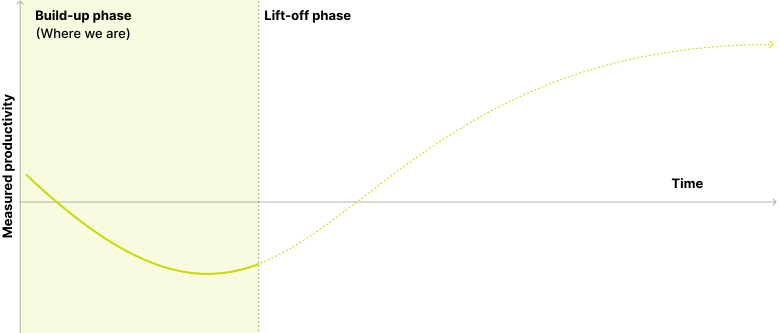
Source: Oliver Wyman Forum analysis
Recent research has shown that junior workers tend to experience higher productivity gains from AI
+14%

Increase in average productivity for customer support agents with AI assistant compared to those without

+34%
Increase in average productivity for less experienced workers
Minimal
Productivity improvement for experienced workers
+26%
Increase in output for software developers with AI tools compared to those without
Up to
+39%
Increase in output for junior software developers (between 27% and 39%)
Up to
+13%
Increase in output for senior software developers (between 8% and 13%)
Source: Erik Brynjolfsson, Danielle Li, and Lindsey R. Raymond, “Generative AI at Work,” NBER Working Paper 31161 (2023); Zheyuan Cui and Mert Demirer et al., “The Effects of Generative AI on High-Skilled Work: Evidence from Three Field Experiments with Software Developers,” MIT (2025)
What makes this wave different is that organizations are chasing a moving target. Utilities didn’t release a new version of electricity every quarter. AI does. According to Stanford’s 2025 AI Index report, AI performance surged 19 to 67 percentage points across key benchmarks in a year. And unlike past technologies, this one is radically accessible. A startup in Hangzhou or student in São Paulo can use the same frontier models as a Fortune 500 company. China’s DeepSeek, which matched Western benchmarks at a fraction of the computing cost, proves the point.
This explains the disconnect we see. At the top of the house, enthusiasm is high. Ninety-seven percent of executives recognize AI’s value. But on the ground, the mood is foggier. New tools are loosely bolted onto old workflows, data still live in silos, and workers struggle with the three questions that govern adoption: Where does AI actually touch their job? What does good look like in practice? And what happens if they get it wrong? That asymmetry explains why 35% of leaders believe their company has a clear AI vision — but only 5% of frontline workers agree. And almost no one reports enterprise-level return on investment.
The promise of AI is clear at the top, but opaque on the ground
At the top
97%
of executives report their company recognizes the value of AI and uses it as a strategic lever
35%
of executives agree that their company has articulated a clear AI vision and kept employees informed on progress
On the ground
<5%
of respondents report their company achieves significant ROI from AI investment
5%
of frontline staff agree that their company has articulated a clear AI vision and kept employees informed on progress
Source: Oliver Wyman 2024 Performance Transformation Global Executive Survey; Oliver Wyman Forum x NYSE CEO Survey 2025 (165 NYSE-listed CEOs); Oliver Wyman Forum survey, 16 countries, May 2025 (N=10,408)
“Most people who use AI do it for themselves, outside of the work pipeline. It speeds up my programming immensely. But because I use it, my programming skills have not improved.”
- Male, 45, Australia
The J-curve is already dividing organizations into climbers and onlookers. Firms that spent the past decade with modern infrastructure, clean data, reengineered workflows, and AI-fluent workforces will hit the inflection point early. Those tangled in legacy systems, manual workarounds, and unprepared workers will find that AI adds noise faster than it adds results.
The workforce is split, too. For younger workers, asking AI to draft and summarize is as natural as opening a browser tab. Younger workers are also 1.7 times likelier to attend AI training, twice as likely to report skill gains, 2.3 times more likely to say AI improves their output, and three times likelier to claim work-life balance improvement from AI. While frequent use has surged 65% among Gen Z since 2023, 45% of boomers have stopped using AI at work altogether. For many older workers, AI’s benefits are harder to leverage.
The divergence is not just a skills issue — it’s a loyalty issue. Heavy AI users do not wait for employers to catch up. They leave. Workers using AI at least three times weekly are three times likelier to be job-hunting. Even within Gen Z, heavy AI users are nearly twice as likely to be searching. This creates a brutal dynamic.
Climbers and onlookers have diverging paths on the J-curve (Illustrative)
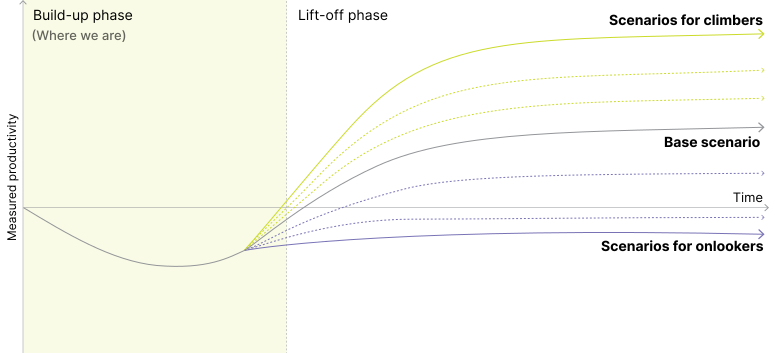
Source: Oliver Wyman Forum analysis
Gen Z is intensifying AI adoption at work, while boomers are opting out
Heavy AI users (more than 3 times a week)
% respondents
Non-users
% respondents
Question: “How often are you using AI in your current job?”
Source: Oliver Wyman Forum surveys, 16 countries, August 2023 (N=14,519), May 2025 (N=14,826)
Every month a company dithers increases the odds that the people who could help it climb the J-curve will climb it elsewhere.
The workforce split is also organizational. Software-native companies are sprinting ahead — rapid iteration, cheap experiments, compounding learning. Physically anchored industries such as hospitality, healthcare, and logistics harbor a dangerous illusion: that because they automate later, they can prepare later. They cannot. Integrating AI into a warehouse or hospital requires not just code but robotics, safety protocols, workflow redesign, and infrastructure upgrades. Firms delaying today will discover that when automation finally becomes affordable, they lack both the systems and the workforce ready to use it.
Compared to boomers, Gen Zers are...
1.7x
More likely to participate in company AI training (85% versus 50%)
2.2x
More likely to report proficiency gain from company training (51% versus 23%)
2.3x
More likely to report productivity gain from AI (63% versus 27%)
3x
More likely to report work-life balance improvement from AI (61% versus 20%)
Source: Oliver Wyman Forum survey, 16 countries, July 2024 (N=15,795), May 2025 (N=14,813)
The best AI users are your biggest flight risk
% respondents
Actively seeking new jobs
[5] Employees who use AI at least 3 times a week at work
Question: “How often are you using AI in your current job?”
Source: Oliver Wyman Forum survey, 16 countries, May 2025 (overall: N=15,191, Gen Z: N=2,517)
“It’s not that anyone tells us we should use AI. For me, I just want to stay on top of it. I want to make sure I use it well, prompt it well, and keep up with the trends and updates.”
- Male, 21, United States
Steam engines had no judgment; the early internet didn’t learn from every click. AI does both. For the first time, the core technology in a transformation wave is an adaptive system that can mimic reasoning, absorb feedback, and continuously update. That changes what “workforce” means. Leaders aren’t designing for humans plus tools; they’re designing for humans, software agents, and robots that share tasks, decisions, and sometimes accountability. As Salesforce’s Marc Benioff put it, “We are the last generation to manage only humans.”
Inside organizations, workers already manage AI the same way they manage interns. They set context, define good output, critique drafts, and push for better versions. Many advanced users practice a form of informal “AI management” — helping a system perform without ever fully controlling it.
Not everyone likes the “intelligent coworker” framing. Linguist Emily M. Bender warns that large language models are sophisticated pattern matchers, not reasoners, and can reproduce bias at scale.
Nobel physicist Geoffrey Hinton, who pioneered the neural networks that power generative AI, warns advanced AI systems will excel at manipulation after “reading all the novels that ever were and everything Machiavelli ever wrote.”
Prompting and feedback loops lead employees’ list of AI productivity optimizers
[6] Power AI users are defined as those who use AI daily and report that AI has increased their productivity
Question: “What strategies have you used to increase your productivity? How often are you using AI in your current work? How has AI impacted your productivity?”
Source: Oliver Wyman Forum survey, 16 countries, August 2023 (N=1,642)
Fair. But metaphysics is losing to psychology. Two-thirds of employees already interact with AI in “human-like” ways, such as expressing concern for the chatbot or asking about its day, and among Gen Z the number climbs to 85%. More startling: 37% of Gen Z would prefer an AI coworker — or even manager — in some situations, versus 15% of boomers. That perception, even if hyperbolic, is what leaders now must manage.
AI’s encroachment into daily life makes this clearer. In shopping, the time is approaching when you can point at someone’s shoes, say “I want those,” and have them appear at your doorstep. Already, 62% of consumers use AI to find or evaluate products. Morgan Stanley predicts nearly half of US online shoppers will use AI agents by 2030. Brands must now persuade both the human and the machine.
Workers are humanizing AI
2 in 3
Share of workers who treat AI as “human-like” (67%); the figure is highest among Gen Z (85%)
Some even prefer AI colleagues over human ones
2.9x
Increased likelihood those with extensive AI trainings (47%) are to prefer an AI colleague or manager compared to those without trainings (16%)
2.4x
Increased likelihood Gen Z (37%) to prefer an AI colleague or manager compared with boomers (15%)
Questions: “Do you agree or disagree with the following statements? I would rather have an AI colleague/manager rather than a human colleague/manager,” “Have you received any AI-related training from your employer?” “How has AI impacted your productivity?”
Source: Oliver Wyman Forum survey, 16 countries, May 2025 (N=15,191)
Robotics pulls the transformation into physical space. In warehouses, factories, hospitals, and labs, AI-enabled robots are moving from pilot to deployment. Humans will increasingly supervise fleets of robots alongside teams of people, with software agents choreographing the flow between them.
The critical question for leaders is no longer “What can AI automate?” It’s “What should humans, agents, and robots do together?” For each part of the value chain, leaders must decide which tasks machines handle end-to-end, which are shared, and which are shielded from automation.
They’ll need new governance clarifying roles when part of the team isn’t human: Who’s accountable when an agent errs? How do we maintain transparency when systems can’t explain themselves? How are AI-driven gains shared with people whose work and data enabled them?
Viewed this way, the J-curve is about how quickly leaders redesign the architecture of work. Organizations that climb fastest will treat AI not as a tooling upgrade, but as a chance to reimagine how value is created, how teams function, and what it means to lead in a workforce that’s no longer only human.
“AI hasn’t replaced my thinking, but it has become part of my workflow. It helps me break down complex tasks, improve the quality of my work, and explore options that would take much longer on my own.”
- Male, 46, Spain
Leadership has always been hard. What’s different now is that leaders must navigate constant geopolitical shocks, AI disruption, and unusual levels of internal resistance.
By Nick Studer, John Romeo, and Ana Kreacic

Modernize your leadership models for a five-generation workforce
Nearly 60%
Growth in employees citing “subpar leadership” as a top source of dissatisfaction at work between 2023 and 2025, with the increase among boomers relatively modest (30%)
+64%
Greater likelihood to prefer collaboration among US Gen Zers versus boomers, with 48% greater likelihood to value flexibility in working hours
2nd
Rank given by Gen Zers to emotional intelligence among 13 leadership traits; boomers rank it 6th
Solve for proximity and emotional intelligence
+74%
Relative increase between 2021 and 2025 in employees who demanded more in-person interaction with leaders, making it one of three top priorities among workers
Emotional intelligence
The leadership capability that grew the most in importance for meeting business needs between 2024 and 2025; employees who see it in their leaders are nearly 5 times more likely to feel satisfied with them
73%
Share of executives in 2024 who believed their company’s leaders had strong emotional intelligence; only 31% of frontline staff agree
Look to emerging markets as leadership labs
15 pp
Average by which emerging-market leaders outperform their peers in developed markets, with the biggest gaps in emotional intelligence, communication, and collaboration
1.6x
Increased likelihood that emerging-market workers say their leaders understand their challenges and needs compared with those in developed markets; they’re also 1.3 times more likely to feel the company values their input
78%
Share of workers in emerging markets who feel connected with their company’s vision and goals, compared with just 61% in developed markets
Leadership has never been easy. In the 20th century, executives were asked to hold firms together through world wars, reconstruction, decolonization, oil shocks, and the first waves of globalization. Markets more often sat within national borders, competitive cycles moved more slowly, and most employees shared a similar picture of what a career and a leader should look like.
Today, the difficulty looks different. Leaders now face two big challenges. First is a more fragmented and unpredictable external landscape shaped by global crises, technological disruption, and AI reshaping work. Second is an internal environment where five generations’ worth of expectations are more diverse, more vocal, and more visible than ever. Leaders are expected to deliver strong financial results, reengineer their companies for an AI-first future, and hold together workforces that no longer agree on what “good leadership” means.
Many leadership models haven’t kept up. Firms talk a fluent language of empowerment and agility yet quietly maintain the approvals, controls, and inherited hierarchy of another era. The result is a gap between the rhetoric of a “team of teams” and the lived experience of command-and-control. In our data, that gap shows up as frustration with proximity, responsiveness, and emotional intelligence — key qualities modern leadership depends on.
Frustration with leaders has soared. The share of employees citing “subpar leadership” as a top source of dissatisfaction has jumped nearly 60% since 2023. Discontent is rising faster for younger employees, increasing by more than 50% for Gen Z through Gen X, versus only 30% for boomers. While 51% of all generations believe their company’s leadership model is outdated and needs to change, Gen Zers in particular are most likely to feel this way.
People are more frustrated with their leaders
% respondents selecting “suboptimal leadership” as a top five area of dissatisfaction
Question: What are your top five areas of dissatisfaction at your current job?
Source: Oliver Wyman Forum surveys, 17 countries, August 2023 (N=7,440), April 2024 (N=16,355), July 2024 (N=16,042), May 2025 (N=15,784)
Boomers show relatively slower growth in leadership dissatisfaction
% respondents selecting “suboptimal leadership” as a top five area of dissatisfaction
Gen Z
Millennials
Gen X
Boomers
Question: “What are your top five areas of dissatisfaction at your current job?”
Source: Oliver Wyman Forum surveys, 17 countries, August 2023 (N=7,440), May 2025 (N=15,784)
Traditional leadership models are losing relevance, and Gen Z feels it the most
51%
Share of respondents that believe their company’s leadership model is outdated and needs to change
37%
Greater likelihood that Gen Z feels this way compared with boomers (54% versus 39%)
Question: “Do you agree or disagree with the following statement? My company’s leadership model is outdated and needs to change”
Source: Oliver Wyman Forum survey, 16 countries, July 2024 (N=16,210)
One reason this is so hard is that the generational split is no longer a subplot; it is the plot. Five generations now share the same org chart, but their preferences for how work should work — and what leadership should optimize for — pull in different directions. Consider these findings: Gen Zers in the US are 1.5 to 7.5 times likelier than boomers to exhibit several core workforce behaviors measured — diverging significantly on switching jobs, prioritizing flexibility, maintaining side hustles, or expecting employers to take social stances.
Meanwhile, boomers sit firmly at the opposite end: They are least likely to job hop, least likely to have a side hustle, and most likely to say they go to the office for a sense of teaming. Gen X and millennials fall between those poles.
We focus on the US because generational preferences vary meaningfully by country, and we did not want to imply a single global pattern where the data is more mixed.
Solving for different generations has always been part of leadership. But when those differences feel starker and more divided than before — and when external volatility and internal complexity are rising at the same time — it becomes a uniquely tricky challenge. Leaders have to hold multiple definitions of good work at once, and still make the organization feel coherent, fair, and worth committing to.
Leadership’s challenge is solving for clear generational differences
Source: Oliver Wyman Forum survey, US only, July 2024 (N=1,022), May 2025 (N=1,051), September 2025 (N=870)
“Proximity plus authenticity” has become the new trust equation. One in three employees want more personal time with leaders — a 75% increase since 2021. To build that proximity, 57% of frontline staff want leaders to engage more often and communicate the strategy clearly. But proximity without substance backfires. Employees who see leaders as inauthentic are 3.6 times more likely to be dissatisfied, even if they receive regular updates.
Emotional intelligence is fast becoming the skill that decides whether proximity feels real. In a recent Harvard study, nearly half of leaders said emotional intelligence is the capability that has risen the most in importance. Employees agree: Emotional intelligence now sits among the top three leadership traits globally, second for Gen Z but, notably, sixth for boomers. Employees who rate their leaders highly on emotional intelligence are nearly five times more likely to be satisfied with them.
But perception divides sharply along hierarchy lines. Nearly three-quarters of executives believe their company’s leaders show strong emotional intelligence; only 31% of frontline staff agree. More than 70% of executives think they understand lower-level challenges; only 29% of frontline workers concur. When leaders believe they are showing up and employees experience something else, trust starts to shift from “what leaders intend” to “what people can reliably predict.”
The rising demand for proximity...
1/3
74% relative change since 2021
Share of respondents who say more in-person interaction with managers and leaders would improve their work experience
…calls for more frequent engagement that feels genuine
55%
Share of frontline employees who say leaders should focus on more frequent engagement and strategy communication, two of the top three priorities for building confidence in leadership
3.6x
Increased likelihood that employees who feel their leaders’ communication is disingenuous are to be dissatisfied with their leader
Questions: “What, if anything, could make your working experience better? What would you want to see more of in your senior leaders (CEO and C-suite) to make you more confident in their ability to drive growth in the business or in its profitability? How satisfied are you overall with the senior leadership at your company? Is this an area of dissatisfaction you have with your company’s senior leadership (CEO and C-suite): Does not feel genuine? Please select the reasons why you believe the company’s strategy and direction are not always effectively communicated to employees: Lack of regular and engaging communication channels”
Source: Oliver Wyman Forum surveys, 4 countries, October 2021 (N=812), 16 countries, July 2024 (N=10,225), 4 countries, September 2025 (N=3,504)
That disconnect helps explain one of the more provocative signals in the dataset: More than a third of Gen Zers say they would prefer an AI coworker or manager, versus 15% of boomers. This is not a blanket request to be managed by machines. More likely, it reflects frustration with human leadership that can feel inconsistent, slow to respond, or unclear about how decisions get made. Employees who cite lack of transparency, disconnected leaders, or perceived bias are 20% to 40% more likely to say they would trust an AI manager. In other words, when trust erodes, some employees start gravitating toward what they expect from systems: predictable rules, faster feedback loops, and fewer unexplained exceptions.
The perception gap is about whether leaders show up. But there is a second gap — what we call the bravery gap — about whether leaders speak up: the gulf between how boldly employees want leaders to communicate and how cautiously leaders feel they must behave. Employees are not only asking for more communication; they are asking for clearer choices and clearer reasoning. Employees want clarity on trade-offs, values, and the pressures leaders encounter.
Emotional intelligence has always mattered, but now more than ever
% respondents citing importance of leadership capabilities, 2024 and 2025
Employees are 5x more likely to be satisfied with an emotionally intelligent leader
Questions: “How satisfied are you overall with the senior leadership at your company? How well does your company’s senior leadership display emotional intelligence?”
Source: 2025 Harvard Global Leadership Development Study; Oliver Wyman Forum survey, 16 countries, July 2024 (N=11,174)
In the United States, more than four in five Gen Z employees now expect employers to take positions on key social issues — a 30 percentage-point increase since 2022 — while that expectation has fallen among boomers. When employers stay silent, Gen Z workers are 89% more likely than other generations to leave. Leaders, facing rising expectations and a polarized environment, often fear that any statement risks alienating someone. Silence and vague messages become a survival strategy — and a trust killer.
This is where many well-intentioned leaders can misfire: They substitute “more touchpoints” for real connection. Leaders insist they are accessible and empathetic, but much of employees’ access to them is scripted — town halls, “visibility days,” and stage-managed visits.
“Authenticity is a hallmark of great leadership today. The best leaders understand their workforce, and their authenticity as people comes through. When leaders slip into corporate speak, like endless talk about programs, initiatives, or data and AI, they lose that human connection.”
- Non-binary, 61, UK
Gen Z prioritizes emotional intelligence more than boomers when defining good leadership
Ranking based on % of respondents selecting the top trait that determines if someone is well-suited for leadership in a business setting
Source: Oliver Wyman Forum survey, 16 countries, May 2025 (N=14,826)
Workers want something simpler and far rarer: to feel genuinely seen, not ceremonially addressed.
The task, then, isn’t to increase the volume of outreach but to make every interaction count. That means choosing in-person time with intent, using digital channels to listen rather than broadcast, and using face time to explain the “why” behind tough choices. Organizations can help by making emotional intelligence a real criterion for promotion, redesigning calendars and forums to foster real dialogue, and equipping managers to practice these habits in the grain of everyday work.
Proximity, emotional intelligence, and bravery work as a system. Proximity without substance is theater; substance without proximity never lands; and neither survives long without the courage to say hard things clearly and sincerely. Every time leaders explain a difficult choice, acknowledge uncertainty, or state openly why they won’t take a stance, they build trust. Every time they duck the question or retreat into vague language, they spend it down. The account is always moving — the question is in which direction.
There is a gap in how workers at different levels perceive leadership’s emotional intelligence and understanding
% respondents who agree with the statement
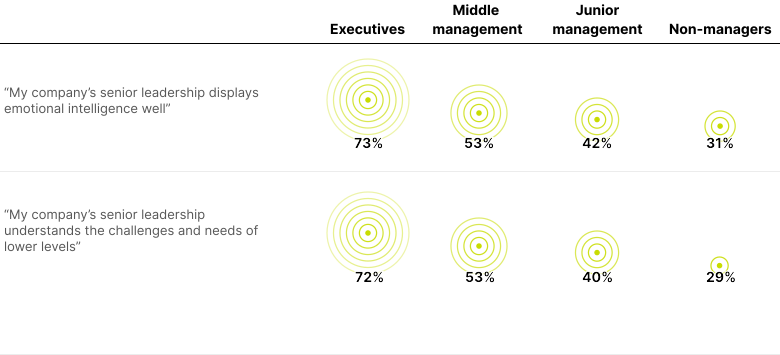
Source: Oliver Wyman Forum survey, 16 countries, July 2024 (N=11,174)
Gen Z increasingly emphasizes employers’ engagement on social issues
% respondents who say it’s important that their employer engages with key social issues
Questions: “How important is it to you that your employer engages with the key social issues you care about? Which of the following actions have you ever taken as a result of your employer not being engaged in social issues that are important to you?”
Source: Oliver Wyman Forum surveys, US only, November 2022 (N=1,923), September 2025 (N=870)
One of the more surprising findings in our data is that employees in emerging markets are far more satisfied with senior leadership than those in richer economies. Roughly two-thirds say they are satisfied, compared with just over half in developed markets. That difference is striking in a world where frustration with leadership is rising almost everywhere.
Emerging-market leaders stand out most on three traits: communication, emotional intelligence, and collaboration. Across all leadership dimensions, they score about 15 points higher on average, with the largest gap on these people skills. Employees say their leaders explain what’s happening, listen to concerns, and work constructively across teams. As a result, they feel more connected to their company’s vision, more optimistic about its future, and more trusting of senior leadership. In each case, the gap with developed markets runs into double digits.
What’s driving this? In part, it appears to be demographics. Workforces in many emerging markets skew younger, with large cohorts of first-generation professionals moving into the middle class. In that setting, employees may be more optimistic about opportunity and more inclined to give leaders the benefit of the doubt, especially when they feel their organization is helping to build something new.
Employees in emerging markets are more satisfied with their leaders
% respondents who are satisfied with senior leadership at their company
Source: Oliver Wyman Forum survey, 16 countries, May 2025 (N=15,191)
Emerging market leaders outscore their developed market peers across every dimension
% respondents who believe their leadership displays a trait well
Source: Oliver Wyman Forum survey, 16 countries, July 2024 (N=11,174)
That said, younger workforces are not automatically “easier”: expectations can be high, patience can be thin, and credibility can be lost quickly if leaders overpromise. The advantage is less deference than disposition — when people feel upward momentum in their own lives, they can be more willing to engage with a leadership story that asks for stretch.
Context matters, too. In our sample, many emerging markets sit in a higher-growth, lower-volatility zone than much of the developed world. When momentum is visible, change can feel like the price of progress rather than the cost of managing decline. That can make it easier for leaders to sustain belief in a direction, even when the work is hard.
Emerging market leaders stand out in making their workforce feel valued and understood
% respondents who agree with the statement
“My company values and seeks my input on important topics”
%
%
“Senior leaders understands the challenges and needs of lower levels”
%
%
Source: Oliver Wyman Forum survey, 16 countries, May 2025 (N=15,191)
Emerging market workers feel more connected to their company’s vision and more confident in its future
% respondents who agree with the statement
“I feel connected to my company's vision and goals”
%
%
“I believe in the future of my company”
%
%
Source: Oliver Wyman Forum survey, 16 countries, May 2025 (N=15,191)
Of course, this is not uniform: Emerging markets still face real pressures—cost-of-living shocks, rapid restructuring, and uneven gains — and developed markets still contain plenty of high-growth pockets. But where the prevailing environment feels more forward-leaning, employees may be more open to a clear narrative about where the organization is headed and why the disruption is worth it.
This is also why the familiar story that emerging-market leaders are simply battle-hardened by volatility misses what our data suggest. The advantage appears less about toughness in chaotic conditions and more about the combination of demographics and tailwinds that can make trust easier to build and sustain. In those conditions, what distinguishes leaders is not their tolerance for turbulence but their ability to convert momentum into shared clarity and coordinated execution. That is what makes these markets such a useful place to look for leadership lessons that travel.
For multinationals, emerging markets are not only growth engines; they are leadership laboratories. The lesson is not that these countries have discovered a secret formula, or that their models can be transplanted wholesale into very different cultural or regulatory contexts.
It is that where trust in leadership is highest, three elements tend to show up together: a believable story of progress, leaders who stay close enough to people to hear and absorb their concerns, and collaboration across teams rather than siloed decision-making. Growing businesses often feel like happier businesses. Where growth is harder to find, leaders have to work much harder on those same levers — clarity of direction, proximity, and cross-team problem solving — to supply the energy that growth would otherwise provide.
Inflation is now a bigger problem in developed markets
Year-over-year change in annual Consumer Price Index, five-year rolling standard deviation
Source: Oxford Economics, Oliver Wyman Forum analysis

Over the past five years, the Oliver Wyman Forum has conducted recurring consumer surveys, fielding multiple waves each year (sometimes monthly, sometimes quarterly) and reaching nearly 300,000 respondents across 20 countries: the United Kingdom, France, Germany, Italy, Spain, Mexico, Brazil, India, Qatar, Kuwait, the United Arab Emirates, Saudi Arabia, China (Hong Kong), Indonesia, Singapore, Australia, South Africa, Canada, and the United States. This ongoing study has served as a venue for us to explore shifting attitudes and behaviors across topics that matter to society and business, including technology and artificial intelligence, the future of work, consumer confidence and spending, brands and loyalty, climate and activism, disinformation, inflation and recession, and more.
Because survey populations can vary across waves (for example, some topic modules are fielded in subsets of countries, and sample sizes may differ by topic), we focus each analysis on the common denominator available for the relevant question set. As a result, some findings in this report draw on different country samples, as noted in the exhibit or accompanying text — for instance, certain analyses span 16 countries, while others use smaller common sets (sometimes as few as four). Unless otherwise specified, these subsets are designed to maintain broad geographic representation, typically spanning multiple continents. (For example, references to a four-country set in our data includes representation across four continents, such as US, UK, China, and Brazil.) Readers who have specific questions about which countries are included in a given insight should please reach out.
The surveys were sourced from a panel of 67 million people worldwide. To support representative distributions, our respondent pool generally mirrored the demographics of each country, including age, income, education level, political affiliation, and gender. In a small number of waves, certain demographic segments may be modestly over- or under-represented due to sampling constraints; where this occurs, results are still intended to be broadly representative at the country level. We also applied standard quality controls to remove inattentive or low-quality responses.
There are typically two sections in the Oliver Wyman Forum survey. The first is fixed and includes recurring questions on basic demographics, psychographics, and other general behaviors, thoughts, and motivations, which allows us to track sentiment and behaviors longitudinally. The second section is modular and focused on “topics du jour” that are salient for society and businesses globally (for example, generative AI adoption, the future of work, consumer spending and brand loyalty, inflation and cost-of-living pressures, climate attitudes and activism, trust and disinformation, health and well-being, and shifting social norms). Some questions are asked only of relevant respondent subsets (for example, employed respondents for workplace-related questions).
In some cases, we also deploy deep-dive surveys to better understand emerging behaviors that warrant additional depth beyond the core tracking instrument. Over the course of the study, we have launched deep-dive surveys focused on topics such as AI, consumer behavior, workforce dynamics, and demographic shifts. These deep dives are typically fielded in the same countries as our core research, often with expanded sample sizes to support more granular analysis.
Finally, parts of this report are informed by complementary methods, including expert and consumer interviews, rapid-turnaround 142 qualitative diary studies, and rigorous secondary research to contextualize and triangulate broader shifts. We conducted interviews in the last quarter of 2025, with a particular focus on respondents in the United States and the United Kingdom, while also incorporating perspectives from other markets globally. One-on-one qualitative research allowed for deeper discussion of more sensitive or personal topics, including themes such as health and wellness, work and identity, values, and social norms. In addition, over the past few years we have supplemented the survey program with focus groups and a wide range of interviews, including one-on-one consumer interviews, CEO interviews, and expert interviews, to add context and depth to these findings.
While many insights are often country-agnostic, there are cases in which regional variation was substantial enough that we analyzed results at a country level and explicitly called out specific markets (for example, the United States or China). These country-specific findings are often illustrative of broader dynamics and can offer lessons that are relevant beyond that market. Where country-level differences materially shaped the story, we included graphics to support a fuller understanding. However, given the scope limitations of the study, it is possible we did not highlight every instance where this was the case. We welcome questions if readers would like additional country-level detail.
Percentages may not sum to 100 due to rounding, and differences shown are descriptive unless otherwise noted.
The Oliver Wyman Forum spent the past five years surveying nearly 300,000 people around the globe. This report transforms their responses into insights and stories, patterns and predictions. The art attempts to illustrate how voices converge, influence one another, and take collective form.
The visual concept begins with a single dot. A voice radiates outward, creating space as it grows. Other voices join, adding depth, complexity, and impact. Together, these overlapping forms create a shape, reflecting how voices blend and harmonize over time. We studied cymatics, equalizers, and sound waves to refine the art direction.
Inspired by early 20th century poster designs like Nikolay Diulgheroff’s 1933 ad for Watt Radio, the cover is bold and intentionally amorphous. It has a clear outline but no fine detail — a silhouette of the future, large enough to sense but not yet fully defined. We also chose warm textures and papers to make it feel human rather than showing humans, visualizing voices without relying on photography and allowing stories of data and sentiment to speak for themselves.
This visual language extends throughout the report. Section separators use a growing pattern of circles that mirrors the main spreads, starting with just a few and gradually increasing. This progression guides readers through the report’s evolution, reinforcing the idea of many voices coming together to tell a more impactful story. By applying a simple, consistent visual metaphor, the separators strengthen narrative flow and keep the reader engaged from start to finish.
Together, these elements form a portrait of collective understanding: 300,000 voices resonating as one, outlining the shape of what’s ahead.
What we value:
Ana Kreacic is Partner and Chief Knowledge Officer of Oliver Wyman, and COO of the Oliver Wyman Forum.
Amy Lasater-Wille is a Partner, Head of Human Insights, Oliver Wyman.
How we feel:
Chris Bernene is a Partner and the Global Lead of Oliver Wyman's Health and Life Sciences Practice.
Sukanya Soderland is a Partner in Oliver Wyman's Health and Life Sciences Practice.
How we invest:
Christian Edelmann a Managing Partner and the Head of Europe at Oliver Wyman.
Rupal Kantaria a Partner at the Oliver Wyman Forum.
Philip Schroeder is a Partner in the Wealth & Asset Management and Private Capital practices at Oliver Wyman.
How we win the next generation of consumers:
Amy Lasater-Wille is a Partner, Head of Human Insights, Oliver Wyman.
Amit Sabharwal s a Senior Partner at Lippincott, a global brand consultancy.
How we work:
Ana Kreacic is Partner and Chief Knowledge Officer of Oliver Wyman, and COO of the Oliver Wyman Forum.
Ravin Jesuthasan is the Global Leader of Mercer’s Transformation Services business.
Simon Luong is a Program Director at the Oliver Wyman Forum.
How we embrace AI:
Jad Haddad s a Partner and the Global Head of Quotient — AI by Oliver Wyman.
Ana Kreacic is Partner and Chief Knowledge Officer of Oliver Wyman, and COO of the Oliver Wyman Forum.
Michael Zeltkevic is a Managing Partner and the Global Head of Capabilities at Oliver Wyman.
Simon Luong is a Program Director at the Oliver Wyman Forum.
How we inspire and lead:
Nick Studer is the President and CEO of Oliver Wyman and Marsh Management Consulting, and Vice Chair of Marsh.
John Romeo is a Managing Partner at Oliver Wyman and CEO of the Oliver Wyman Forum.
Ana Kreacic is Partner and Chief Knowledge Officer of Oliver Wyman, and COO of the Oliver Wyman Forum.
Tom Buerkle, Jan Feldman, Dean Foust, Joshua Geesey, Aoife Hughes, Robert Hunter, Dustin Irwin, Ali Kazmi, Minoti Kishor, Dan Kleinman, Hoang Son Lai, Larissa de Lima, Nick Liptak, Jose Lopez, Marissa Lynch, Jilian Mincer, Heather Stern, Jourdin Thomas, Michelle Zhang
Neil Campbell, Anne-Laure Chauvin, Julia Chudzik, Wai Leong Hoh, Karolina Jaworska, Karolina Lewandowska, Cynthia Perez, Ramona Pillai, Weronika Talaj, Dan Winikur