


Key Insights
1. The Oliver Wyman Forum’s Asia 2030 community hosts roundtable discussions involving over 80 executives representing significant $2.2 trillion in market capitalizations across Asia, in such cities as Hong Kong, Singapore, Kuala Lumpur, Ho Chi Minh City, Shanghai, and Sydney. This report synthesizes the first round of these conversations and our ongoing research.
2. The roundtable discussions highlight the importance of building workforce capacity and skills aligned with technological change and evolving market demands. Operational agility, supported by diversification and flexible supply chain strategies, will be key to sustaining competitive advantage. Enhancing risk management capabilities will be essential to balance short-term priorities with long-term investments in a volatile and evolving regional landscape.
3. Geopolitical tensions are reshaping traditional trade relationships and supply chains. Companies must strategically diversify supply chains and navigate emerging trade corridors, such as the China-ASEAN corridor, while managing operational and regulatory risks in an increasingly complex geopolitical environment. Businesses that proactively engage with these new corridors can secure strategic advantages in market access and supply chain resilience.
4. Asia will continue to be a major global growth engine, but companies must update their growth strategies to respond to rapidly evolving consumer preferences, emerging mid-tier city markets, and shifts in industrial exports while also addressing the region’s heavy reliance on bank financing by unlocking deeper capital markets and new funding sources to sustain future investment and competitiveness.
5. Rapid adoption of AI, clean technology, and robotics is transforming productivity and revenue models across Asia. Multinational corporations are capitalizing on these technologies as a critical lever for future growth, particularly in China and India, and are eyeing greater employee training.
6. Asia faces diverging demographic trends, with North Asia’s average age projected to reach 48 by 2030. Demographic shifts will significantly impact consumer demand and labor markets, requiring businesses and financial institutions to innovate products and services tailored to an aging population.
Executive Summary
Asia is undergoing profound and far-reaching changes. While the region’s GDP continues to grow an average of 4% annually, geopolitical tensions have disrupted long-held assumptions about the region’s alliances and trade partners. The rebalancing of supply chains is upending a multi-decade manufacturing model built on China’s scale, in turn contributing to new growth opportunities across India and countries in the Association of Southeast Asian Nations (ASEAN). Technological innovation, meanwhile, is transforming business as it meets the needs of a rapidly aging population.
While uncertainty and volatility will mark the next five years, four key trends — geopolitics, economic growth, technology, and demographic shifts — will shape the future. Understanding these changes and anticipating their impact can help business and government plan around a set of assumptions and respond dynamically.
What to expect from Asia’s geopolitical, supply chain, and business shifts by 2030
GEOPOLITICS AND TRADE
A more complex flow of goods and capital
Geopolitical disruptions will persist over the next five years, requiring companies to manage increasingly complex flows of goods and capital amid heightened operational and regulatory risks. The region will remain the world’s manufacturing hub in 2030, but supply chains will diversify further as firms build resilience. New trade and capital corridors will reshape commercial opportunities, with the China-ASEAN corridor emerging as one of the world’s largest and the Asia-Middle East route among the most dynamic.
ECONOMIC GROWTH
Navigating new consumer and industrial trends
The Asia growth story continues, with the region contributing around 46% of global growth through to 2030. But the growth model is shifting: China is pivoting toward advanced manufacturing, while ASEAN countries and India compete for manufacturing investments as supply chains reconfigure. The region’s consumers will similarly evolve, with channels shifting and demand spreading to mid-tier cities. The region’s total investment runs at over $13 trillion annually, requiring ever deeper public and private capital markets and improving capital returns.
TECHNOLOGICAL CHANGE
AI, clean tech, and robotics are leading a revolution
Asia’s 2030 landscape will be transformed by AI and other technological advances. Leading multinational corporations will move faster than others, benefiting from their global capabilities and pilot programs. But the region may also surprise — from China’s pragmatic, economy-wide AI strategy push to the rush of global AI companies into India. China’s pursuit of new innovations in other industries, such as biopharma and industrial robotics, will ensure technological advancements also extend beyond AI.
DIVERGING DEMOGRAPHICS
Businesses and financial institutions adapt to aging populations
The region’s populations are aging fast, with North Asia’s average age forecast to reach 48 by 2030, compared with 44 in Europe and 40 in the United States. The over-60 population will grow to 785 million within five years, representing a large and fast-growing market. Companies are adapting their products in response — from AI-enabled medical devices to off-peak season travel packages. The impact on financial industries is equally large, with senior customers demanding more predictable fixed yields and greater flexibility in income streams.
Implications for business leaders
Asia’s business leaders face a unique convergence of short-term disruption and long-term trends — much like their global peers. The challenges are especially acute in a region central to the world’s geopolitical tensions and economic shifts. As one experienced leader and board member noted, “These long-term uncertainties are paralyzing boards, even as they face business-as-usual challenges.” Navigating the next five years requires balancing short-term cost constraints with growth opportunities, while strategically investing to anticipate and respond to competing long-term market trends.
Some possible actions include:
- Develop a set of possible future scenarios against which to test the business — its resilience and its dexterity to seize opportunities
- Establish an external advisory council to develop rapid insights and to serve as a sparring partner for the executive team and board in assessing the probability of scenarios
- Rotate board directors more regularly to infuse emerging expertise (AI, geopolitics, regulatory risk)
- Create centralized teams that scan, integrate, and recommend action on complex ecosystem risks and opportunities
- Build capabilities to continuously update assumptions on tariffs, supply chain fragilities, and talent movement and to model their combined impact
Implications for companies
Companies will face a more fragmented business landscape by 2030. Many are investing “in China for China” even as they strengthen supply chain resilience and explore new growth opportunities by expanding across ASEAN countries and India, including into the region’s many mid-tier cities. Leading players will have deployed AI to boost productivity and revenue, aligned with China’s new advanced industries and exports, as well as developed a new suite of products to tap into Asia’s fast-growing senior markets.
Implications for financial institutions
ASEAN countries and India will see increased banking demand and capital market development as GDP per capita nears $12,500 in key markets. Meanwhile, geopolitics will add new complexity to banking footprints and capital corridors, especially with China, even as AI offers new ways to automate processes and reduce costs; aging populations will shift demand toward more predictable income streams; and the rise of stablecoins and other emerging payments will potentially disrupt traditional payment rails.
Four Trends Transforming Asia
1. Navigating geopolitics with expanded supply chain footprints and new commercial corridors
Asia has benefited materially from decades of globalization, but political tensions and economic statecraft have forced companies and governments to rethink the region’s traditional growth drivers. “We’re now operating in a world where long-held assumptions are no longer true,” noted one financial leader, capturing the mood of senior leaders across all industries. The roundtables consistently highlighted the seismic shift in trade and capital flows — and the game-changing impact this will have on the business landscape — as one of the defining transformations ahead.
Companies, particularly those in Hong Kong, are concerned about their exposure to China-US tensions, but they also are optimistic. “ASEAN has the agility and pragmatic policymaking to navigate the tensions,” remarked one senior Singaporean banker — a commonly shared view. US multinationals are likewise staying agile and, according to one foreign business association leader, remain highly committed to ASEAN markets, “but we are keeping our heads down and focusing on backroom lobbying rather than major press releases.”
Nevertheless, de-risking is the dominant theme. “It’s all about China plus five,” said a major fashion brand executive, capturing the prevailing mood as brands and manufacturers expand their supply footprints across multiple countries to build resilience. Few are exiting China entirely. ASEAN countries and India are among the main scalable alternatives, with global export shares of roughly 8% and 2%, respectively. This shift implies a far more complicated supply chain — one that will require “big investments in technology” to manage the complexity, noted a supply chain chief.
The China-ASEAN corridor captures the most attention — and for good reason. Trade flows already rival those between Europe and the United States, and are forecast to reach $1.4 trillion by 2030, up from $880 billion in 2024.8 Senior bankers and industrial leaders are focused on tapping into these flows. US efforts to target Chinese “transshipments” introduce uncertainty. But ASEAN countries export 70% to 90% to non-US markets, and demand for imported Chinese component parts is expected to remain strong, whether shipping to the United States or the rest of the world.
Executives expect Chinese foreign direct investment to continue flowing into ASEAN countries through 2030. Some ASEAN business leaders described receiving nonstop calls as Chinese firms searched for new industrial park locations in response to higher US tariffs. Chinese investments into the region will include not just manufacturing but also related sectors, such as logistics and industrial real estate. There is also an expectation that the growing number of Tier 2 suppliers moving to ASEAN countries for the first time may stimulate new wealth flows, as factory owners diversify their assets.
The shift in trade and capital flows is also reshaping the Asia-Middle East corridor. “From a business and geopolitical perspective, it’s only going in one direction,” noted a Middle Eastern banking executive in Hong Kong, citing new free trade agreements, routine visits by officials and regulators, and increasingly strong business activity. It is not just a North Asia story — executives in Kuala Lumpur and Singapore are equally focused on the opportunities, with the ASEAN, China, and Gulf Cooperation Council (GCC) Summit in Malaysia in early 2025 yet another sign of the regions’ increasingly close ties.
Trade in consumer goods and oil has flourished since the mid-2000s. But private capital is the newest and most compelling development for many. Since 2024, Asian and Middle Eastern investors have transacted over 75 private equity deals involving both sides. The GCC economies are diversifying from oil — through projects such as Saudi Arabia’s NEOM and the United Arab Emirates’ growing artificial intelligence ambitions. These shifts create opportunities for Asian firms across advanced manufacturing and technology sectors alike.
2. Adapting growth strategies to new consumer preferences, industrial exports, and financing
Asia will remain a global growth engine over the next five years, with its economy expanding at around 4% annually and contributing half of global growth. However, geopolitics and economic shifts are changing the growth model for consumers and businesses. Executives said that while the opportunities are significant, the experiences of the past two decades are less relevant for the coming decade, and companies need to update their playbooks in response.
The Asian consumer remains a priority for all businesses. If Asia’s household consumption rises at an average of 5% over the next five years, that would add roughly $6 trillion to global GDP. “We plan to grow from 300 to 12,000 branches,” remarked a retail executive at our Ho Chi Minh City roundtable, as the firm seeks to tap into Vietnam’s many cities. Together, ASEAN countries and India have more than 380 mid-tier cities generating $1.2 trillion in GDP. Companies view them as emerging consumer hotspots, hoping to repeat the past decade’s success selling to China’s more than 250 mid-tier cities.
Asia’s city economies
Combined 2030 GDP of Major Cities
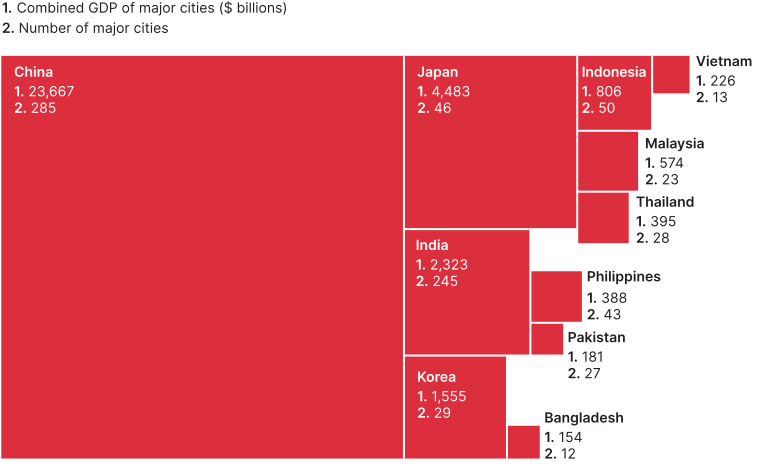
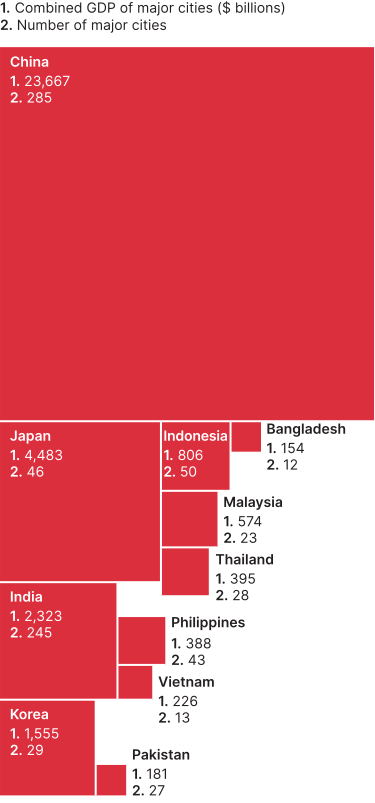
Source: Oliver Wyman
However, “doing more of the same is no longer enough,” said one retail executive, as consumer channels and preferences evolve rapidly. Multinational corporations in China recognize this and are partnering with local players to find new approaches. Chinese companies responded quickly to consumer shifts and captured market share — from rapid “test and learn” to greater production efficiency and faster channel experimentation. These lessons are now being exported as leading Chinese firms and foreign partners seek to grow their footprints across the region.
The changes in business models are equally apparent in China’s industrial sector. Executives talk about how the country’s growing exports of advanced products like electric vehicles (EVs) and lithium batteries are driving a host of opportunities — from rising freight volumes through Hong Kong to growing partnership opportunities for ASEAN-based EV distributors. Many industrial players are running what feels like “two distinct businesses,” as one Chinese player noted — the first focused on China’s vast $18 trillion domestic market and the second pivoting to selling product to global markets.
There is both opportunity and risk for the rest of the region. Executives see tariffs as a “wake-up call” for ASEAN manufacturers focused on low-value added final assembly. “We can’t just rely on foreign companies to drive exports,” said one Vietnamese executive. Talk of the need for more reform is common in our discussions — from rethinking Malaysia’s foreign investment policies and attracting more valueadded industries to tackling Vietnam’s corporate governance models and kickstarting the next stage in the country’s growth. The future looks bright, but success isn’t guaranteed.
For growth models to shift, the region must also improve capital productivity. Asia’s appetite for fixed investment remains high, averaging 26% of GDP compared with an average of 21% in Organization for Economic Co-operation and Development (OECD) countries. However, the region remains unusually reliant on bank loans to fund these investments. Nonfinancial companies depend on bank credit for an average of 76% of their funding, compared with 31% in the United States and 50% in Europe; it’s much harder for small and medium-sized enterprises to access bank credit than blue-chip firms, as one CEO of a regional stock exchange noted.
Further reform of capital markets and reduced reliance on bank credit will unlock new forms of financing. The region’s equity market capitalization stands at a median 92% of GDP, well above the OECD average of 35%; however, institutional and foreign investor participation remains relatively low. Corporate bond markets are shallow, averaging just 24% of GDP. New financing will ease constraints but increase pressure on corporates to deliver higher returns. Private equity participants noted how they are working with Japanese conglomerates to achieve just this, for example by spinning off business lines.
3. AI and tech advances demand new upskilling, operations, and financing models
AI remains the largest source of uncertainty. Predicting how the technology will reshape the region by 2030 is difficult. However, change is coming, and the Oliver Wyman Forum’s recent survey of CEOs at New York Stock Exchange-listed firms shows that companies are splitting into two camps — leaders, which see cost and revenue gains from AI of 10% or more, and laggards. Among CEOs of AI-leading companies, half say their top concern is not moving fast enough and being left behind; only 29% cite too few proven, feasible use cases for AI. They are asking “How fast can we scale this?” not “How can we be certain this works?”
Our roundtables suggested that multinational AI leaders are moving first, tapping global capabilities and pilots. The need for greater employee training is a common theme for most. Local companies face greater challenges, constrained by their smaller scale and linguistically diverse markets. Many expect governments to play a larger role in supporting local businesses; Singapore, for example, has rolled out multiple programs and investments under its National AI Strategy. But the world’s two AI superpowers — the United States and China — are still setting the direction in the region.
Frequency of AI use at work, by country
% share of respondents
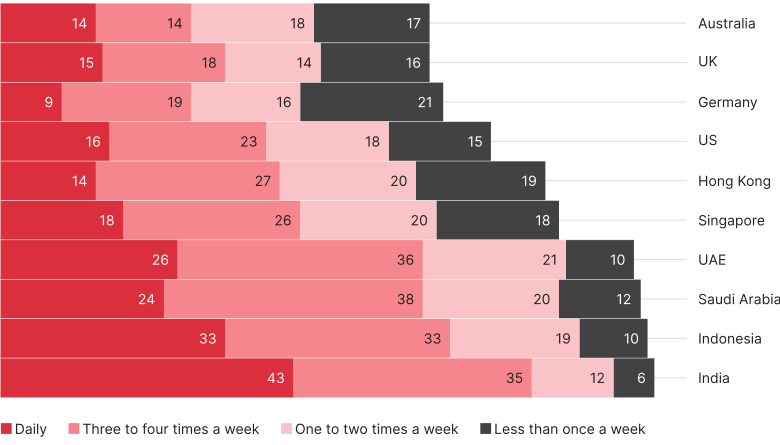
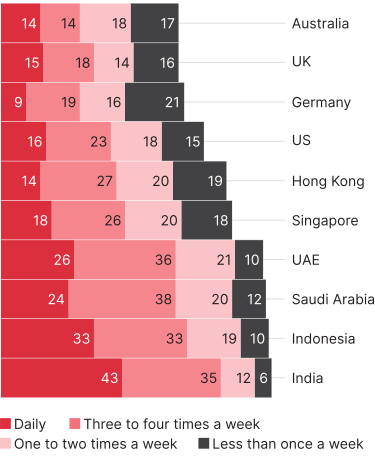
Question: “How often are you using AI in your current job?”
Source: Oliver Wyman Forum’s Global Consumer Sentiment Survey May 2025
And yet “Asia is a region of tipping points,” as one senior insurance executive noted, referring to India’s Unified Payments Interface and the speed at which it fundamentally changed how 1.5 billion people transact — from buying financial assets on their phones to adopting buy now, pay later. American AI companies are investing in India in part because of the country’s digital infrastructure, offering low-cost or even free access to powerful AI tools. Executives are alert to the possibility that Asia again surprises with its speed of technological adoption.
China, meanwhile, is following its own trajectory. The early 2025 launch of DeepSeek, a homegrown model, upended the global AI industry. Yet the country’s “AI+” initiative is less about building frontier models and more about identifying industry-specific applications and deploying AI pragmatically. Expect bubbles to form and possibly burst. Even so, the way Chinese companies and local governments embed AI as a foundational layer of the economy will have global ramifications.
How China applies AI across its vast manufacturing base is pivotal. Executives describe using AI to enable more flexible factory-floor production and to optimize warehousing, thereby lifting productivity. Others are using AI to redesign products, making them safer or cheaper and therefore more compelling to customers. China’s manufacturing base could emerge from the current disruption even more efficient as a result — putting pressure on other firms around the region to invest in productivity.
China’s ambition is also a reminder that technological advancements will extend beyond software. The country’s “Made in China 2025” and other industrial policies continue to drive growth in advanced manufacturing; clean-technology exports alone reached $177 billion in 2024. New growth areas over the next five years will include industrial robotics and biopharma. Australian executives remarked that collaboration between their pharma sector and Chinese counterparts is growing, even as global pharmaceutical giants make billion-dollar investments in China.
These investments — from AI and industrial robotics to biopharma — will all demand new capital financing. Malaysia already attracted $23 billion in data center investments in 2024. in 2024. Singapore is investing $743 million in its AI capabilities through 2029 as part of the country’s National AI Strategy 2.0. China’s ambitions will require capital on an even greater scale. Funds that were once directed toward property and transport infrastructure could increasingly flow into advanced manufacturing and software development, reshaping opportunities for the financial sector.
4. Aging populations are driving new labor, consumer, and business needs
The region’s aging population will impact all industries. North Asia is where the speed of change is most rapid. The region’s average age will reach 48 by 2030, compared with 44 in Western Europe and 40 in the United States. China’s demographic shift is especially significant given the country’s scale. In the early 2000s, its average age was only 29, even as export manufacturing boomed and shipments doubled every four years. The average age will reach 43 by 2030, and factories are automating in response.
North Asia’s aging populations are already transforming economic models. Executives in the region talk of labor shortages across many industries and a growing reliance on imported labor. China’s own investments in automation and robotics are driven as much by demographic need and the imperative to sustain productivity growth as by the government’s ambitions to turn the country into a global leader in advanced manufacturing. And where automation isn’t an option, labor-intensive manufacturers will continue to look for openings in younger markets.
At 36, the average age in ASEAN countries is lower than in North Asia, so it is a destination for manufacturing. But there are significant differences even within ASEAN itself. For instance, the average customer in Thailand will be 43 years old by 2030, compared with just 28 in the Philippines. That makes it harder to roll out a single business model across the region, and consumer products and solutions will differ by country. It also creates opportunities: Executives in Singapore, for instance, talk about redesigning products to suit the city’s older population, even as a growing share of their call centers are based in the Philippines, tapping the country’s youth.
Despite these challenges, the population over 60 is projected to reach 785 million by 2030, up from 383 million in 2010, and companies are unsurprisingly looking to target this vast new market. Insurers are rolling out modular health and retirement products. Airlines are targeting shoulder-season, senior-friendly itineraries. Automakers are building age-inclusive vehicles with easier access, clearer interfaces, and safety subscriptions. New technologies — AI-enabled devices and remote monitoring — make home-first care models feasible, creating richer ways to engage and sell.
Over 60s population
Million people


Source: UN Population Projection and Oliver Wyman analysis
This shift presents both risks and opportunities for the financial sector. Executives anticipate growing demand for fixed-return assets offering predictable yields, potentially deepening debt markets. Fee-based income will rise, driven by expanding wealth management industries. However, concerns remain that future credit demand — particularly a possible slowdown in mortgage financing as populations age — could pressure bank profitability.
The aging trend also will create new opportunities and risks for insurers in the next five years. Growth is expected in products offering greater flexibility in income streams and asset allocation. Demand will rise for senior-care products, especially those with healthcare components. However, the region’s capital markets lack sufficient depth to support the insurance policies being written, complicating the landscape further amid geopolitical shifts in capital flows. And “US capital is still pivotal to the region’s markets,” noted one insurance executive.
Even as they plan for aging markets, leaders aren’t overlooking Asia’s older digital adopters. As one global insurance executive noted, the region “moves from initial adoption to habit formation rapidly,” meaning change can happen fast. Reflecting this, one Vietnamese banking CEO shared that nearly 98% of consumer payments at his institution are made digitally today, up from 20% before the pandemic. Winners are pivoting quickly, testing social commerce, embedded finance, and streamlined payment journeys as older users join younger cohorts online.
As we look ahead to our next series of roundtables, we expect the conversation to remain focused on managing risk in an uncertain world. But there will also be greater clarity on how companies have responded to supply chain shifts, 12 months on from the initial tariff disruption. China’s role in the region meanwhile continues to evolve; rapid advances in AI threaten workforce disruption even as they offer new commercial promise; and the region’s aging markets grow ever larger. The year 2030 draws nearer, but the outlook remains as fluid as ever.
Acknowledgements
Authors
Ben Simpfendorfer is a Partner in the Hong Kong office and APAC Head of the Oliver Wyman Forum. He was formerly CEO of a boutique Asian consultancy and China Economist for several global investment banks.
Matt Austen is Managing Partner for Asia Pacific. He established the firm’s banking practice in Asia in 2006, led the Financial Services Practice in Europe, and was Group Strategy Director and Exco member for a global bank.
Contributors
This report would not have been possible without the contributions of Oliver Wyman Partners Tim Colyer, Andrew Dennison, Seo Young Lee, Paul Ricard, Jasper Yip, Sean Cory, and Kuhan Jeganathan as well as Agatha Foo, Dan Kleinman, Nidhi Kumar, Nick Liptak, Sophie Liu, Jilian Mincer, Samantha Seah, Eva Tong, Ho Jai Yoon, Simon Crofts and Yoshi Arnaud, as well as Marsh McLennan colleagues Joan Collar, Anupama Jain, Gary Chua, Bui Hai Tri, Tuan Minh Hoang.