
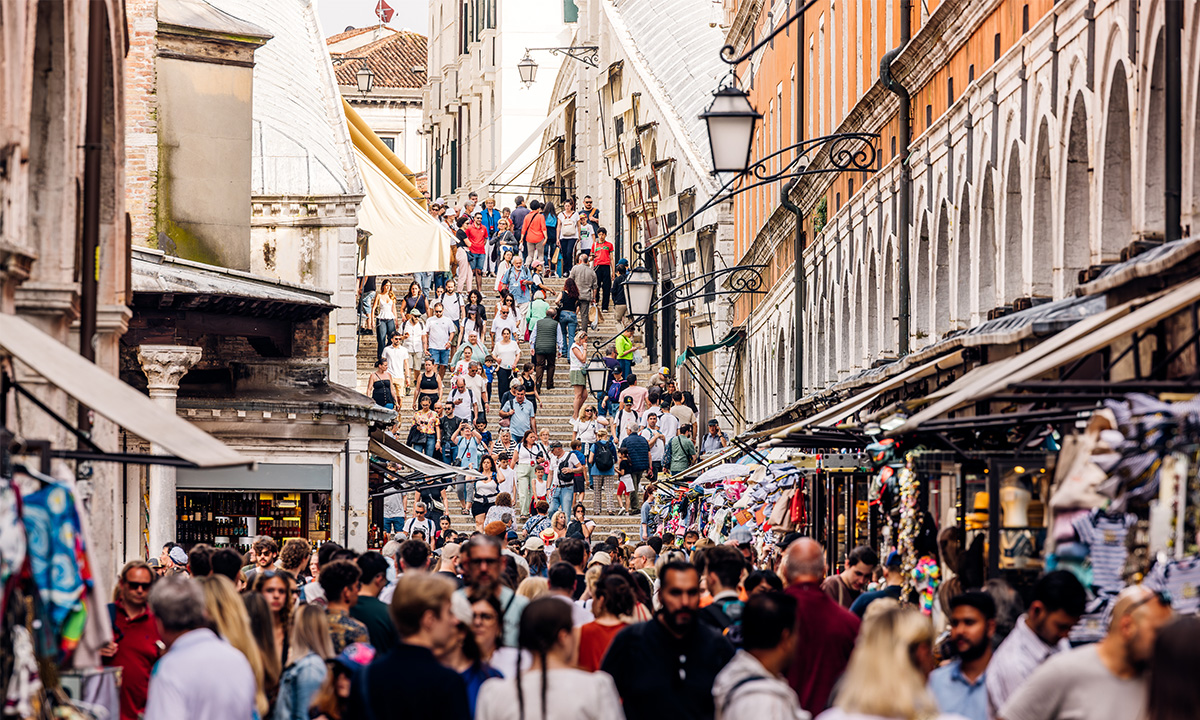
Humanity is placing tremendous pressure on the world’s cities. Nearly half the world’s 8.2 billion people live in urban areas today, and their numbers will swell by another billion by 2050, according to UN projections. That will strain physical and social infrastructure even as climate change poses a growing threat to many cities.
Architects must rise to the challenge by leading with optimism, harnessing technology to reveal urban life as people actually experience it, and building nature into solutions, says Carlo Ratti, a professor of urban technologies and planning and director of the Senseable City Lab at the Massachusetts Institute of Technology. “It’s about making cities more human.”
Ratti turned Venice into an innovation lab last year as curator of the Venice Biennale’s International Architecture Exhibition, with over 300 exhibits on topics ranging from Italy’s first community land trust offering affordable housing for low-income families to using artificial intelligence to produce modular timber structures.
He responded recently to questions from Ben Simpfendorfer, a Hong Kong-based partner at Oliver Wyman who leads the Oliver Wyman Forum’s work across the Asia-Pacific region.
You’ve long argued for “senseable” rather than “smart” cities. What’s the nuance you’re getting at?
People still talk about smart cities as if the goal were to turn urban life into a perfectly optimized machine. That idea has always worried me — it puts efficiency before people. What matters is not how much technology a city has, but what that technology lets us see and do.
At the Senseable City Lab, we’ve spent years shifting the conversation toward this nuance. Take Treepedia: We didn’t measure greenery from satellites or master plans but from the perspective of a person walking down the street. Using AI on Google Street View images, we built the Green View Index to show how much tree canopy people actually experience. That simple shift — from top-down to ground level — has become a useful indicator for climate resilience and public health.
For me, that’s the real meaning of a senseable city: using digital tools to reveal urban life as it is lived, and to give communities more agency. The next generation of urban innovation is not about smartness at all — it’s about making cities more human.
You’ve suggested that cities must balance climate mitigation with serious adaptation. How can architecture and urban technologies help cities adapt to climate realities while still projecting ambition?
Adaptation does not mean lowering our sights. If anything, it asks us to rethink ambition. At the Biennale, we explored three forms of intelligence that can guide this shift: natural, artificial, and collective.
Natural intelligence shows that cities can adapt by working with climate forces: Shade, water, vegetation, and circular materials can act as true infrastructure, improving comfort and resilience. Artificial intelligence adds another layer by helping cities sense and understand their own dynamics — as we demonstrated in Venice with a robot that attendees could maneuver through public spaces using a virtual interface to test AI-predicted crowd behavior. And collective intelligence remains essential: Resilient cities are shaped by many minds, with participatory processes that ground adaptation in lived experience.
Buckminster Fuller wrote that “we are called to be the architects of the future, not its victims.” By embracing this adaptive, multifactor model — natural, artificial, and collective — cities can meet climate realities head-on while still projecting a forward-looking vision. In that spirit, the Biennale turned Venice into a living prototype of how such a future might begin to take shape. Much of the exhibition will continue beyond Venice. Several installations will travel to new venues, extending the message of adaptation and reuse.
How do you imagine AI changing the way we plan and govern cities over the next decade?
We’ve lived through several waves of transformation. The early 2000s brought digital tools that enabled complex forms — the era of Frank Gehry, Zaha Hadid, and a kind of digital baroque. Then came the rise of data: dynamic models and digital twins that made cities feel almost sentient. Much of our early work at the Senseable City Lab used these tools not as an end in themselves, but to reveal the “city of flows,” a place that is biological and alive rather than static.
Now we are entering a third wave: generative AI. It is already reshaping how designers begin projects, and it will reshape how cities understand themselves. AI will not act as a master planner; it will expand what we can see — from microclimates to mobility patterns — giving us a better foundation for planning, debate, and governance. The real challenge is governance. AI will help cities read their own pulse, but it must be transparent, accountable, and used to empower communities rather than bypass them.
So no, AI will not design cities for us, nor will it replace the creative leap that invents what does not yet exist. But it will change how cities learn. And cities that learn are the ones that adapt.
A lot of high-profile smart city work has been in wealthy cities, yet much of the world’s urban growth is elsewhere. Which experiments in the Global South or second-tier cities are you watching closely?
New technologies tend to follow a familiar arc: They begin as costly luxuries accessible only to a few. Over time, though, they can become tools of leapfrogging — enabling those who once lagged behind to surge ahead.
At the MIT Senseable City Lab, we have been using LiDAR in Rio de Janeiro’s Rocinha, the largest favela in Latin America, to capture highly detailed three-dimensional information about physical space, including measurements of street width, changes in elevation, and the density of building facades. This allowed us to produce high-resolution morphological maps that reveal where circulation narrows, crowding is likely to intensify, and light and air struggle to circulate.
This data is useful for planners to address structural safety, air quality, emergency access, and infrastructure upgrades. It also could support the assignment of property titles to residents, addressing one of the key challenges of informal settlements. What matters is that these approaches bring advanced technologies to places that are too often overlooked, ensuring that marginalized communities can explore the potential of innovation.
Looking ahead 10 to 15 years, what is one experiment you’re itching to try but haven’t yet found the right city, partner, or technology to make possible?
I would love to find new ways to spark meaningful encounters between strangers, no matter the city. That simple moment — someone approaching you in a café, a park, a square — is the reason cities emerged 10,000 years ago: to bring us together. I am convinced that in 10 to 15 years, despite all the layers of technology we may have added, that basic impulse will still define urban life.