The cities shaping the future

Key Insights

  • Growth is shifting from global megacities to midsize cities, driven by new industries, affordability, and quality of life. Early engagement gives companies an advantage in fast-scaling markets.
  • Emerging-market midsize cities benefit from supply-chain realignments, increased household spending, and growth policies aimed at developing logistics and manufacturing. These cities are projected to add about $7 trillion in global consumption over five years. These cities share traits: strong connectivity, large workforces, and universities that support BPO growth.
  • In developed markets, lower living costs and industrial and demographic shifts fuel growth in midsize cities. Defense and biopharma sectors are driving growth .in US and European midsize cities.
  • Advancing tech, talent, government support, and venture capital investments are colliding in midsize cities to create vibrant startup ecosystems.

Key Insights

  • Growth is shifting from global megacities to midsize cities, driven by new industries, affordability, and quality of life. Early engagement gives companies an advantage in fast-scaling markets.
  • Emerging-market midsize cities benefit from supply-chain realignments, increased household spending, and growth policies aimed at developing logistics and manufacturing. These cities are projected to add about $7 trillion in global consumption over five years. These cities share traits: strong connectivity, large workforces, and universities that support BPO growth.
  • In developed markets, lower living costs and industrial and demographic shifts fuel growth in midsize cities. Defense and biopharma sectors are driving growth .in US and European midsize cities.
  • Advancing tech, talent, government support, and venture capital investments are colliding in midsize cities to create vibrant startup ecosystems.

The world’s largest cities often dominate the headlines, but much of the next wave of growth is happening outside these behemoths. There are numerous cities that fall outside the top 100 Commercial Hubs in our index that are growing rapidly because of new industries, affordable housing, and other factors.

The challenge for companies is identifying and prioritizing these communities. In North America alone, there are over 95 cities with populations exceeding 250,000. The number is even larger in other regions: Europe has 240, Africa 414, and Latin America 236. Asia stands out with an impressive 1,190 such cities. Companies that engage with cities early in their development will have a competitive edge over those that enter later, when competition is fierce.

Cities in emerging markets benefit from supply chain and logistics shifts

Emerging markets offer scale and fast-growing midsize cities. China’s experience over the past two decades is instructive, with infrastructure and manufacturing investments driving demand across smaller cities, such as Changde or Weifang, and companies ranging from construction to retail benefiting as a result. During the next five years, the emerging market’s midsize and larger cities are expected to add $7 trillion to global consumption, a material figure for global companies, although not all cities will grow robustly.

To prioritize these options, companies should map cities by underlying growth drivers. For example, supply chain shifts are driving industrial growth in Vietnam’s Da Nang, India’s Surat, and Turkey’s Bursa, and lifting household spending in turn. National growth policies aimed at developing non-oil sectors, such as logistics and manufacturing, are expanding in Saudi Arabia’s Dammam and Azerbaijan’s Baku. New business process outsourcing (BPO) centers are driving demand in cities such as Cebu and Hyderabad.

The most successful midsize cities have a common set of drivers. Strong international or domestic connectivity is key, as such cities tend to be hubs for regional activity. Some 45% of cities ranked below 250 in our commercial index have flight connections to at least 10 other destinations. Many are located among a cluster of other cities or near a major national capital, such as the UAE’s Sharjah or Indonesia’s Batam. Large workforce populations are important for manufacturing, such as Mexico’s Saltillo, and universities can foster the growth of BPO centers, like in India’s Gurgaon.

Midsize cities in developed countries surge on industrial shifts and lower costs

The developed world’s urbanization rates, by contrast, have been high for many decades, and urban population growth there is usually not as rapid compared with emerging peers. Nevertheless, midsize cities continue to grow. The developed world’s 100 largest cities have added an extra 69 million people since the 2000s. But other cities with populations greater than 50,000 saw their populations rise by a still sizeable 48 million, with many offering economic opportunities, lower housing costs, and an attractive quality of life. New winners will emerge in the coming years as they tap into supply chain shifts, technological change, or cost of living concerns.

Population growth in many midsize American cities has accelerated rapidly, with some, like Brownsville and Spartanburg, expanding by over 10% in the last five years — outpacing larger metropolitan areas. Lower living costs and competitive income taxes are contributors. Columbus, is attracting industrial investments across a range of advanced manufacturing sectors, while Indianapolis is enjoying strong growth in the biopharma industries. Targeting of public-private sectors, such as aerospace, is another driver, exemplified by Long Beach’s emergence as a national aerospace hub.

European cities have not experienced such dramatic population shifts, and in some older cities, aging populations have further constrained the workforce supply. But there are bright spots as industries develop and attract younger workers. Defense spending in Europe, for example, will help drive growth across cities such as Bristol and Lyon, with their companies supplying precision components to military vehicles and aircraft, as well as Hamburg, with its large naval vessel and aerospace industries, or Hanover, with its defense-adjacent industries. Biopharma and biotech clusters in Cambridge and Eindhoven are likewise driving growth.

A shift in jobs and industries is not the only driver. Demographic shifts are also key in the developed world, where the median age is 42 years compared with 30 in developing nations. Retirees are driving population growth in cities such as Myrtle Beach in the United States, Valencia in Spain, and the Sunshine Coast in Australia, as older populations migrate for lifestyle and affordability. Such shifts also create employment across healthcare, retail, and hospitality sectors, albeit with wages often at the lower end.

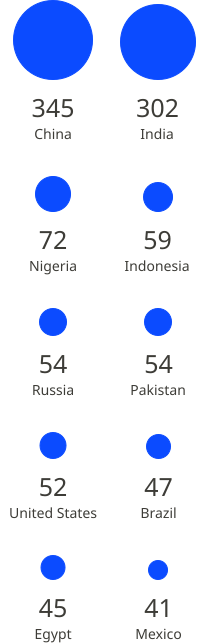
Countries leading in medium-sized cities

Number of cities with population between 250,000 and 1 million, by country
Exhibit of the countries leading in having the most medium-sized cities for future business growth, with China having 345 cities.
Source: United Nations Population Division; Oliver Wyman Forum analysis

The world’s largest cities often dominate the headlines, but much of the next wave of growth is happening outside these behemoths. There are numerous cities that fall outside the top 100 Commercial Hubs in our index that are growing rapidly because of new industries, affordable housing, and other factors.

The challenge for companies is identifying and prioritizing these communities. In North America alone, there are over 95 cities with populations exceeding 250,000. The number is even larger in other regions: Europe has 240, Africa 414, and Latin America 236. Asia stands out with an impressive 1,190 such cities. Companies that engage with cities early in their development will have a competitive edge over those that enter later, when competition is fierce.

Cities in emerging markets benefit from supply chain and logistics shifts

Emerging markets offer scale and fast-growing midsize cities. China’s experience over the past two decades is instructive, with infrastructure and manufacturing investments driving demand across smaller cities, such as Changde or Weifang, and companies ranging from construction to retail benefiting as a result. During the next five years, the emerging market’s midsize and larger cities are expected to add $7 trillion to global consumption, a material figure for global companies, although not all cities will grow robustly.

To prioritize these options, companies should map cities by underlying growth drivers. For example, supply chain shifts are driving industrial growth in Vietnam’s Da Nang, India’s Surat, and Turkey’s Bursa, and lifting household spending in turn. National growth policies aimed at developing non-oil sectors, such as logistics and manufacturing, are expanding in Saudi Arabia’s Dammam and Azerbaijan’s Baku. New business process outsourcing (BPO) centers are driving demand in cities such as Cebu and Hyderabad.

The most successful midsize cities have a common set of drivers. Strong international or domestic connectivity is key, as such cities tend to be hubs for regional activity. Some 45% of cities ranked below 250 in our commercial index have flight connections to at least 10 other destinations. Many are located among a cluster of other cities or near a major national capital, such as the UAE’s Sharjah or Indonesia’s Batam. Large workforce populations are important for manufacturing, such as Mexico’s Saltillo, and universities can foster the growth of BPO centers, like in India’s Gurgaon.

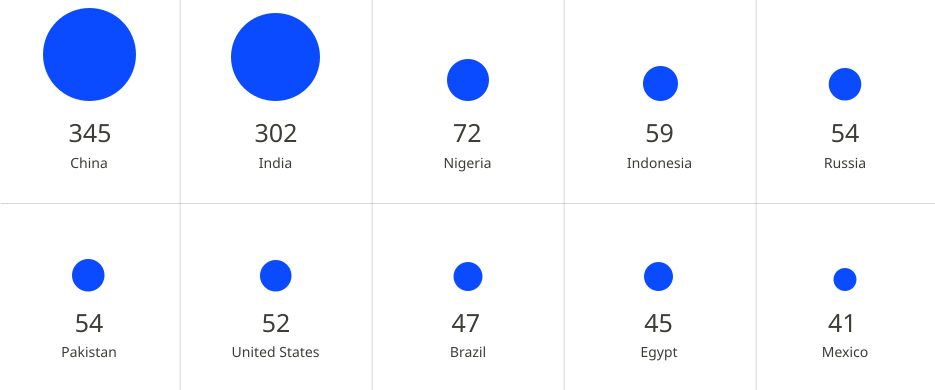
Countries leading in medium-sized cities

Number of cities with population between 250,000 and 1 million, by country
Exhibit of the countries leading in having the most medium-sized cities for future business growth, with China having 345 cities.
Source: United Nations Population Division; Oliver Wyman Forum analysis

Midsize cities in developed countries surge on industrial shifts and lower costs

The developed world’s urbanization rates, by contrast, have been high for many decades, and urban population growth there is usually not as rapid compared with emerging peers. Nevertheless, midsize cities continue to grow. The developed world’s 100 largest cities have added an extra 69 million people since the 2000s. But other cities with populations greater than 50,000 saw their populations rise by a still sizeable 48 million, with many offering economic opportunities, lower housing costs, and an attractive quality of life. New winners will emerge in the coming years as they tap into supply chain shifts, technological change, or cost of living concerns.

Population growth in many midsize American cities has accelerated rapidly, with some, like Brownsville and Spartanburg, expanding by over 10% in the last five years — outpacing larger metropolitan areas. Lower living costs and competitive income taxes are contributors. Columbus, is attracting industrial investments across a range of advanced manufacturing sectors, while Indianapolis is enjoying strong growth in the biopharma industries. Targeting of public-private sectors, such as aerospace, is another driver, exemplified by Long Beach’s emergence as a national aerospace hub.

European cities have not experienced such dramatic population shifts, and in some older cities, aging populations have further constrained the workforce supply. But there are bright spots as industries develop and attract younger workers. Defense spending in Europe, for example, will help drive growth across cities such as Bristol and Lyon, with their companies supplying precision components to military vehicles and aircraft, as well as Hamburg, with its large naval vessel and aerospace industries, or Hanover, with its defense-adjacent industries. Biopharma and biotech clusters in Cambridge and Eindhoven are likewise driving growth.

A shift in jobs and industries is not the only driver. Demographic shifts are also key in the developed world, where the median age is 42 years compared with 30 in developing nations. Retirees are driving population growth in cities such as Myrtle Beach in the United States, Valencia in Spain, and the Sunshine Coast in Australia, as older populations migrate for lifestyle and affordability. Such shifts also create employment across healthcare, retail, and hospitality sectors, albeit with wages often at the lower end.

Investment horizons expand to include midsize cities

Midsize cities also have a long history of nurturing future champions, from Bentonville to Hangzhou. But as technologies advance, a different set of cities are becoming home to a new wave of companies across industries, such as electric vehicles, healthcare, and artificial intelligence. For private capital and other investors, these cities offer new hunting grounds beyond the usual set of candidates, but that means a more nuanced view of what’s driving growth in these geographies.

Data on venture capital, unicorns, and the presence of industrial and technology leaders all show a fast-changing picture. Munich and Paris are already well-known VC hubs, but Hamburg and Manchester are also attracting startup capital, technology talent, and global tech giants across fintech, AI, and climate tech. In the United States, Austin and Denver have emerged in the last decade as innovation hubs. The former is home to 22 unicorns and hosts operations of many tech giants.

Leading cities by venture capital investment

Ranked by total capital raised
Source: Oliver Wyman Forum analysis

In the rest of the world, investors also will have to search for opportunities across a wider range of locations. Hefei has transformed into China’s electric vehicle capital, Hangzhou is home to Chinese tech giants Alibaba and DeepSeek, and Suzhou is a growing biopharma hub. India’s Bengaluru ranks high globally for unicorns, venture capital, and multinational presence. Riyadh has seen a significant influx of VC funds and is supported by a strong government vision. Bogotá and São Paulo lead the charge on enterprise creation in Latin America.

Governments have a role to play. Hefei invested in local startups, prioritizing the electric vehicle value chain, and reinvested the returns from the sale of these startup investments to build industrial parks and other supporting infrastructure. Austin, meanwhile, anchored its talent strategy around the University of Texas, offered targeted incentives, and actively recruited major multinationals over a multidecade period. Each had a long-term vision and understood the importance of building a supporting ecosystem over the years.

The world’s largest cities often dominate the headlines, but much of the next wave of growth is happening outside these behemoths. There are numerous cities that fall outside the top 100 Commercial Hubs in our index that are growing rapidly because of new industries, affordable housing, and other factors.

The challenge for companies is identifying and prioritizing these communities. In North America alone, there are over 95 cities with populations exceeding 250,000. The number is even larger in other regions: Europe has 240, Africa 414, and Latin America 236. Asia stands out with an impressive 1,190 such cities. Companies that engage with cities early in their development will have a competitive edge over those that enter later, when competition is fierce.

Cities in emerging markets benefit from supply chain and logistics shifts

Emerging markets offer scale and fast-growing midsize cities. China’s experience over the past two decades is instructive, with infrastructure and manufacturing investments driving demand across smaller cities, such as Changde or Weifang, and companies ranging from construction to retail benefiting as a result. During the next five years, the emerging market’s midsize and larger cities are expected to add $7 trillion to global consumption, a material figure for global companies, although not all cities will grow robustly.

To prioritize these options, companies should map cities by underlying growth drivers. For example, supply chain shifts are driving industrial growth in Vietnam’s Da Nang, India’s Surat, and Turkey’s Bursa, and lifting household spending in turn. National growth policies aimed at developing non-oil sectors, such as logistics and manufacturing, are expanding in Saudi Arabia’s Dammam and Azerbaijan’s Baku. New business process outsourcing (BPO) centers are driving demand in cities such as Cebu and Hyderabad.

The most successful midsize cities have a common set of drivers. Strong international or domestic connectivity is key, as such cities tend to be hubs for regional activity. Some 45% of cities ranked below 250 in our commercial index have flight connections to at least 10 other destinations. Many are located among a cluster of other cities or near a major national capital, such as the UAE’s Sharjah or Indonesia’s Batam. Large workforce populations are important for manufacturing, such as Mexico’s Saltillo, and universities can foster the growth of BPO centers, like in India’s Gurgaon.


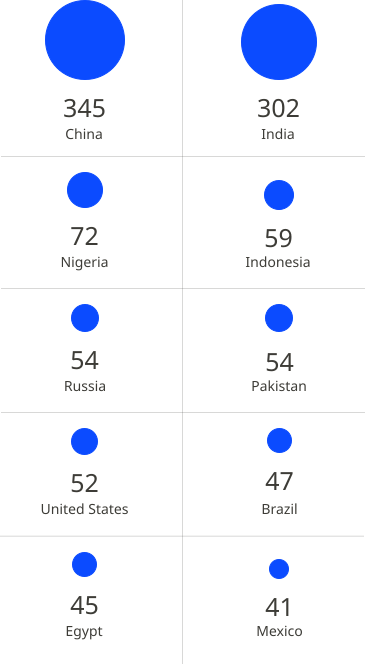
Countries leading in medium-sized cities

Number of cities with population between 250,000 and 1 million, by country
Exhibit of the countries leading in having the most medium-sized cities for future business growth, with China having 345 cities.
Source: United Nations Population Division; Oliver Wyman Forum analysis

Midsize cities in developed countries surge on industrial shifts and lower costs

The developed world’s urbanization rates, by contrast, have been high for many decades, and urban population growth there is usually not as rapid compared with emerging peers. Nevertheless, midsize cities continue to grow. The developed world’s 100 largest cities have added an extra 69 million people since the 2000s. But other cities with populations greater than 50,000 saw their populations rise by a still sizeable 48 million, with many offering economic opportunities, lower housing costs, and an attractive quality of life. New winners will emerge in the coming years as they tap into supply chain shifts, technological change, or cost of living concerns.

Population growth in many midsize American cities has accelerated rapidly, with some, like Brownsville and Spartanburg, expanding by over 10% in the last five years — outpacing larger metropolitan areas. Lower living costs and competitive income taxes are contributors. Columbus, is attracting industrial investments across a range of advanced manufacturing sectors, while Indianapolis is enjoying strong growth in the biopharma industries. Targeting of public-private sectors, such as aerospace, is another driver, exemplified by Long Beach’s emergence as a national aerospace hub.

European cities have not experienced such dramatic population shifts, and in some older cities, aging populations have further constrained the workforce supply. But there are bright spots as industries develop and attract younger workers. Defense spending in Europe, for example, will help drive growth across cities such as Bristol and Lyon, with their companies supplying precision components to military vehicles and aircraft, as well as Hamburg, with its large naval vessel and aerospace industries, or Hanover, with its defense-adjacent industries. Biopharma and biotech clusters in Cambridge and Eindhoven are likewise driving growth.

A shift in jobs and industries is not the only driver. Demographic shifts are also key in the developed world, where the median age is 42 years compared with 30 in developing nations. Retirees are driving population growth in cities such as Myrtle Beach in the United States, Valencia in Spain, and the Sunshine Coast in Australia, as older populations migrate for lifestyle and affordability. Such shifts also create employment across healthcare, retail, and hospitality sectors, albeit with wages often at the lower end.

Investment horizons expand to include midsize cities

Midsize cities also have a long history of nurturing future champions, from Bentonville to Hangzhou. But as technologies advance, a different set of cities are becoming home to a new wave of companies across industries, such as electric vehicles, healthcare, and artificial intelligence. For private capital and other investors, these cities offer new hunting grounds beyond the usual set of candidates, but that means a more nuanced view of what’s driving growth in these geographies.

Data on venture capital, unicorns, and the presence of industrial and technology leaders all show a fast-changing picture. Munich and Paris are already well-known VC hubs, but Hamburg and Manchester are also attracting startup capital, technology talent, and global tech giants across fintech, AI, and climate tech. In the United States, Austin and Denver have emerged in the last decade as innovation hubs. The former is home to 22 unicorns and hosts operations of many tech giants.


Leading cities by venture capital investment

Ranked by total capital raised
Source: Oliver Wyman Forum analysis

In the rest of the world, investors also will have to search for opportunities across a wider range of locations. Hefei has transformed into China’s electric vehicle capital, Hangzhou is home to Chinese tech giants Alibaba and DeepSeek, and Suzhou is a growing biopharma hub. India’s Bengaluru ranks high globally for unicorns, venture capital, and multinational presence. Riyadh has seen a significant influx of VC funds and is supported by a strong government vision. Bogotá and São Paulo lead the charge on enterprise creation in Latin America.

Governments have a role to play. Hefei invested in local startups, prioritizing the electric vehicle value chain, and reinvested the returns from the sale of these startup investments to build industrial parks and other supporting infrastructure. Austin, meanwhile, anchored its talent strategy around the University of Texas, offered targeted incentives, and actively recruited major multinationals over a multidecade period. Each had a long-term vision and understood the importance of building a supporting ecosystem over the years.

Investment horizons expand to include midsize cities

Midsize cities also have a long history of nurturing future champions, from Bentonville to Hangzhou. But as technologies advance, a different set of cities are becoming home to a new wave of companies across industries, such as electric vehicles, healthcare, and artificial intelligence. For private capital and other investors, these cities offer new hunting grounds beyond the usual set of candidates, but that means a more nuanced view of what’s driving growth in these geographies.

Data on venture capital, unicorns, and the presence of industrial and technology leaders all show a fast-changing picture. Munich and Paris are already well-known VC hubs, but Hamburg and Manchester are also attracting startup capital, technology talent, and global tech giants across fintech, AI, and climate tech. In the United States, Austin and Denver have emerged in the last decade as innovation hubs. The former is home to 22 unicorns and hosts operations of many tech giants.

In the rest of the world, investors also will have to search for opportunities across a wider range of locations. Hefei has transformed into China’s electric vehicle capital, Hangzhou is home to Chinese tech giants Alibaba and DeepSeek, and Suzhou is a growing biopharma hub. India’s Bengaluru ranks high globally for unicorns, venture capital, and multinational presence. Riyadh has seen a significant influx of VC funds and is supported by a strong government vision. Bogotá and São Paulo lead the charge on enterprise creation in Latin America.

Governments have a role to play. Hefei invested in local startups, prioritizing the electric vehicle value chain, and reinvested the returns from the sale of these startup investments to build industrial parks and other supporting infrastructure. Austin, meanwhile, anchored its talent strategy around the University of Texas, offered targeted incentives, and actively recruited major multinationals over a multidecade period. Each had a long-term vision and understood the importance of building a supporting ecosystem over the years.

Leading cities by venture capital investment

Ranked by total capital raised
Source: Oliver Wyman Forum analysis

About the authors

Ben Simpfendorfer is a partner at Oliver Wyman, based in Hong Kong. He also leads the Oliver Wyman Forum’s work across Asia Pacific, and works across a range of practices, including geopolitics, public policy, finance, and risk. He also drives the firm’s Asia-Middle East corridor initiatives.


Matthew Tucker is a partner in Oliver Wyman’s Private Capital practice, based in London. With close to 20 years of experience working across private equity, financial and business services, and fintech, Matt brings extensive and varied expertise that enables him to support investors and entrepreneurs throughout every stage of the investment lifecycle.