Key Insights
-
Globalization is evolving with shifting tech, trade, and demographics.
Businesses must invest wisely to unlock market access, talent, and resilience,
while policymakers must position their cities competitively.
-
The Oliver Wyman Forum ranked 1,500 cities representing over 75% of global
GDP by five factors: commercial vibrancy, connectivity, supply chains,
innovation, and climate resilience.
-
Leading cities remain commercial, connectivity, and investment hubs; while
midsize and emerging-market cities are gaining due to affordability and supply
chain pivots.
-
CEOs and investors must anticipate new cities for growth, diversify operations,
explore acquisitions, balance efforts in large or midsize cities, and attract
talent.
-
City leaders address climate risks and intensifying competition, nurture a
startup ecosystem, and attract global talent and anchor multinational
businesses.
Globalization is far from dead, and cities are living proof. The
average multinational company currently operates in more than 120 cities. That number
will increase as technology, economic and demographic growth, and changing trade
policies create new business opportunities.
Deciding where to invest has never been more critical. Companies
must navigate complex factors — geopolitical tensions, supply chain resilience, rapid
technological disruption, and rising climate risks — as they reshape their global
footprints for growth. Getting these decisions right can lock in durable advantages in
sourcing, market access, talent, and resilience. Getting them wrong puts growth and
stability at risk. Policymakers face equally high stakes as they strive to position
their cities competitively in this evolving global landscape.
To help leaders navigate these challenges, the Oliver Wyman
Forum ranked 1,500 cities globally using over 50 key indicators that will drive future
city growth, ranging from the presence of multinationals and the availability of venture
capital funding to flight connectivity and work visa policies. These cities account for
more than three-quarters of global GDP, worth some $88 trillion, and are home to 1.9
billion people who spend an estimated $56 trillion annually. They host 92% of the
world’s listed companies and are the starting point for 86% of the world’s passenger
flights.
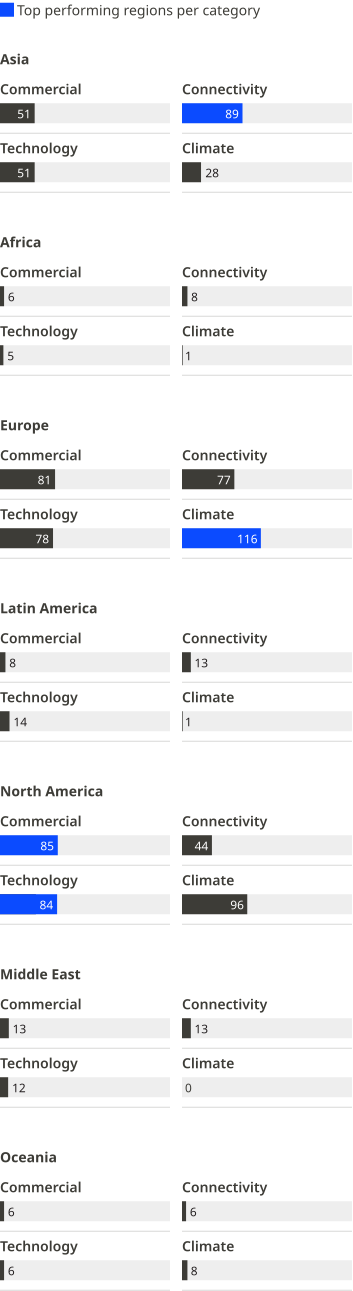
Distribution of the top 250 cities, by region
and
category
Source: Oliver Wyman
Forum
Global CEOs and investors must rethink their geographic
strategies to capitalize on this growth. Choosing where to open new offices, build
factories, deploy sales teams, or find the next unicorn is an ongoing process. While
geopolitical tensions and supply chain challenges increasingly influence these
decisions, the fundamental opportunities remain. A company's geographic spread
simultaneously enhances resilience across its facilities, workforce, and customer
networks in a disrupted world.
City leaders in turn have a unique opportunity to attract new
business investment, create greater employment opportunities, leverage emerging
technologies, and build stronger climate resiliency. Past success no longer guarantees
future wins. Leaders who act boldly can compete with the world’s existing champions, as
evidenced by the rapid rise of Gulf cities from Dubai to Riyadh, China’s
electric-vehicle capital Hefei, and America’s Battery Belt cities.
More than 480 of our cities are in Europe and the United States,
where factors ranging from data center investment to industrial reshoring drive growth.
But an even larger share are in Asia, the Middle East, Africa, and Latin America, where
average GDP growth rates are often several percentage points higher and 84% of the world’s urban population
resides. While not all of these cities will thrive, many will outperform their countries
at large.
1,500 Cities by region and population
Exhibit of the distribution of the top cities for future business growth by
region and population, with the highest populations concentrated in Asia.
Five critical themes driving city performance
Our indicators measure how well cities perform in areas such as
commercial vibrancy, connectivity to regional and global markets, technological
innovation, and climate resilience. By analyzing that data, we have identified five key
themes that CEOs, investors, and city leaders should consider in planning their next
steps.
Leading cities are commercial, connectivity, and investment
hubs
During the 20th century, leading global cities were mainly in
North America, Europe, and Japan. However, rapid growth in China, India, and emerging
economies has created new urban powerhouses — from megacities like Shanghai and Seoul to
fast-growing Gulf cities. CEOs must pinpoint which cities will sustain their competitive
edge amid geopolitical and technological shifts, while city leaders should learn from
these emerging successes.
Emerging markets are jockeying for a place in global supply
chains
Tariffs and technology are reshaping global manufacturing,
increasing supply chain diversification and reshoring. Emerging champions such as Ho Chi
Minh City, Guadalajara, and Tangier are winning market share by providing low costs,
nearshoring opportunities, and diversification, even as reshoring efforts, driven by
measures to bolster economic sovereignty, boost new investments across cities such as
Phoenix and Munich.
Affordability and business shifts help midsize cities
generate
outsize growth
The game today is not all about global megacities. Midsize
cities in emerging and developed markets — from Austin and Hamburg to Patna — are
growing rapidly by leveraging new industries, taking advantage of shifting supply
chains, and offering more affordable housing than their bigger rivals. These cities are
key drivers of future economic growth, innovation, and investment opportunities beyond
traditional global hubs.
Innovation and tech hubs shape the knowledge economy
Accelerating technological innovation is driving today’s economy
and reshaping opportunities. To compete effectively, cities must become innovation hubs
to attract and nurture skilled talent, while also offering strong science, technology,
engineering, and mathematics (STEM) education, vibrant tech ecosystems, and favorable
policies. The global talent war already is fierce with favorable tax rates, visa rules,
and indices of livability influencing flows of skilled workers.
Climate resilience is key to attract business and talent
Cities are on the front lines of climate change, and the gap
between leaders and laggards will widen as the threat worsens. Those that invest in
resilience, ranging from flood protection to renewable power — as Paris and Singapore
have done — will be better able to attract business and talent. Those that struggle will
face worsening dynamics, including rising insurance costs, shortages in resources such
as water, and even potential population displacement.
Future cities by the numbers
Data that shows how future cities will account for 75% of global GDP and
25% of global population.
2.1 billion
Population (25% of global total)
$88 trillion
GDP (75% of global total)