




Most executives say their company is ready for AI, yet most lack a shared direction
78%
of white-collar executives say their company is ready for AI at scale
37%
report a clear AI ambition with progress shared
 THE AI AGENDA
As humans and machines work side by side, a new architecture is required for leadership, management, and performance

The Industrial Revolution moved work from farms and workshops into steam-powered mills in the late 1700s. A century later, electrification and the rise of large corporations transformed work around assembly lines, defined jobs, and management hierarchies. Those shifts took decades to diffuse. AI is moving on a much faster cycle: Capabilities can advance in months and spread through an organization long before roles, skills, career paths, and management systems have had time to adjust.
The dawn of an AI world heralds a new and more urgent imperative for transformation, as machine intelligence becomes an active participant in the workforce. The technology is beginning to reshape the very nature of work: how it is broken down, who directs it, where judgment sits, what managers are for, and whether a task is performed by a human or a machine.
That makes AI an opportunity for organizational transformation as much as technological innovation. Leaders have to agree on where AI is taking the enterprise and what role employees will play on that journey. At the same time, management is being unbundled, judgment and ownership are moving up and down throughout the hierarchy, the career ladder that once built expertise is thinning, and a small group of emerging “AI superworkers” is showing what human-plus-AI performance can look like. This moment requires full organizational commitment, from top to bottom. There is no partial path to success.
78%
of white-collar executives say their company is ready for AI at scale
37%
report a clear AI ambition with progress shared
62%
of daily AI users have downplayed how good they are with AI at work, to avoid extra work, scrutiny, or looking replaceable
68%
of employees would give up part of their salary for a guarantee never to be replaced by AI; 47% would give up 10% or more
80%
of daily AI users say AI has taught them as much as or more than their manager in the past 12 months
Nearly 3 in 4
white-collar middle managers and above say AI now does tasks junior employees used to learn from
1 in 4
of those who see this shift say their employer has fully rebuilt how junior employees learn the same skills
27%
of workplace AI users say AI at least doubles the work they can complete
2×
as many superworkers emerge when five or six employer conditions are in place as when two or fewer are
10×
as many employees report a transparent, shared AI ambition versus those at companies seen as behind
73%
intend to stay two years or more, versus 48% at companies seen as behind
Source: Oliver Wyman Forum Global Voices Survey, April 2026 (footnotes 1, 2, and 7–9) and August 2026 (footnotes 3–6); Oliver Wyman Forum analysis
REALITY CHECK 1
Every AI strategy needs to begin with a decision about what the technology is for. Is the ambition primarily growth and innovation, better customer outcomes, margin expansion, or doing the same work with fewer people? Many organizations have embraced AI before taking those decisions or making them explicit enough to guide the workforce. We call this the Great Leadership Misalignment, and it starts at the very top.
In our conversations with senior executives, the misalignment often originates inside the C-suite itself. A CEO and CFO might disagree on whether AI is primarily a cost lever or a growth lever, or on how fast to move. Closing this gap is one of the first imperatives of the AI era, because the workforce cannot move coherently toward a future that leadership hasn’t clearly defined.
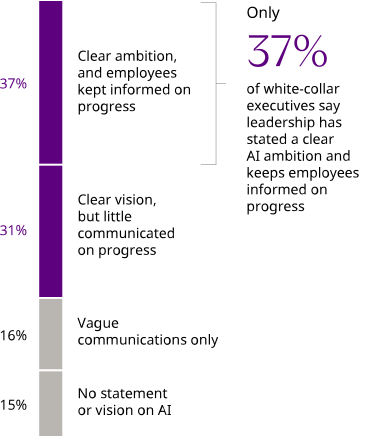
Even among the people closest to the strategy, a shared sense of direction is far from universal. Only 37% of white-collar executives say their company has stated a clear AI ambition and keeps employees informed about progress. An additional 31% see a clear vision but say little is communicated about progress. The remaining third describe the vision as vague or absent altogether.
Characterizations by white-collar executives of their company’s stated ambition on AI
Source: Oliver Wyman Forum Global Voices Survey (April 2026)
Survey question: “To what extent has your company’s leadership stated a clear ambition on the AI strategy?”
Base: N=659 (employed respondents who describe their job as white-collar and their level as executive management)
Until the strategic choices are sufficiently clear, thousands of local AI decisions can move in different directions, producing activity without transformation. The uncertainty at the top compounds as it works its way down through the rest of the enterprise. Only 11% of non-managers see a clear AI direction, roughly a third the level of their bosses.
The trickle-down confusion extends beyond AI. A transformation that asks every employee to change how they work depends on employees believing the strategic direction is real, understanding what objectives it’s intended to achieve, and seeing where they fit in the big picture. When the leadership signal weakens before it reaches the people doing the work, employees begin drawing their own conclusions about where the enterprise is headed with AI and what the future holds for them.
White-collar employee sentiment on their workplace, by job level

Note: Respondents selecting “Other” job level are excluded.
Source: Oliver Wyman Forum Global Voices Survey (April 2026)
Survey question: “Please indicate your level of agreement with the following statements” (7-point scale). Strongly agree = 6 or 7
Base: N=8,038 white-collar employed respondents: executive N=659; senior N=1,163; middle N=2,759; junior management/senior staff N=1,583; non-managerial N=1,874
REALITY CHECK 2
Leaders need to rally the troops. That means defining an objective, setting a strategy for achieving it, and making people feel like they have a real stake in the outcome. If business leaders fail to provide a clear vision of what AI means for staff and how they can share in the gains the technology may throw off, employees create their own and act in ways that don’t help the enterprise. They hide capability and AI use, and assume productivity will translate into headcount reduction. The result can be organizational chaos as individually rational behaviors produce collectively dysfunctional outcomes.
Among daily workplace users, people who should be spearheading the organization’s transformation, 62% have played down how good they are with AI to avoid extra work, scrutiny, or looking replaceable. And 68% of employees would give up part of their salary to work somewhere that guaranteed never to replace people with AI; nearly half would give up 10% or more. The employees companies most need to find are hiding.
Source: Oliver Wyman Forum Global Voices Survey (August 2026)
Survey questions: “Have you ever downplayed how good you are with AI at work, to avoid extra work, scrutiny, or looking replaceable?”; “How much of your salary would you give up to work somewhere that guaranteed never to replace people with AI?”
Base: N=3,429 daily workplace AI users for 62%; N=9,833 all workplace AI users for 52%; downplayed skills = “Yes, often” plus “Yes, occasionally”; N=12,279 employed respondents for the salary question; salary metrics: 68% chose any amount above 0%; 47% chose 10% or more; median response = 5%
Currently, executives and frontline employees see very different futures. Asked what will happen if AI raises productivity in their role, executives expect to be rewarded for it, with 31% anticipating higher pay or a bonus and only 7% a higher risk of layoffs. On the front line, the figures are reversed, at 9% and 24%. Same technology, same companies, opposite expectations.
Digging deeper into employee expectations reveals the extent of the challenge leaders face. Asked what should happen if AI were to double their team’s output, employees rank a shorter week, higher pay, and time for training and new ideas at the top of the list, and fewer people on the team last. Asked what they expect will actually happen, the order inverts, with “fewer people” ranked first. Employees understand that the productivity dividend exists, and they are concluding it’s unlikely to be shared with them.
Anticipated effects of AI on the workforce cited by white-collar employees, by job level

Source: Oliver Wyman Forum Global Voices Survey, April 2026 (rows 1 and 3) and August 2026 (rows 2 and 4)
Survey questions: “If AI increases productivity in your role, what do you think will happen over the next year?” (“Higher risk of layoffs”; “Higher pay/bonus potential”); “If AI doubled your team’s output, what do you think will actually happen?” (“The same hours, with fewer people on the team”); “Knowing what you know about AI, would you advise a young person to start a career in your field today?” (“Yes, definitely”); “Not sure” responses excluded
Base: White-collar employed respondents by job level; April N=7,079; August N=7,196 (young person) and N=7,139 (team output)
Employees may be reading their organizations accurately. In the United States, AI has been among the most frequently cited reasons for announced job cuts in 2026, and employees see those announcements whether or not they reflect real displacement, rather than relabeled cost-cutting. The implication is that the first AI workforce intervention must belong to leaders. They have to agree on and promote a vision of what AI means for people. That story cannot be a messaging exercise. At its core, it is a bargain: what AI is for, and what employees can expect in return for actively participating in the transformation.
Desired and anticipated effects of AI on the workplace cited by employed respondents, ranked

Note: Respondents selecting “Other” job level are excluded
Source: Oliver Wyman Forum Global Voices Survey (August 2026)
Survey questions: “If AI doubled your team’s output, what should happen?”; “If AI doubled your team’s output, what do you think will actually happen?”
Base: N=12,279 (employed respondents)
REALITY CHECK 3
AI is upending the traditional division of labor, empowering rank-and-file employees and putting new responsibilities on managers.
At the bottom, a growing share of employees no longer look to their managers for instruction. Four out of five daily AI users say AI has taught them as much as or more useful things than their manager in the past 12 months. Managers, in turn, need to shift their focus to things AI cannot supply: human judgment about what matters, and empathetic development of junior talent. Those are harder tasks than the ones being taken away, and most managers were not prepared for them.
In this new scheme of things, basic components of management are becoming a growing part of junior employees’ work. White-collar entry-level staff and non-managers who use AI frequently spend nearly a third of their working week, on average, managing AI tools; for more than a quarter of them, it’s at least half the week. These employees are spending a growing share of their time directing work rather than doing it themselves, and doing so before they’ve ever had a direct report.
Source: Oliver Wyman Forum Global Voices Survey (August 2026)
Survey questions: “Who has taught you more useful things in the past 12 months?” (“AI”; “My manager”; “Both about equally”; “Neither”; “I don’t have a manager”); “Could AI do your boss’s job better than they do it?” (“Yes, today”; “Probably within a few years”)
Base: N=3,429 (employed respondents who use AI in their job daily); boss question N=3,393 (excludes respondents without a boss)
We have often described AI as the world’s smartest intern. An extraordinary intern produces extraordinary output only when someone knows how to direct it, and that responsibility is moving to every employee. All employees now increasingly direct, judge, and improve a digital workforce around them. The required skills include deciding what needs doing, specifying it clearly, judging whether the result is good enough, and owning the outcome. Organizations once developed these capabilities over a decade before entrusting someone with a team.
What does that imply for managers? They should begin to operate like “micro-CEOs” of agentic-powered human teams. As employees increasingly direct machine capacity and take decisions without waiting for supervision, the manager’s role also moves upward: aligning human-plus-machine capacity around a common objective, resolving competing priorities, building judgment across the team, and carrying the organizational consequences of the choices that team makes. AI can help someone learn or draft feedback but it can’t form human bonds, sponsor a career, or repair the morale of damaged teams.
Unbundling management also changes accountability. An employee who can direct the output of a small team can also create the risk footprint of one, from an unchecked error repeated at scale to sensitive data or intellectual property going where it should not. Organizations need explicit rules for what people can delegate to AI, what they must verify, and when they must escalate.
Few organizations have noticed this unbundling. Only one in five non-managers describes their role as having shifted toward identifying what needs to be done, and 41% say they are simply doing more of the same work. Most learned to use AI on their own: 65% of non-managerial AI users taught themselves while only 18% received formal training from their employer.
The unbundling of management therefore creates a double obligation: Redefine the manager upward, and rebuild, deliberately, the way everyone below learns to direct.
Proportion of time white-collar employees spend managing AI, by job level
Note: Respondents selecting “Other” job level are excluded.
Source: Oliver Wyman Forum Global Voices Survey (April 2026)
Survey question: “How much of your working week do you spend managing AI tools? (e.g., writing prompts, reviewing AI output, selecting which tool to use)”
Base: N=4,339 (white-collar employed respondents using AI in their job daily or 3–4 times a week): executive N=490; senior N=836; middle N=1,615; junior management/senior staff N=798; non-managerial N=600
REALITY CHECK 4
Junior-level work has always served two purposes at once: It produces output and it produces the next generation of experienced people. Research, first drafts, coding, and analysis are among the tasks easiest to hand to AI. They are also the tasks that traditionally have taught less experienced employees how a business works.
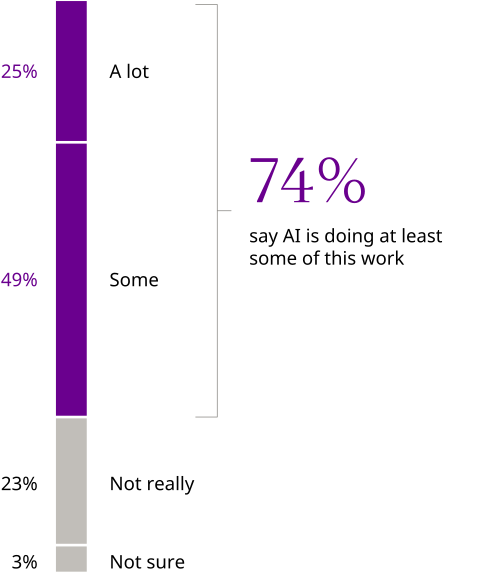
Among white-collar respondents at middle management level or above, 74% say AI is doing at least some of the tasks junior employees used to learn from. Of this group, barely a quarter say their employer has fully rebuilt the pathways through which juniors develop the same skills. Leaders’ intentions suggest a reason for that last point: 43% of CEOs who responded to our survey with the New York Stock Exchange plan to reduce junior roles in the next two years, up from 17% a year earlier. Actual reductions have so far lagged these plans, but early signs of change are visible in payroll data. Employment of 22- to 25-year-olds in the most AI-exposed occupations now stands 19% below what it would have been had it kept pace with peers in less-exposed fields.
Extent to which AI is seen as performing junior white-collar employees’ tasks
Source: Oliver Wyman Forum Global Voices Survey (August 2026)
Survey question: “At your workplace, is AI now doing the kinds of tasks that junior employees used to learn on the job?”; “Where AI has taken over tasks that junior employees previously learned from, has your employer created other ways for them to build the same skills?”
Base: N=4,686 (white-collar employed respondents at middle management level or above); N=3,446 (those answering “a lot” or “some” to the first question)
Companies are trading away learning for an uncertain return. The savings from automating junior tasks are rarely captured deliberately. The cost of a weaker apprenticeship appears later, when a cohort that had fewer chances to build judgment is expected to exercise it. Entry-level roles are becoming more demanding at the same time. AI raises the skill floor while removing some of the work through which people used to gain experience. Job postings increasingly ask junior candidates for judgment and leadership once expected of senior staff.
Leadership needs to tackle the apprenticeship issue head on. Before turning work over to AI, leaders should know what the work produced and what it was teaching. That can include everything from pattern recognition and context to exception handling and judgment to maintaining relationships and accountability. Then they can build new development opportunities through simulated cases, wider scenario exposure, feedback, and faster practice. The learning architecture needs a deliberate design and a clear owner.
The challenge is whether organizations can keep producing experienced humans while machines absorb more of the work that once made humans experienced.
REALITY CHECK 5
Some people have already learned how to operate in this new division of labor, and their performance looks radically different. Twenty-seven percent of workplace AI users say the technology at least doubles the amount of work they can complete. These people are increasingly described as AI superworkers. More than a quarter of everyone using AI at work, and more than a third of those who use it daily, are superworkers. These are self-reported figures, and Chapter 1 shows how easily perceived productivity gains can run ahead of proven value. But the biggest finding is how differently they work from other employees.
Share of workplace AI users who say AI at least doubles the amount of work they can complete, by frequency of AI use at work
Source: Oliver Wyman Forum Global Voices Survey (April 2026)
Survey question: “With AI, how much more work can you get done compared to without it?” At least double = “About double (2x)”, “2–5x more”, or “More than 5x”
Base: N=9,836 (employed respondents who use AI in their job at least occasionally): daily N=2,827; 3–4 times a week N=2,835; 1–2 times a week N=2,308; less than once a week N=1,866
Superworkers spend the week directing rather than repeating. More than half spend at least 50% of their working week managing AI tools, versus 18% of users who report no productivity gain. They are nearly twice as likely to say they spend more time identifying what needs to be done and less time figuring out how to do it. And they are half as likely to say they are doing more of the same work than before.
Superworker performance also creates a new retention risk. These workers are nearly twice as likely as low-gain users to say AI has fueled expectations that they do more work or take on more tasks, and they are more likely to have considered leaving over how their organization handles AI. Organizations that treat extraordinary output as an invitation to simply load on more work may quickly exhaust their most valuable AI talent.
Prevalence of workplace behavior among respondents who say AI at least doubles their output and those who say AI leaves it about the same
Source: Oliver Wyman Forum Global Voices Survey (April 2026)
Survey questions: “With AI, how much more work can you get done compared to without it?”; “How much of your working week do you spend managing AI tools?”; “Have you spent your own money on AI tools to use for work?”; “How has AI shifted your role or mindset within your organization?”; “Select statements that you agree with regarding AI’s impact on your work-life balance and/or productivity”
Base: Workplace AI users reporting at least 2x output (N=2,678) or about the same output (N=2,349). Users reporting “up to 50% more” or “not sure” are not shown
REALITY CHECK 6
Superworkers are not simply a small group of unusually capable people who happened to figure AI out first. They are more common in organizations that give people both the capability to work differently and a reason to do so openly. These workers feel they’ve been given a clear direction, training that changes how they work, rules they can follow, and enough trust from leadership to experiment and say what they think.
Twelve percent of employed respondents say their company is ahead of the competition on AI; 15% say it is behind. The two groups describe very different places to work. At companies employees regard as being ahead, 51% say leadership has stated a clear AI ambition and shares progress; at companies seen as behind, only 5% do. That’s a tenfold gap in perception, the widest of any trait we measured.
The picture is not entirely comfortable: Employees at leading companies are also more likely to say AI has already reduced headcount and to worry about their own potential redundancy. At the same time, they are more likely to expect to share in AI productivity gains, and more likely to believe in the future of the company. That is what organizational alignment looks like from the employee side: People can see the disruption coming, but they are more willing to lean into it when they understand where the company is going and believe there is a place for them in that future.
Respondent sentiment on employer AI approach, by how employees rate their company’s AI progress versus competitors
Source: Oliver Wyman Forum Global Voices Survey (April 2026)
Survey questions: “How would you describe your company’s progress in adopting AI compared to others?” (“Ahead of the competition”; “Behind the competition”); “To what extent has your company’s leadership stated a clear ambition on the AI strategy?” (“Extensive; my company has provided a clear vision and has kept employees informed on progress”); “My employer’s training and resources have enhanced my use of AI” (“I agree with this statement”); 7-point agreement, with scores of 6 or 7, with “My company values and seeks my input on important topics,” “I believe in the future of my company,” and “I feel comfortable sharing my honest opinions at work”
Base: N=1,488 (ahead) and N=1,793 (behind) employed respondents; output comparison for superworkers filtered to workplace AI users, N=1,450 and N=1,511
Six conditions that employers can influence are associated with more superworkers: a clear AI ambition with progress shared, access to frontier models, quick adoption, clear rules, training that improves use, and easy access to specific AI apps/tools. Where five or six are present, 38% of AI users are superworkers, compared with 17% where two or fewer conditions prevail. To stress how consistent this pattern is, the higher superworker rate associated with the above conditions holds across every white-collar job level, broad industry group, and market surveyed.
One large financial-services firm is rolling out Digital Twins across its 5,000-plus workforce. Each is designed to learn how an employee works and help with research, meeting preparation, and email. The model offers a glimpse of the bionic workforce: one employee surrounded by persistent machine capacity that becomes more useful as it learns how they work. It also raises a harder question about trust. A system that learns how someone works can become a record of how they work, so employees need clear consent, access rules, and confidence that it is there to extend their capacity rather than monitor performance or make them easier to replace.
The superworker matters less as a new employee category than as evidence that the performance frontier has moved. The companies that pull ahead will be the ones that make exceptional human-plus-AI performance progressively less exceptional.
Employees who use AI at work, grouped by how many kinds of support they get

Source: Oliver Wyman Forum Global Voices Survey (April 2026)
Survey questions: “With AI, how much more work can you get done compared to without it?” (superworkers = “About double (2x)”, “2–5x more”, or “More than 5x”); “To what extent has your company’s leadership stated a clear ambition on the AI strategy?” (“Extensive”); agreement with “My organization provides access to the best AI tools available”, “My organization has clear rules on what employees can and cannot do with AI”, “My organization is quick to adopt new AI tools compared to other companies”, “My employer’s training and resources have enhanced my use of AI” (agree); “At your workplace, how easy is it to get access to AI tools you want to use?” (“Very easy” or “Somewhat easy”)
Base: N=9,836 workplace AI users; 2 kinds of support or fewer N=3,778; 3 or 4 N=3,151; 5 or 6 N=2,907
Ana Kreacic is Partner and Chief Knowledge Officer of Oliver Wyman, and COO of the Oliver Wyman Forum
Helen Leis is a Partner and Co-Head of Oliver Wyman's Mergers and Acquisitions practice
Rupal Kantaria is a Partner at the Oliver Wyman Forum
Simon Luong is a Program Director at the Oliver Wyman Forum
Terry Stone is a Managing Partner and previously led Oliver Wyman Americas region